This is the third essay in a series, Technology as Strategic Power: Compute, Capital, and the New Grammar of National Advantage.
In 2016 two American strategists, Robert Blackwill and Jennifer Harris, published a complaint that has aged strangely. The United States, they wrote, ‘despite having the most powerful economy on earth’, too often ‘reaches for the gun instead of the purse’.[1] Washington had let its economic instruments rust while rivals reached for them first. A decade on, the complaint reads as dated, and not because it was wrong. It reads as dated because it has been answered so completely. The purse is now firmly in hand. States wield trade, sanctions and export controls with new confidence, and, more strikingly, they have begun to treat the allocation of capital itself, who invests, in what, and alongside whom, as an instrument of national power.
That is the subject of this essay, and its claim is a single one: in the age of artificial intelligence, deciding where capital goes has become a form of statecraft. This is more than the familiar point that economics and security are tangled together. It is that the specific act of directing investment, through sovereign wealth funds, through the state taking equity in strategic firms, and through private money steered toward national ends, now does work once reserved for alliances and arsenals. The compute and the power on which frontier AI depends are being financed into existence by vehicles that are commercial and geopolitical at the same time. To follow the new map of power, sketched in the first essay of this series, you must follow the money as closely as the chips.
The old idea and the new twist
The intellectual pedigree here is long. Writing in 1945, Albert Hirschman saw in the trading system ‘some inherent weakness which makes it vulnerable to the will of any government so minded using it in the pursuit of power’.[2] His point was structural, not moral. Trade breeds dependence, and dependence can be turned into influence. Forty years later David Baldwin made the deliberate use of economic tools for foreign-policy ends a category in its own right, and insisted they be judged as techniques of statecraft, no better and no worse than the alternatives.[3] In 1990 Edward Luttwak gave the synthesis a name, coining ‘geoeconomics’ for what he called the logic of war conducted in the grammar of commerce.[4]
The tradition these thinkers built is almost entirely one of denial. Its tools are the sanction, the embargo, the tariff and the export control, the withholding of some economic good to compel or constrain. Even now the vocabulary reaches instinctively for restriction: the way one power freezes access to financial markets, or another threatens to choke off rare earths. This is geoeconomics as a weapon of subtraction.
What is new, and what this essay means by strategic capitalism, is the inversion of that logic. Alongside the power to deny, states have rediscovered a power to build: to create strategic capacity by pointing capital at it, to bind partners by investing beside them, and to own a slice of the firms that matter most. The critical resource of the AI era is unusually well suited to this treatment. Computing power, as a much-cited 2024 study put it, is ‘detectable, excludable, and quantifiable, and is produced via an extremely concentrated supply chain’.[5] Those traits make it governable, and they also make it fundable as an act of policy. A concentrated supply chain can be reached with a single cheque. An excludable good can be handed to friends and denied to rivals. Where the twentieth-century state secured oil by holding territory and sea lanes, its successor secures compute by financing the fabs, the data centres and the power stations that feed them.
This is the constructive twin of the more famous idea of the moment. Henry Farrell and Abraham Newman’s theory of ‘weaponised interdependence’ explains how a state that sits astride the central nodes of the global economy can spy through them and choke them off.[6] It is a theory of leverage over networks that already exist. Strategic capitalism is what comes before: the financing of the nodes, the chokepoints and the dependencies that a state may later be positioned to exploit. The equity stake precedes the panopticon.
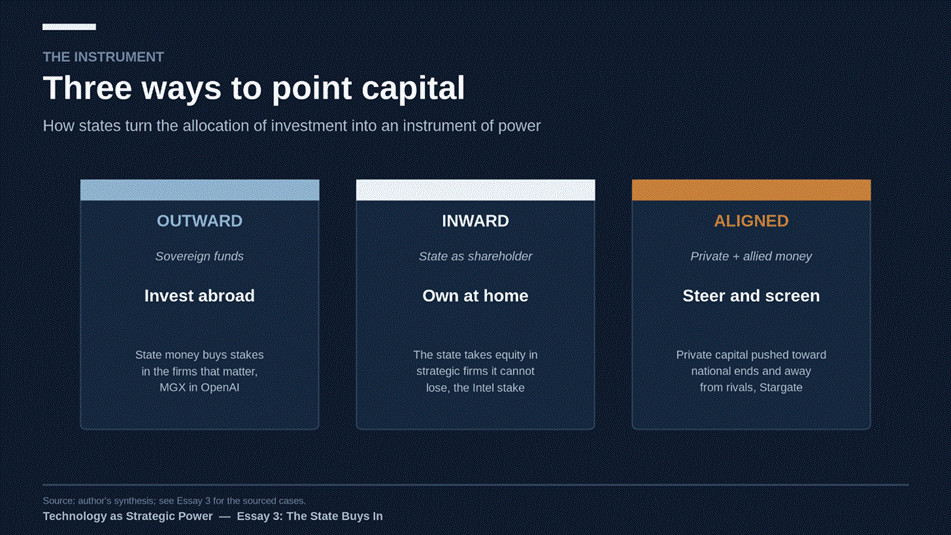
A word of caution is owed before the tour begins, because ‘strategic capitalism’ could swallow half the economy if left loose. It is not a synonym for state capitalism, the settled condition in which the state is simply a big owner, nor for industrial policy, which favours sectors through subsidy and regulation. It is narrower: the subset of state-directed capital whose conscious purpose is positional advantage in a general-purpose strategic technology, and in which the state acts as an equity principal or a mobiliser of capital rather than a mere subsidiser. That yields tests. A national-security figure at the head of an investment vehicle; ownership tied to a strategic contingency; public money taking first losses to summon private money toward a security goal; co-investment launched under a head of state’s banner. Where those markers are absent, the ordinary hunt for returns is explanation enough, as Norway and Singapore will show. The instrument, so defined, works in three ways: outward, inward, and aligned.
Allocation outward: the sovereign funds
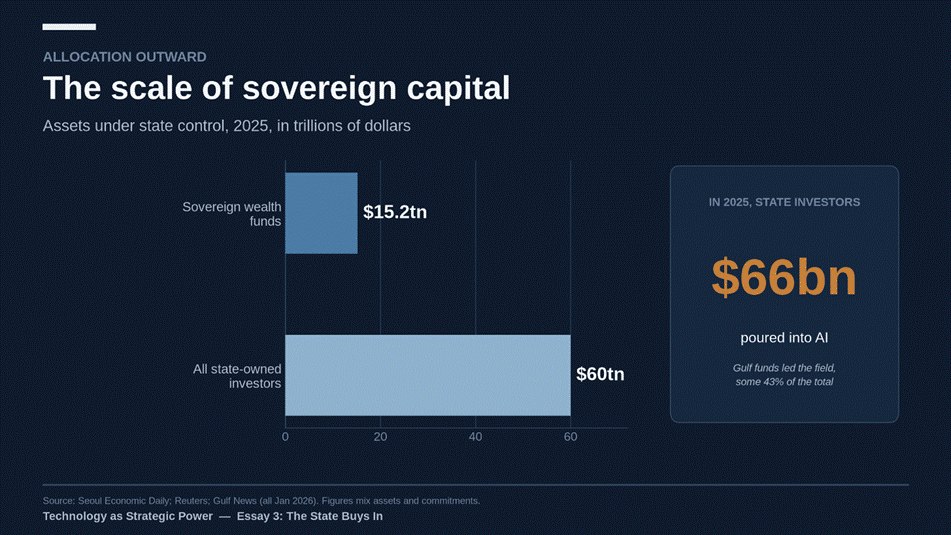
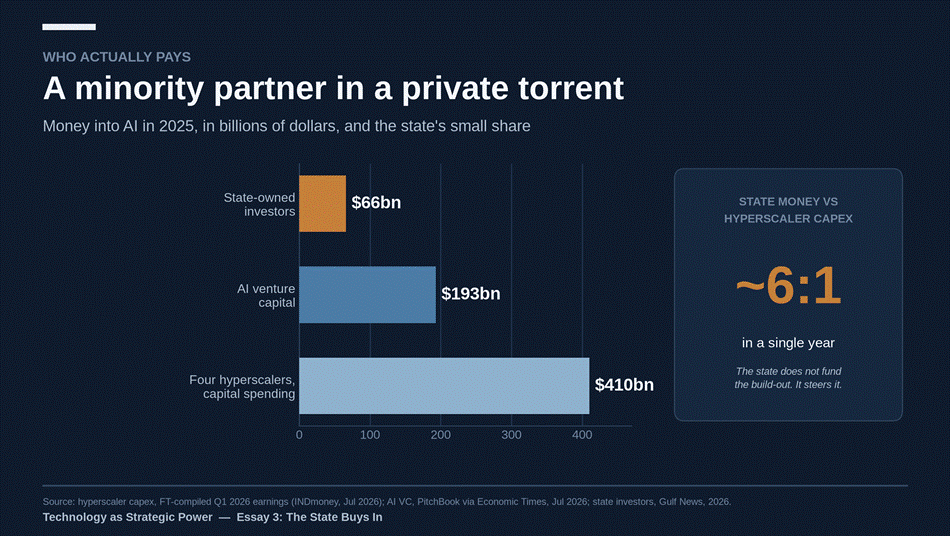
No institution better fuses profit and geopolitics than the sovereign wealth fund. Once feared, in the nervous debates of the late 2000s, as a conduit for opaque foreign influence, these funds are now among the chief architects of the AI build-out. Global sovereign wealth assets reached a record 15.2 trillion dollars in 2025, and the wider universe of state-owned investors some 60 trillion.[7] State-owned investors as a whole put an estimated 66 billion dollars into AI and digitalisation that year, and the Gulf funds led the field: the seven biggest accounted for some 43 per cent of all capital deployed by state investors, with Abu Dhabi’s Mubadala alone responsible for 12.9 billion dollars.[8] A warning about all such figures applies throughout: headline numbers mix assets under management, capital committed and capital actually spent, three very different things, and the gap between a pledge at a podium and money out of the door is often vast. The argument rests on the purpose and structure of the deals, not the size of the press release.
The fund is close to an ideal instrument. It commands patient money on a scale no private firm can match; it answers to a state rather than to fee-paying clients, so it can weigh political returns beside financial ones; it can take stakes small enough to slip below the thresholds that trigger investment review; and because its mandate looks commercial, it can pursue ends that would be awkward if a foreign ministry pursued them openly. It is statecraft in the costume of investment, though, as the conclusion insists, how much statecraft is real varies a great deal.
The clearest case is the United Arab Emirates’ MGX. Launched in March 2024 by Mubadala and the AI firm G42, it is chaired by the country’s national security adviser, a fact that dissolves any neat line between an investment vehicle and an organ of the state.[9] MGX has taken positions in all three leading American frontier laboratories, OpenAI, Anthropic and xAI, and helped lead OpenAI’s vast 2026 funding round.[10] It is a founding partner, alongside BlackRock and Microsoft, of an infrastructure vehicle that committed 30 billion dollars of equity with an ambition to reach 100 billion, and a founding partner in the Stargate project discussed below.[11] A fund chaired by a national security adviser, pouring sovereign money into the American AI stack while building a sovereign one at home, is not diversifying a portfolio. It is conducting foreign policy.
That this is statecraft cuts both ways, and the recipient should note it as much as the investor. The very closeness of the Emirati investment and security machinery that makes MGX an instrument of Abu Dhabi’s strategy makes it, from Washington’s chair, a possible channel of risk. Its co-founder G42 has drawn sustained American scrutiny over past ties to China: it agreed, under pressure, to strip out Huawei equipment and shed Chinese holdings as the price of a 1.5-billion-dollar Microsoft investment.[12] Sovereign money that arrives bearing strategic intent also arrives bearing strategic questions, about technology transfer and about where the vehicle’s ultimate loyalties lie.
The pattern runs across the Gulf. Saudi Arabia’s Public Investment Fund set up a sovereign AI company, Humain, in May 2025, with an opening commitment above 40 billion dollars and a target of a thousand megawatts of data-centre capacity by 2030, and in the same month announced a ten-billion-dollar AI hub with Google Cloud, its benefits pointedly flowing back to the United States.[13] Qatar’s investment authority launched its own national AI company in December 2025, formed a twenty-billion-dollar venture with Brookfield, and pledged to deploy up to 500 billion dollars in America over the coming decade.[14]
It matters to the argument that these Gulf funds are not typical of sovereign wealth as a whole. Norway’s fund, the largest of all and the owner of roughly 1.5 per cent of every listed company on earth, runs on an ethics-and-returns mandate deliberately walled off from geopolitics.[15] Singapore’s GIC and Temasek kept their combined spending essentially flat in 2025 even as Gulf peers accelerated, the signature of a diversification logic rather than a strategic one.[16] A 2026 study found that only around 30 per cent of the Saudi fund’s assets were invested abroad, concluding that such funds remain ‘ultimately driven by domestic priorities’.[17] So the claim must be stated with care. Not every sovereign fund is a geopolitical actor. A specific and consequential subset has become one and is reshaping the terms on which the AI era is financed.
Allocation inward: the state as shareholder
If the sovereign fund is capital thrown outward, the boldest move of 2025 was capital turned inward: the state buying direct equity in the firms it cannot do without. The United States, long the standard-bearer of the very market-state separation Blackwill and Harris mourned, supplied the defining case.
The backdrop was the CHIPS and Science Act of 2022, which set aside 52.7 billion dollars to lure firms such as TSMC, Intel, Samsung and Micron into building advanced fabrication on American soil.[18] For three years it ran as ordinary industrial policy, grants and loans to induce investment. Then, in August 2025, the character of the thing changed. The federal government bought 8.9 billion dollars of Intel common stock, roughly a 9.9 per cent stake, by converting unpaid grants into equity, and became one of the company’s largest shareholders overnight.[19] The stake was passive, with no board seats, but it carried a warrant for a further five per cent should Intel let its ownership of its foundry business fall below a majority.[20] The president signaled that ‘many more’ such deals would follow.[21]
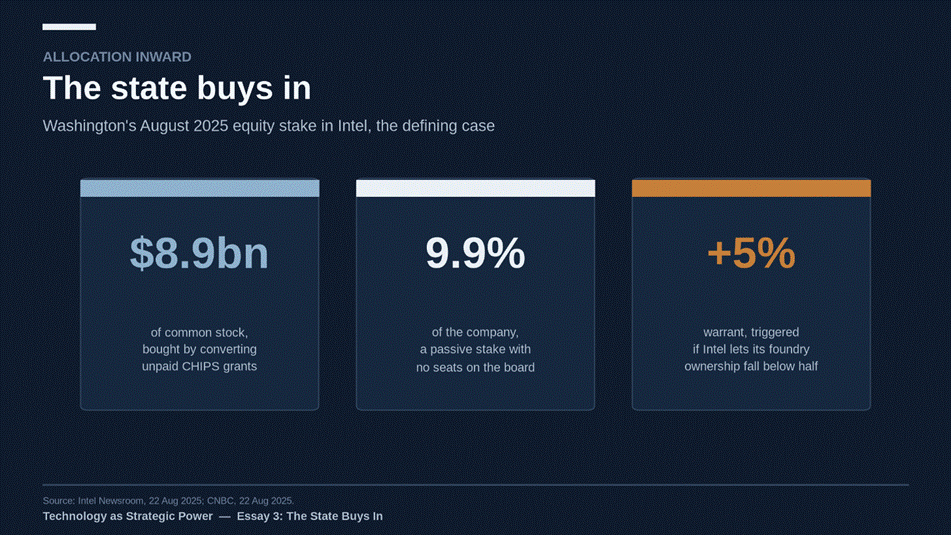
The design repays a second look, because its passivity is deceptive. A near-ten-per-cent government holding, paired with a warrant that punishes any sale of the foundry, disciplines management without a single seat at the table. It says, more clearly than any covenant could, that the state regards the domestic foundry as a strategic asset not to be spun off or starved. Control need not be exercised to be felt.
The wider significance was best caught by the Center for Strategic and International Studies, which set the Intel deal inside a pattern it labelled ‘strategic capital’: forward-looking federal equity in important companies, deliberately unlike the emergency rescues of 2008.[22] The crisis-era bailouts were meant to stop a collapse. The 2025 stakes are meant to secure supply chains, above all against dependence on China, which supplies some 72 per cent of American rare-earth imports and dominates over 90 per cent of global refining.[23] The doctrine reached beyond chips: an eighty-billion-dollar nuclear-energy arrangement struck in October 2025 applied the same logic to the electricity that data centres devour.[24]
The conceptual leap is larger than it looks. For a generation the animating rule of American policy toward its own firms was arm’s-length neutrality: the state set the rules but did not own the players. The Intel stake abandons that rule, in a defined set of strategic sectors, in favour of the state as a principal rather than a referee. And because the intervention took the form of ownership rather than subsidy, it is an instance of strategic capitalism rather than of industrial policy as usual.
To describe an instrument is not to bless it, and Baldwin’s own standard, that a tool be judged by whether it works better than the alternatives, demands the harder question. The evidence is genuinely mixed. An equity stake can buy information, align a champion’s choices with national priorities, and draw in private money that a wobbly strategic firm might not raise alone. But ownership is not competence. The state gains no special gift for allocating capital well, and it imports into the firm political incentives, toward jobs, toward favoured regions, toward avoiding painful closures, that can be hostile to the commercial discipline recovery needs. The cautionary tale is near at hand. China’s ‘Big Fund’, the most sustained experiment in state semiconductor equity, became the target of a sweeping corruption inquiry in 2022 that swept up its most senior managers.[25] A standing pool of politically directed capital is also a standing invitation to rent-seeking. The Intel stake is too young to judge on returns. Its worth as statecraft will turn not on whether the Treasury profits but on whether the foundry it was built to protect ever reaches competitive leading-edge production, an outcome that depends on engineering the state cannot supply by owning shares.
Three models: America, China, Europe
The United States is not alone in blurring subsidy into ownership, and the comparison shows that strategic capitalism is not one model but a family of them, differing in how they split the work between state and market. Three variants stand out, each a different answer to the same question: how to summon into being the compute and power the AI era demands.
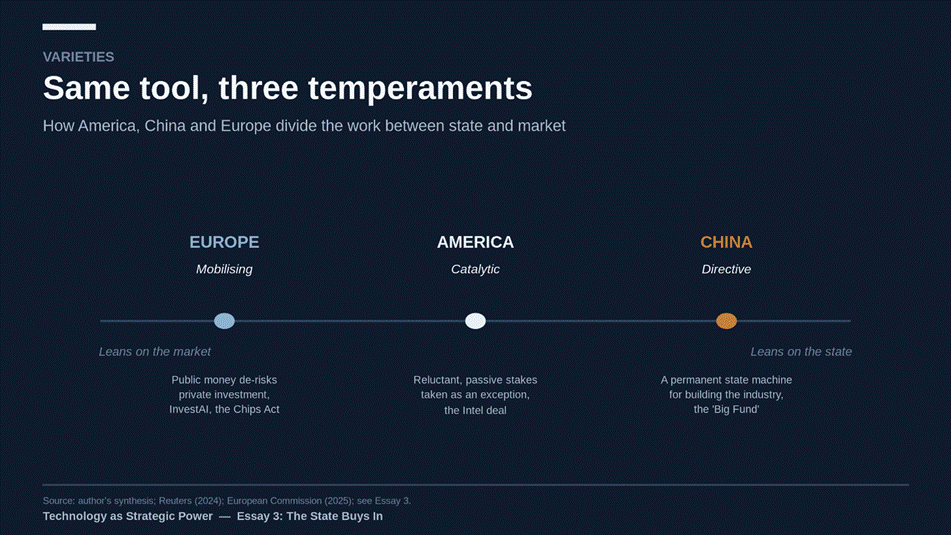
The American variant is catalytic and reluctant. It reaches for equity as an exception to a market norm, takes passive minority stakes, and dresses each move as a discrete response to a specific weakness rather than a settled programme of state ownership. Washington invests in order to catalyze private capacity it would rather the market had produced by itself.
The Chinese variant is directive and unembarrassed. State capital there is not an exception to the market but a feature of it. The third phase of the National Integrated Circuit Industry Investment Fund, the ‘Big Fund’, was set up in 2024 with registered capital of about 47.5 billion dollars, drawn largely from the finance ministry and the state banks, to spread equity across the domestic chip supply chain as a matter of declared strategy.[26] Where the American state takes one stake in one champion under duress, the Chinese state runs a permanent machine for building an indigenous industry insulated from foreign denial. That the two arrive at the same tool from opposite ideological ends is itself a measure of how indispensable the tool has become.
The European variant is mobilizing and coordinative, an effort to conjure capacity mainly by leveraging private money rather than owning firms. (Japan sits closer to the directive end: its state-backed venture Rapidus, chasing two-nanometre production by 2027, took funding in 2026 that made the government its largest shareholder, complete with a golden-share veto.[27]) But the European Union, lacking both an American-scale treasury and a Chinese-style party-state, has pioneered public finance as a lever on private investment. The European Chips Act of 2023 set out to mobilize more than 43 billion euros to double Europe’s share of global chip production; by 2026 the Commission reported some 80 billion euros in announced commitments and floated a sequel.[28] In compute, the InvestAI initiative of February 2025 aimed to mobilize 200 billion euros, including a twenty-billion-euro fund for ‘AI gigafactories’, pitched by the Commission president as ‘a CERN for AI’.[29] The mechanism is the revealing part: a layered fund in which the public budget takes the first loss so that private capital will follow. Europe does not aspire to own the AI champions. It aspires to de-risk them enough that someone else will build them on European soil.
Europe has paired this constructive push with a defensive one, proposing an EU-level mechanism to watch over start-ups in critical fields and shield them from hostile foreign takeover.[30] A single jurisdiction now builds capacity by drawing in friendly capital and defends it by screening out hostile capital, the two logics running side by side in one architecture. That all three contenders have reached capital allocation as a central instrument, by different routes and from different premises, is the strongest sign that the phenomenon is structural rather than accidental.
Allocation aligned: private money, national ends
The third and most novel face of strategic capitalism is capital that is private in name but national in function, steered through two mechanisms: the conscious channelling of investment toward trusted partners, and the mobilization of venture and corporate money behind state aims.
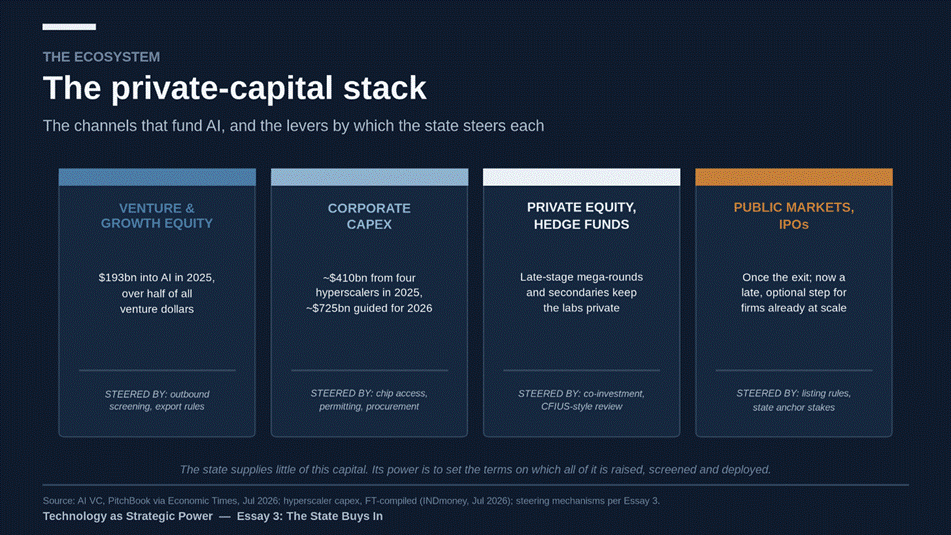
Before turning to those mechanisms, a corrective is in order, because it disciplines the whole thesis. For all the attention the sovereign funds attract, the state is not the main source of money in the AI build-out. It is a minority partner in a private torrent. The four largest American hyperscalers, Amazon, Microsoft, Alphabet and Meta, spent roughly 410 billion dollars on capital expenditure in 2025 and have guided toward some 725 billion for 2026, a rise of about 77 per cent, the bulk of it aimed at AI data centres and the chips inside them.[31] Set that beside the roughly 66 billion dollars state-owned investors put into AI and digitalisation across the whole of 2025, and the ratio is close to six to one in a single year, before venture capital is counted at all. Private risk capital tells the same story: AI companies drew about 193 billion dollars of venture funding in 2025, the first year in which artificial intelligence took more than half of all venture dollars raised worldwide.[32] The productive way to read the sovereign funds, then, is not as the primary financier but as the orchestrator of an ecosystem. This is the argument of the first essay in the series carried into the language of capital: structural power in the intelligence age comes less from owning the largest balance sheet than from setting the terms on which a much larger pool of private money is raised, screened and put to work. The state’s cheque is small next to the market’s. Its leverage lies in deciding whose cheques clear.
The channelling logic got its canonical phrasing from the American Treasury Secretary Janet Yellen, who in 2022 argued for the ‘friend-shoring’ of supply chains to a wide set of trusted countries.[33] Its corollary is screening capital away from rivals. In August 2023 an executive order established the first programme by any major Western democracy to police outbound capital on security grounds, restricting American investment into Chinese semiconductors, quantum technology and AI.[34] Lawyers promptly dubbed it ‘reverse CFIUS’ and called it a significant broadening of the economic toolkit; by the end of 2025 it had been written into statute, its passage from improvisation to settled instrument complete.[35] A reciprocity problem shadows the wielder here. A state that normalises stakes in its own champions and screens its citizens’ investments abroad licenses everyone else to do the same, inviting foreign governments to take their own stakes, screen their own flows, and treat inbound American capital with the suspicion America now directs at Chinese capital. The very universality this essay documents is partly the fruit of such emulation, and it points toward a world of managed, mutually suspicious capital flows in which the openness that made American markets a source of strength is itself worn away. The purse, wielded as a weapon, invites counter-armament.
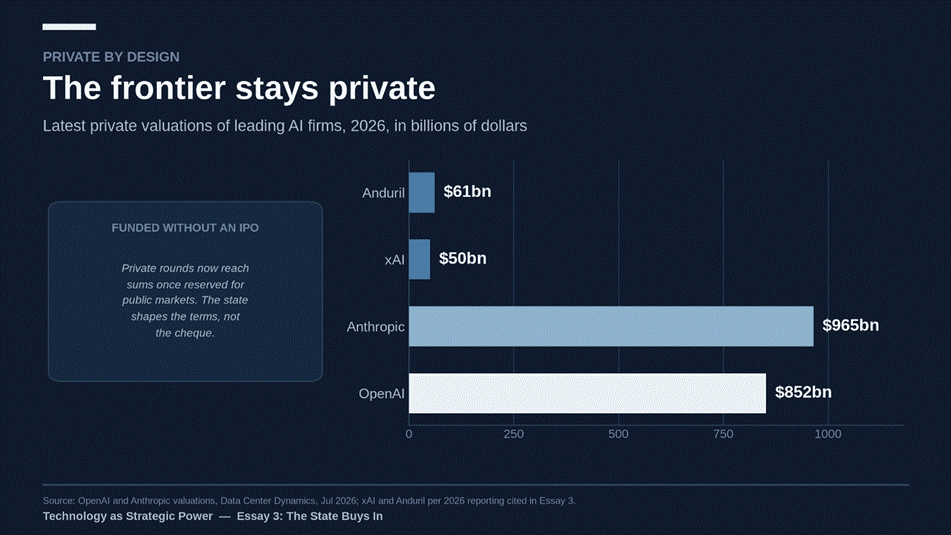
The second mechanism is the alignment of private risk capital with national aims, nowhere plainer than in defence and frontier technology. Anduril Industries raised five billion dollars in May 2026 at a sixty-one-billion-dollar valuation, more than double a year earlier, with the financial press framing the raise against the drive to modernise the military.[36] Palantir, its remaining government-contract backlog worth 4.4 billion dollars at the end of 2025, watched its revenues and valuation soar on the strength of its entanglement with the state.[37] These are private firms funded by private money, yet their valuations price a fundamentally geopolitical bet: that the state’s strategic needs are a durable and growing market. When venture capital underwrites the arsenal, the line between private investment and defence policy is hard to hold. The concentration is striking in its own right. The frontier laboratories have stayed private far longer than the technology firms of earlier cycles, raising sums once reserved for public markets: OpenAI reached a valuation of some 852 billion dollars in early 2026, and Anthropic passed it at around 965 billion months later, both funded by private rounds rather than an initial public offering.[38] A handful of firms now absorbs the majority of the world’s venture money, which means the state that would shape the frontier need not fund it. It need only shape the terms, through screening, procurement and the occasional anchor stake, on which this narrow band of private capital flows. That is orchestration of an ecosystem, not ownership of it.
The purest expression of blended capital is Stargate, announced in January 2025: a commitment of up to 500 billion dollars over four years to build AI infrastructure, its partners OpenAI and Oracle, Japan’s SoftBank, and the Emirati fund MGX.[39] American commercial, Japanese corporate and Gulf sovereign money, fused in a single vehicle and unveiled at the White House under a banner of American AI leadership. Stargate is neither a purely private consortium nor a state programme. It is the shape strategic capitalism takes when the sums exceed what any one actor can supply. That it has since hit trouble, with SoftBank conceding the project ‘needs more time’, does not lessen its significance as a template.[40] The alliance of this century may be sealed as much by a co-investment agreement as by a mutual-defence treaty.
Stargate’s stumble carries a lesson the argument must absorb rather than dodge: capital is necessary but not sufficient. Its troubles were not, at root, about money, which was pledged, but about the physical order money cannot conjure by decree, power generation and grid connection, sites, water for cooling, advanced chips, and the scarce people to design and run the whole. Allocation can put a fabrication plant on a balance sheet years before it can put electrons on a grid. That is where this essay hands off to the last in the series: the financial layer of power rests on a physical one, energy, minerals, fabrication, skilled labour, with its own stubborn logic, and it can veto the ambitions of even the best-funded vehicle. Capital directs and accelerates. It does not levitate above the material world.
The limits of the thesis
An argument like this invites three objections, and each sharpens it rather than sinking it.
The first is that the strategic reading over-reads, that sovereign funds are mostly chasing returns, and that to see grand strategy in every large cheque is to mistake the ordinary churn of global capital for a plan. The 2026 finding that Gulf and other funds remain mostly domestic in orientation gives this real force, and the honest response is to narrow the claim, not drop it.[41] Strategic capitalism is not the universal condition of sovereign capital. It is a distinct and growing practice, concentrated in identifiable actors, whose defining trait is the conscious instrumentalization of allocation. Where its markers are absent, the ordinary logic of returns will do.
The second is that none of this is new, that states have steered capital toward national ends since Colbert, that the chartered East India companies were blended sovereign-commercial ventures, and that the developmental states of twentieth-century East Asia financed their champions as settled doctrine.[42] The lineage is real, but it understates what has changed. Three things are different now. The object of allocation is a general-purpose technology that confers advantage across the whole economy and military at once, not a single commodity or industry. The scale of the sums, the multi-hundred-billion-dollar commitment, the trillion-dollar fund, dwarfs anything the mercantile or developmental state could imagine. And the self-consciousness of the practice, articulated as an explicit doctrine and adopted simultaneously across rival systems, marks a shift from occasional expedient to standing instrument. The developmental state directed capital to catch up within an order it did not contest. Today’s strategic capitalism directs capital to position within an order whose very architecture is the prize.
The third objection is normative: that fusing capital and statecraft is corrosive. Research in 2025 found that holding a sovereign wealth fund is associated with a measurable decrease in economic globalisation and cooperation, hinting that the instrumentalization of investment may fragment the open order rather than fortify it.[43] A world in which every major state owns its champions and screens its rivals is one of managed rather than free capital flows. There is a genuine tension at the heart of the aligned mode, too: capital yoked to the state surrenders some of the ruthless indifference to anything but return that made it efficient in the first place. A defence firm valued on perpetual state demand, or a fab sited where security rather than economics dictates, may be strategically necessary and economically fragile at once. Whether the resulting order steadies or destabilises is genuinely uncertain. What is not uncertain is that it marks a departure from the settlement whose passing Blackwill and Harris both mourned and foresaw.
What it comes to
The first essay in this series argued that AI remakes the metrics of power, swapping compute, talent and model access for the territory and population of the old atlas. This one has argued that the instrument by which such power is now acquired is, increasingly, the allocation of capital: thrown outward through sovereign funds, turned inward through state equity, and aligned through private money and the screening of hostile flows. The state that would command the compute and power of the intelligence age does so not chiefly by conquest, nor even by regulation, but by investment. That the United States, China and the European Union have each arrived at this instrument from radically different starting points suggests it is no passing fashion but a structural feature of the emerging order.
Blackwill and Harris urged Washington to reach for the purse instead of the gun. It has done so, and in doing so it has helped inaugurate an order in which the purse is itself a weapon. What institutions such an order will demand, and what physical foundations it can never escape, are the questions the remaining essays take up.
Next in the series: The Arsenal of Innovation, on the industrial base that capital alone cannot build.
If this way of thinking is useful to you, subscribe to receive the rest of the series as it appears.
Notes
- 1Robert D. Blackwill and Jennifer M. Harris, War by Other Means: Geoeconomics and Statecraft (Cambridge, MA: Belknap Press of Harvard University Press, 2016). See Council on Foreign Relations, ‘War by Other Means’.
- 2Albert O. Hirschman, National Power and the Structure of Foreign Trade (Berkeley: University of California Press, 1945), full text at the Internet Archive.
- 3David A. Baldwin, Economic Statecraft (Princeton, NJ: Princeton University Press, 1985), WorldCat record.
- 4Edward N. Luttwak, ‘From Geopolitics to Geo-Economics: Logic of Conflict, Grammar of Commerce’, The National Interest, no. 20 (Summer 1990), reprinted in The Geopolitics Reader.
- 5Girish Sastry, Lennart Heim, Haydn Belfield, Markus Anderljung, Miles Brundage and others, ‘Computing Power and the Governance of Artificial Intelligence’, arXiv preprint (13 February 2024). Paper.
- 6Henry Farrell and Abraham L. Newman, ‘Weaponized Interdependence: How Global Economic Networks Shape State Coercion’, International Security 44, no. 1 (Summer 2019), pp. 42–79. DOI.
- 7‘Global Sovereign Wealth Fund Assets Hit Record $15.2 Trillion’, Seoul Economic Daily, 2 January 2026, report; and ‘US draws bulk of state-owned investment in 2025 as assets hit record $60 trillion’, Reuters, 1 January 2026.
- 8‘Sovereign wealth funds pour $66 billion into AI as assets hit $15 trillion’, Gulf News, 1 January 2026.
- 9‘Abu Dhabi Targets $100 Billion AUM for AI Investment Firm MGX’, Bloomberg, 11 March 2024.
- 10On MGX’s positions in OpenAI, Anthropic and xAI, see CNBC, 15 October 2025; on OpenAI’s March 2026 round, see OpenAI, ‘OpenAI raises $122 billion’ and Bloomberg, 31 March 2026.
- 11MGX and the AI Infrastructure Partnership, reported in ‘MGX, AIP and BlackRock’s GIP to acquire Aligned Data Centers’, The National, 15 October 2025.
- 12On Congressional concern over G42’s China ties and the Microsoft 1.5-billion-dollar investment and divestment commitments, see ‘Republican lawmakers “deeply concerned” over Microsoft-G42 AI deal’, Reuters, 11 July 2024.
- 13‘Google Cloud and PIF Advance AI Hub in Saudi Arabia’, Google Cloud Press Corner, 13 May 2025.
- 14‘Brookfield and Qai Form $20 Billion Strategic Investment Partnership for AI Infrastructure’, Qatar Investment Authority Newsroom, 9 December 2025; QIA’s roughly $524bn in assets reported by Bloomberg, 29 September 2025.
- 15Norges Bank Investment Management, Annual Report 2025; and ‘About the fund’, NBIM.
- 16‘GIC, Temasek investments flat at $39.8 billion in 2025 while spending by global peers rises’, The Straits Times, 2 January 2026.
- 17‘More local than global: rethinking sovereign wealth and state investment’, Journal of Chinese Governance, 25 March 2026.
- 18National Institute of Standards and Technology, ‘CHIPS for America’ fact sheet, April 2024 (52.7 billion dollars total); on the wider authorisation, see McKinsey & Company, ‘The CHIPS and Science Act’.
- 19‘Intel and Trump Administration Reach Historic Agreement’, Intel Newsroom, 22 August 2025.
- 20‘U.S. government takes 9.9% equity stake in Intel’, CNBC, 22 August 2025.
- 21‘Trump’s Intel Deal and the New Economic Strategy’, The New York Times, 25 August 2025.
- 22‘Understanding Federal Equity Investments in Strategic Companies’, Center for Strategic and International Studies, 20 May 2026.
- 23CSIS, ‘Understanding Federal Equity Investments in Strategic Companies’, 20 May 2026 (rare-earth import and refining figures). Analysis.
- 24CSIS, ‘Understanding Federal Equity Investments in Strategic Companies’, 20 May 2026 (Westinghouse, Brookfield and Cameco nuclear arrangement). Analysis.
- 25‘China watchdog investigates three more execs linked to chip-focused Big Fund’, Reuters, 9 August 2022.
- 26‘China sets up $47.5 bln state fund to boost semiconductor industry’, Reuters, 27 May 2024.
- 27‘Rapidus lands $1.7bn to chase 2nm chip production by 2027’, The Register, 27 February 2026.
- 28European Commission, ‘European Chips Act’; on the sequel, European Commission, ‘European Technological Sovereignty Package’ (Chips Act 2.0), 3 June 2026.
- 29‘EU launches InvestAI initiative to mobilise €200 billion of investment in artificial intelligence’, European Commission, 11 February 2025; and ‘EU looks to the private sector to help fund “AI Gigafactories”’, TechCrunch, 11 February 2025.
- 30European Commission, communication on supply-chain diversification and economic security, 2025.
- 31Figures compiled by the Financial Times from Q1 2026 earnings calls: the four hyperscalers guided to roughly 725 billion dollars of capital expenditure in 2026, up about 77 per cent from some 410 billion in 2025. See ‘Microsoft vs Google vs Amazon vs Meta’, INDmoney, 6 July 2026; on the wider trajectory, ‘JPMorgan says the $5.5 trillion AI capex explosion is profitable, for now’, Fortune via Yahoo Finance, 25 June 2026. The roughly 66 billion dollars of state-owned AI and digitalisation investment in 2025 is from ‘Sovereign wealth funds pour $66 billion into AI’, Gulf News, 2026.
- 32PitchBook data reported in ‘Year 2026: retool, reset or melt?’, The Economic Times, 19 July 2026: AI startup fundraising reached 192.7 billion dollars in 2025, or 52.5 per cent of all global venture funding of 366.8 billion dollars.
- 33‘Remarks by Secretary of the Treasury Janet L. Yellen on the Way Forward for the Global Economy’, US Department of the Treasury, 13 April 2022.
- 34Executive Order 14105, ‘Addressing United States Investments in Certain National Security Technologies and Products in Countries of Concern’, 9 August 2023; US Treasury, Outbound Investment Security Program.
- 35‘A New National Security Instrument: The Executive Order on Outbound Investment’, CSIS, 8 October 2023; on codification, ‘U.S. Treasury’s Reverse CFIUS Authority’, Skadden, 8 January 2026.
- 36‘US defense firm Anduril raises $5 billion, doubling its valuation to $61 billion’, Reuters, 13 May 2026.
- 37Palantir Technologies, 2025 FY 10-K; and Palantir Q4 2025 results, 2 February 2026.
- 38On OpenAI’s valuation of some 852 billion dollars following its March 2026 round, and Anthropic’s 965 billion post-money valuation on a 65 billion dollar Series H led by Altimeter, Dragoneer, Greenoaks and Sequoia, see ‘Anthropic raises $65bn, overtakes OpenAI to $965bn valuation’, Data Center Dynamics, 9 July 2026.
- 39‘Announcing the Stargate Project’, OpenAI, 21 January 2025; and ‘Trump announces $500bn Stargate AI project’, BBC, 22 January 2025.
- 40‘SoftBank Concedes Stargate Project with OpenAI Needs More Time’, Bloomberg, 7 August 2025.
- 41‘More local than global’, Journal of Chinese Governance, 25 March 2026.
- 42Philip J. Stern, The Company-State (Oxford: Oxford University Press, 2011), DOI; Chalmers Johnson, MITI and the Japanese Miracle (Stanford, CA: Stanford University Press, 1982); and Robert Wade, Governing the Market (Princeton, NJ: Princeton University Press, 1990).
- 43‘Treasure Troves: Understanding Sovereign Wealth Funds Using the SWIFT Dataset’, International Studies Quarterly 69, no. 4 (11 September 2025).