This is the second essay in a series, Technology as Strategic Power: Compute, Capital, and the New Grammar of National Advantage.
In the summer of 1911, Winston Churchill changed his mind. He had been one of the Cabinet’s sceptics about naval spending, but a war scare with Germany convinced him it was coming, and when he was made First Lord of the Admiralty, he faced a question that looked technical and turned out to be historic: whether to convert the Royal Navy from Welsh coal, safe under British soil, to oil shipped across the sea from distant fields in Persia.
The case for oil was overwhelming. It meant greater speed, longer range, faster refueling and fewer men worn out shoveling coal. Churchill knew the danger too, that Britain would now depend on a resource it did not control, but he judged the prize worth the gamble: ‘mastery itself’, as he put it, ‘was the prize of the venture.’[1] In June 1914 the government bought a controlling stake in the Anglo-Persian Oil Company. Oil, in the words of the historian Daniel Yergin, had become ‘an instrument of national policy, a strategic commodity absolutely central to national strategy’.[2]
That bargain set the pattern for a century. Depend on a distant resource in exchange for supremacy, then build the ships, the alliances and the doctrines to keep it flowing. And it recurs so exactly in today’s contest over artificial intelligence that the temptation to call compute ‘the new oil’ is almost irresistible.
This essay gives in to the temptation, but carefully. The comparison is not a lazy one. It earns its keep precisely where it breaks down, and a disciplined account of where oil and compute differ turns out to be more revealing than the slogan itself.
The first essay in this series argued that AI changes what power is made of, swapping compute, chips and talent for the territory and population of the old atlas, and that these new resources are far more tightly concentrated than anything before them.[3] This one grounds that claim in the most familiar strategic story of the modern age, and presses it against the age of oil to see what holds and what gives way.
The century oil built
What Churchill started, the twentieth century turned into a complete system. Oil packed more energy into less space than any rival fuel, which made it indispensable to mechanized war and mass mobility alike. It was also spread with maddening unevenness across the earth, which made securing it a permanent problem. Out of those two facts grew an architecture with three recurring parts.
First came the companies and concessions that controlled production at the source. Anglo-Persian was the template: a foreign firm, backed by its home government, pumping oil from someone else’s soil on terms tilted in its favor. The model spread across the Gulf, most consequentially in the 1933 deal that became Aramco, the consortium of American majors whose bond with Riyadh would anchor United States strategy in the region for the rest of the century.[4]
Second came the security guarantee. If your economy and your armed forces ran on oil you did not own, then the sea lanes and the producing regions it travelled through became vital interests, to be defended with force if need be. The line runs straight from Churchill’s Persia to Jimmy Carter’s Persian Gulf. In January 1980, weeks after the Soviet invasion of Afghanistan, Carter warned that any attempt by an outside power to seize the Gulf will be regarded as an assault on the vital interests of the United States of America, and such an assault will be repelled by any means necessary, including military force’.[5] It was not merely rhetoric. It put a permanent American military presence in the Gulf whose real job was to keep the oil moving.
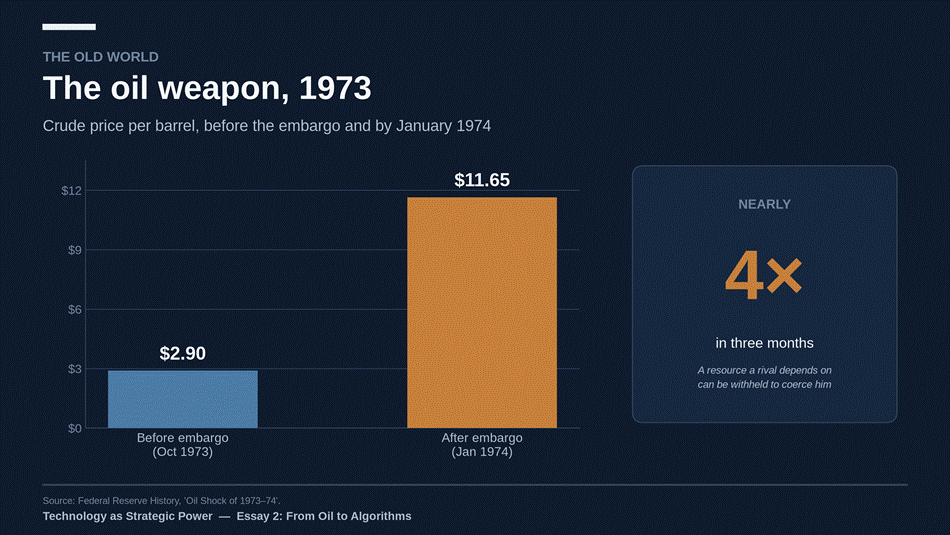
Third came denial, the resource turned into a weapon. The system held only while the producers accepted their junior place in it. In October 1973 they refused. After American resupply of Israel during the Yom Kippur War, the Arab members of OPEC embargoed the United States and cut output. A barrel went from $2.90 before the embargo to $11.65 by January 1974, a near-quadrupling that tipped the industrial world into recession.[6] The lesson was learned at once: a resource your rival depends on can be withheld to coerce them.
Beneath all three ran geography, and geography’s cruelty was sharpest at the chokepoint. Oil is heavy and mostly moves by sea, which means it must squeeze through a few narrow straits where the flow can be cut. The Strait of Hormuz is the classic case. Around 21 million barrels a day passed through it in 2022, roughly a fifth of the world’s petroleum consumption, and the United States government calls it, flatly, ‘the world’s most important oil transit chokepoint’.[7] A single waterway some thirty kilometres wide at its narrowest carries a slice of the world economy on its surface, and whoever can close it holds a lever over the whole. That is the machine the compute era must be measured against, and the measurement starts with what the two resources share.
Where the slogan is right
The claim that compute is the new oil is not empty, and it deserves its strongest hearing before the qualifications begin. In several respects the resource behind artificial intelligence sits exactly where oil once sat, and states are already treating it that way.
This essay is not the first to take the parallel seriously. Recent peer-reviewed work has put it at the centre of the analysis: Alison Lawlor Russell and Kevin McGravey argue that oil, rather than the more usual comparison with nuclear weapons, is the better lens for the strategic worries raised by chips and AI.[8] The reason is that compute, like oil and unlike fissile material, is built by private firms, woven through the ordinary economy and useful for almost everything, rather than locked in a narrow class of weapons under state monopoly. The nuclear template was built for a resource governments could plausibly bottle up. It misleads about one they do not even own.
Start with what oil and compute have most obviously in common: both matter everywhere at once. Oil was strategic because it did nearly everything: moving armies, feeding factories, carrying people. Advanced computing has acquired the same reach. Frontier AI now feeds into scientific research, weapons design, intelligence work, industrial productivity and consumer services alike, which is why access to compute has become a rough proxy for capability across the board. A landmark 2024 study from the governance-of-AI community captured the resemblance well, noting that computing power is ‘detectable, excludable, and quantifiable, and is produced via an extremely concentrated supply chain’, the very traits that made oil both governable and contestable in the last century.[9]
Then there is scarcity under concentration. Oil’s weight came from its uneven spread, and the compute stack is more concentrated still, with leading-edge fabrication in a handful of firms, frontier models in fewer laboratories, and the price of entry running into the tens of billions.[10] Concentration is what makes a resource strategic, because it makes denial possible. A good everyone can make is no lever at all; a good only a few can make is the essence of one.
And states already behave as though the analogy holds. The old machinery of the oil order, guarantee the supply you control and deny it to rivals, has reappeared in a silicon dress. Export controls on advanced chips are the embargo run in reverse, a producer’s denial turned into a customer’s. Allied compute pacts are the new concession diplomacy. The scramble to site and power data centres is the modern version of securing the fields and the lanes. So the slogan is not wrong: compute is scarce, concentrated, excludable and fought over, and treated by governments as a prize. If the argument stopped here, ‘compute is the new oil’ would do the job.
It does not stop here, and it should not. An analogy is a claim about which features carry across and which do not, and this one is worth as much for its failures as its fit. Three differences separate the compute era from the oil order, and each moves the point of leverage somewhere new.
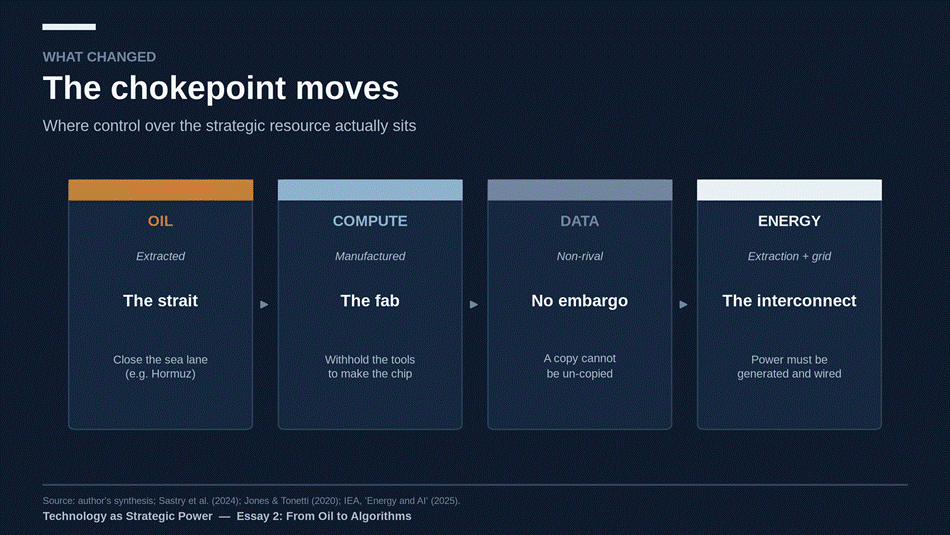
The single slogan hides four different resources. Only oil and energy share the geography of blockade. Source: author’s synthesis of the sources cited below.
First difference: it is built, not found
The deepest difference is the simplest. Oil is found; compute is made. A barrel of crude is a gift of geology, and no policy can conjure a reservoir where the rock holds none, which is why the oil order was, at bottom, a fight over territory, over who held the ground the oil lay beneath and the water it crossed. Advanced computing has no geology. A leading-edge processor is one of the most complicated objects ever manufactured, and mastery of it lives not in the earth but in accumulated engineering, specialised machinery and a supply chain refined over decades. The strategic question changes accordingly. It is no longer ‘who sits on the resource?’ It is ‘who can build it?’
That shift moves the chokepoint. In the oil century the weak point was geographic, the strait, the pipeline, the tanker route, the field. In the compute century it is industrial, the fabrication plant, the lithography tool, the design flow. There is no Hormuz for microprocessors. There is instead a short list of firms and facilities without which the frontier cannot be reached. And because the resource is manufactured, denial works by withholding the means of production rather than the product, by controlling the tools and blueprints upstream of the chip rather than the chip itself. That is why the sharpest instruments of this contest are export controls on fabrication equipment and design software, not blockades of finished goods. Later essays in this series take up the industrial base directly; the point to fix here is only that manufacture, not extraction, is what makes compute strategic.[11]
Being built carries a second consequence geology denied to oil. A manufactured resource improves. A field is fixed; you can pump it faster or find another, but you cannot make its crude more potent. Chips get better. The performance wrung from a given quantity of silicon has climbed relentlessly, with each accelerator generation delivering several times the training throughput of the last, so ‘more compute’ can be had not only by building more plants but by designing cleverer chips.[12] That changes the very nature of scarcity. Oil scarcity was about depletion, a race between reservoirs running dry and new ones being found. Compute scarcity is about the manufacturing frontier, a race to make the next process node work. A resource that gets better under investment behaves quite differently from one that is merely drawn down: the incumbent’s edge is not a stock of reserves but a lead that has to be re-earned every year.
So the compute contest is won in the factory and the design house, not the field. A state cannot lock in its position by taking territory or guarding a sea lane, because the resource is not in the ground and does not travel by tanker. It can only secure its position by owning, or reliably reaching, the capacity to fabricate at the leading edge. The twenty-first-century equivalent of Churchill buying Anglo-Persian is not seizing an oilfield but financing a fabrication plant. The strait gives way to the fab.
Second difference: data cannot be embargoed
If the first difference is about the chip, the second is about the thing the chip processes. Data breaks the property that made oil worth hoarding in the first place. A barrel is rival: burned by one engine, it cannot be burned by another; held by one party, it is denied to a second. Data is not. A dataset used to train one model can be used, at the same moment and without any loss, to train any number of others. Copied, it is not consumed. Economists call this non-rivalry, and it is the cleanest break between the two ages.
The idea is precise and it matters. In the economics of growth, non-rivalry is the defining feature of ideas: as Paul Romer showed, a good is non-rival when one person’s use does not reduce anyone else’s, and it is the non-rivalry of ideas that drives long-run growth.[13] Charles Jones and Christopher Tonetti carried the analysis over to data itself, starting from the plain observation that ‘a person’s location history, medical records, and driving data can be used by any number of firms simultaneously’, infinitely usable in principle, however hedged about by law or secrecy in practice.[14]
Non-rivalry rewrites the economics of denial that ran the oil order. The oil weapon worked because oil is rival: to withhold a barrel is genuinely to deprive, and the 1973 embargo bit because the crude America did not get was crude it could not use.[15] Data cannot be cut off in that way. Once a dataset exists and has been shared, denying it to a rival is far harder, because another copy costs almost nothing and copies multiply. The characteristic disease of a non-rival resource is therefore hoarding rather than scarcity. Jones and Tonetti show that firms, afraid of what a competitor might do with their data, often sit on information that society would gain from sharing.[16] The instinct inherited from the oil century, corner the resource and deny it, simply misfires on a substance that copying does not deplete.
Two caveats stop this from hardening into its own glib slogan. First, non-rivalry belongs to data as information, not to every stage of its life. The cables, storage and memory that move and hold data are emphatically rival, subject to congestion and capacity limits like anything physical, so the friction the oil order found in the tanker reappears in the interconnect. Second, non-rival does not mean non-excludable: data can be, and routinely is, walled off by secrecy, encryption and law, and much of the most valuable training data is proprietary for exactly that reason. The point is not that data cannot be controlled but that the method of control differs. You do not deny data by seizing a field or closing a strait; you deny it by never letting the copy escape, which is a problem of security rather than of blockade. Two of the three legs of the compute stack, then, pull away from the oil analogy. The third pulls it straight back.
Third difference: energy brings the old world back
One input in the stack behaves exactly as oil did, and its return is the heart of this essay. Compute does not run on silicon alone. It runs on electricity, in quantities that have made power, not chips and not capital, the binding constraint at the frontier. Energy has to be generated and carried down a grid; it is slow to build, stubbornly tied to place, and impossible to copy. It is the genuinely oil-like member of the trio, and it is where the resource politics of the last century comes roaring back.
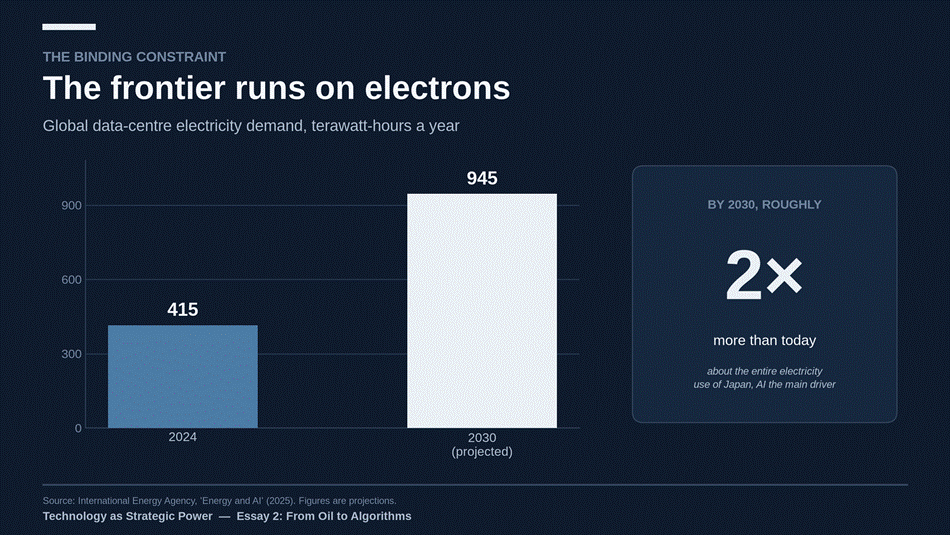
Begin with the scale. The International Energy Agency reckons data centres used about 415 terawatt-hours of electricity in 2024, roughly 1.5 per cent of the world’s total, and expects that to more than double to around 945 terawatt-hours by 2030, more than the whole of Japan consumes today, with AI the biggest single driver and nearly half the increase falling in the United States.[17] These are projections, not outcomes, and should be read with caution: they mix committed with speculative build-out, and serious analysts differ on the path.[18] But the order of magnitude is not in doubt, and even the low estimates describe a demand shock large enough to reshape national power systems.
The technical core of the matter is why frontier AI has become power-limited rather than chip-limited. Training a large model means running vast clusters of accelerators together for weeks or months, and their electrical draw has exploded. Individual chips have gone from a few hundred watts to well over a kilowatt each, so assembling enough to train a frontier model now means a load of hundreds of megawatts, sometimes more than a gigawatt, in a single building. The biggest sites already sit at that scale, and a joint study by Epoch AI and the Electric Power Research Institute projects that the largest single training runs could draw on the order of 4 to 16 gigawatts by 2030.[19] For perspective, one gigawatt is roughly the output of a large nuclear reactor, enough to power about a million American homes. The frontier is nearing the point at which a single training run rivals the electricity demand of a small country.[20]
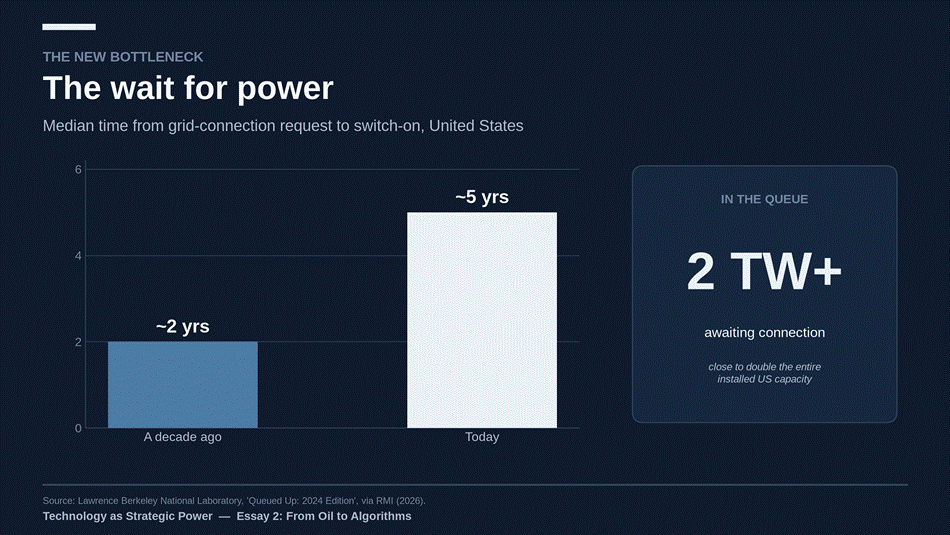
The decisive fact is that this power, not the chips it feeds or the money that buys them, is now the gate. The industry passed through three phases in quick succession: the frontier was chip-bound through 2023, when the trick was securing enough accelerators; capital-bound in 2024 and 2025, when it was writing a big enough cheque; and power-bound thereafter, when it became a matter of gigawatts of firm electricity and the years-long wait between a signed lease and a running cluster.[21] The reason is a mismatch of clocks. Chips can be made and installed in months; the power to run them cannot. New generation and the transmission to carry it take years to permit and build, and the queue tells the story. More than two terawatts of generation and storage sit in United States interconnection queues, close to double the country’s entire installed capacity, and the typical wait from request to switch-on has stretched to about five years, up from under two a decade ago.[22] Google has warned that grid delays are now the single biggest obstacle to powering its data centres, with some utilities quoting connection timelines of four to ten years.[23] Mark Zuckerberg has admitted that energy, not chips or money, is the ceiling: firms ‘would probably build out bigger clusters than we currently can if we could get the energy to do it’.[24] The wall socket, not the fab, has become the limit.
It is the response to that limit that most vividly resurrects the oil century. Unable to draw power from a grid that cannot connect them fast enough, the frontier builders are doing what Churchill did when domestic coal would not serve: securing their own supply. Some are co-locating data centres directly at power plants, plugging into nuclear and gas generators behind the meter to skip the queue, a practice that drew a landmark order from American energy regulators in December 2025.[25] The hyperscalers have signed a wave of nuclear deals: Microsoft contracted to restart a reactor at Three Mile Island to feed an AI campus, and announced nuclear commitments across the sector now exceed nine gigawatts, more capital aimed at nuclear power in a few years than in any prior decade.[26] Others are building their own gas generation on site to move faster still, and Washington has begun offering federal land at national-laboratory sites, generation included, to speed things along.[27] The pattern is unmistakable, and it is the pattern of 1914: when the superior input depends on a supply you cannot get reliably through the ordinary market, you go and acquire the supply yourself. Having escaped oil’s geology and oil’s rivalry, the compute era runs headlong back into oil’s deepest logic at the level of the electron.
The practical lesson for statecraft follows directly, and it is worth stating without inflating it. If energy binds the frontier, the electrical grid becomes strategic infrastructure in the way sea lanes once were, and three levers shift accordingly. The speed at which a state can permit generation, build transmission and clear its queue becomes a measure of competitiveness: the country that can move a gigawatt from approval to operation in two years rather than seven will host the frontier. Export controls acquire an energy dimension, because a rival denied advanced chips but rich in cheap, fast power may simply substitute scale for efficiency, so managing alliances now means coordinating electricity as well as silicon. And the generating fleet tied to compute enters the world of critical-infrastructure protection. None of this calls for the gunboats of the oil age. The instruments of the electron era are permitting reform, grid investment and allied energy diplomacy, not fleets. But the thing they serve, securing the input on which advantage depends, is Churchill’s own.
The limits of the comparison
An argument built on an analogy invites objections aimed at the analogy, and three deserve an answer. Each sharpens the thesis rather than sinking it.
Does the comparison not flatter the present by borrowing the drama of the past? Invoking Churchill and Hormuz could be said to lend false grandeur to what is, after all, a commercial build-out of computing gear, and one might add that no serious analyst thinks compute is literally oil. The reply is that the slogan is not a straw man but a live heuristic, used by officials to justify export controls, stockpiling and supply guarantees on the reflex that a scarce strategic input must be secured and denied as oil was. Used uncritically, it imports exactly the wrong intuitions, oil’s geography and oil’s rivalry, into a resource that has neither. The claim defended here is narrower, and stronger for it: that the shape of the twentieth-century security order, secure the input, guarantee the flow, deny it to rivals, recurs in the compute era, but with the point of leverage moved from the field to the fab, from the tanker to the interconnect, from the barrel that can be embargoed to the electron that must be generated. The comparison is a structure to be corrected, not a picture to be admired.
Is the trio being treated too tidily, as though compute, data and energy came apart cleanly when they are entangled? This is fair. A chip is useless without power, power is wasted without chips, and both are idle without data, and the binding constraint shifts over time. But the entanglement is the argument’s friend, not its enemy. The oil analogy is revealing precisely because it fits one leg almost perfectly and the other two hardly at all, and it is the contrast among the three, manufactured, non-rival, extraction-bound, that shows where the action is. Flatten the trio into a single ‘new oil’ and you lose exactly what the differences carry.
And is a passing moment being mistaken for a permanent order? Here I should be candid, because this is the objection I find hardest to wave away: I have spent long enough inside this argument to know how tempting it is to read a decade’s technology as the fixed grammar of the century. So the boundary should be drawn honestly. The energy that binds the frontier is generated by plant and carried by grid, and plant and grid are themselves built from copper, from specialized metals for turbines and batteries and chips, dug from particular ground under conditions that revive the oldest resource geopolitics of all. That is not a gap in the argument. It is a boundary within the series: the minerals story belongs to a later essay, the mirror image of this one, where the resource that here escapes geology by being manufactured turns out to rest, at its foundation, on materials still dug from the earth.[28] So too the capital that finances the fabs and the power deals: that is the subject of the next essay, and this one has pointed at it without re-arguing it.[29]
What it comes to
So what is the settled claim? That the security architecture of this century is reorganizing around compute, data and energy as the last century’s organized around oil, and that the reorganization is neither a clean repeat nor a clean break. From oil the compute era inherits the deep grammar of resource statecraft: concentration breeds contest, dependence breeds vulnerability, and a state that would command a general-purpose strategic input must be able to secure it, move it and deny it. From oil it departs in two ways that matter: control now lies in the capacity to build rather than the accident of geology, and the informational core of the resource is non-rival, so it slips the embargo that made oil a weapon. And to oil it returns, unexpectedly and completely, to the level of energy, the one input still extracted, still gridded, still stubbornly tied to place, and now the ceiling on the frontier.
Churchill accepted dependence on a distant, insecure resource because the alternative was to give up mastery, and he built the political machinery of a century to guard what he had chosen to depend on. The states now converting themselves to compute face the same bargain in a new idiom. They are discovering, as he did, that the superior input carries its own sea of troubles, and that the hardest of them is not the chip they can manufacture nor the data they can copy but the power they must generate, the barrel, as it were, that never went away. The age of algorithms is, at its foundation, an age of electrons, and mastery, now as then, is the prize of the venture.
Next in the series: Strategic Capitalism, How Capital Allocation Became Statecraft.
If this way of thinking is useful to you, subscribe to receive the rest of the series as it appears.
Notes
- 1The quoted phrases are from the Prologue to Daniel Yergin, The Prize: The Epic Quest for Oil, Money, and Power (New York: Simon & Schuster, 1991), pp. 11–12 (Churchill on ‘naval supremacy upon oil’, ‘to take arms against a sea of troubles’, and ‘mastery itself was the prize of the venture’). The history of the coal-to-oil conversion, the Agadir crisis and the Royal Commission on Fuel and Engines is given in ch. 8, ‘The Fateful Plunge’, pp. 150–64. Full text (PDF).
- 2On the June 1914 bill acquiring a controlling 51 per cent stake in the Anglo-Persian Oil Company, and oil becoming ‘an instrument of national policy, a strategic commodity’, see Yergin, The Prize, ch. 8, esp. p. 161. The chronology is corroborated in ‘Oil Agreements in Iran’, Encyclopaedia Iranica.
- 3The framing of technological realism, and the claim that AI substitutes compute, talent and model access for the territory and population of classical realism, is set out in Essay 1 of this series, ‘AI Isn’t a New Weapon. It’s a New Way of Counting Power.’
- 4On the 1933 concession granted by King Abd al-Aziz Ibn Saud that led to the formation of Aramco and its role in anchoring US–Saudi relations, see Saudi Aramco, ‘Our history’; and Yergin, The Prize, chs 16 and 23.
- 5Jimmy Carter, State of the Union Address, 23 January 1980; the operative passage is quoted and analysed in the Baker Institute for Public Policy, ‘Carter Doctrine 3.0: Evolving U.S. Military Guarantees for Gulf Oil Security’, 27 April 2017.
- 6On the near-quadrupling of oil prices, from $2.90 a barrel before the embargo to $11.65 in January 1974, and the embargo of 19 October 1973, see Federal Reserve History, ‘Oil Shock of 1973–74’.
- 7US Energy Information Administration, ‘The Strait of Hormuz is the world’s most important oil transit chokepoint’: approximately 21 million barrels per day (2022), about a fifth of global petroleum-liquids consumption.
- 8Alison Lawlor Russell and Kevin McGravey, ‘Digital oil: chips, artificial intelligence and US national security’, International Affairs 101, no. 3 (May 2025), pp. 1087–1101. Russell and McGravey argue that oil, rather than nuclear development, better captures the strategic concerns raised by chips and AI. DOI.
- 9Girish Sastry, Lennart Heim, Haydn Belfield, Markus Anderljung, Miles Brundage and others, ‘Computing Power and the Governance of Artificial Intelligence’, arXiv preprint (13 February 2024): compute is ‘detectable, excludable, and quantifiable, and is produced via an extremely concentrated supply chain’. Paper.
- 10On the extremity of compute concentration, leading-edge fabrication clustered in a handful of firms and territories and frontier-model development in a small number of laboratories, see Essay 1 of this series.
- 11The semiconductor manufacturing ecosystem, the fabless/foundry split, advanced packaging, and lithography as the true chokepoints, is the subject of Essay 4 of this series, ‘The Arsenal of Innovation’. This essay treats manufacture only as a property of the resource.
- 12On rising per-accelerator performance and the several-fold generational gains in training throughput, alongside the parallel rise in per-chip power draw, see Epoch AI, ‘Can AI scaling continue through 2030?’, 20 August 2024.
- 13Paul M. Romer, ‘Endogenous Technological Change’, Journal of Political Economy 98, no. 5, part 2 (1990), pp. S71–S102. DOI.
- 14Charles I. Jones and Christopher Tonetti, ‘Nonrivalry and the Economics of Data’, American Economic Review 110, no. 9 (September 2020), pp. 2819–58 (’data is nonrival … a person’s location history, medical records, and driving data can be used by any number of firms simultaneously’). DOI.
- 15On the rivalry of oil as the property that made the 1973 embargo effective, see Federal Reserve History, ‘Oil Shock of 1973–74’.
- 16Jones and Tonetti, ‘Nonrivalry and the Economics of Data’, on data hoarding driven by fear of creative destruction and the large potential social gains from broader data sharing. DOI.
- 17International Energy Agency, Energy and AI (Paris: IEA, 2025): global data-centre electricity consumption of around 415 TWh in 2024 (about 1.5 per cent of the global total), projected to more than double to about 945 TWh by 2030 (more than Japan’s current consumption), with AI the biggest driver and nearly half the projected global increase in the United States. Report.
- 18On the wide dispersion of projections and the committed-versus-realised caveat, see IEA 4E, ‘Data Centre Energy Use: Critical Review of Models and Results’, March 2025 (surveying 2030 estimates from roughly 515 to over 1,400 TWh).
- 19Epoch AI and the Electric Power Research Institute, summarised in Epoch AI, ‘How much power will frontier AI training demand in 2030?’ (largest individual frontier training runs likely to draw 4–16 GW by 2030). On operational cluster scale (xAI’s ~350 MW Colossus in Memphis; OpenAI’s ~240 MW Abilene site planned toward 1.2 GW), see Epoch AI, ‘Could decentralized training solve AI’s power problem?’, 13 October 2025.
- 20On the scale comparison, a 1 GW site drawing roughly the electricity of about a million US homes, see Epoch AI, ‘Introducing the Frontier Data Centers Hub’.
- 21The three-regime characterisation, chip-bound through 2023, capital-bound in 2024–25, power-bound thereafter, is corroborated by Epoch AI, ‘Can AI scaling continue through 2030?’, 20 August 2024, which concludes that ‘the constraint likely to bind first is power’.
- 22On the interconnection-queue backlog (more than 2 terawatts of generation and storage awaiting connection, close to double installed US capacity) and median times from request to commercial operation rising to roughly five years, see Lawrence Berkeley National Laboratory, Queued Up: 2024 Edition, summarised at RMI, 17 March 2026.
- 23‘Google warns grid connection delays are now the biggest threat to data center expansion’, Network World, 15 January 2026 (utilities quoting four-to-ten-year timelines).
- 24Mark Zuckerberg, quoted in Epoch AI, ‘Could decentralized training solve AI’s power problem?’, 13 October 2025 (’we would probably build out bigger clusters than we currently can if we could get the energy to do it’).
- 25On the Federal Energy Regulatory Commission’s December 2025 order directing PJM to develop rules for co-locating data centres at power plants, see Introl, ‘FERC Lets Data Centers Plug Directly Into Power Plants’, 18 January 2026.
- 26On hyperscaler nuclear agreements, including Microsoft’s 20-year power-purchase agreement for the Three Mile Island Unit 1 (Crane Clean Energy Center) restart, roughly 835 MW, and sector-wide commitments exceeding 9 GW, see SMR Intelligence, ‘Every Nuclear Data Center Deal’, 6 July 2026.
- 27On on-site gas generation and the US Department of Energy’s July 2025 offer of national-laboratory sites for co-located data-centre and generation projects, see American Nuclear Society, ‘Data centers planned at four DOE sites’, 25 July 2025.
- 28The critical-minerals and refining-chokepoint argument, the physical floor of the digital age and the claim that midstream refining concentration matters more than raw reserves, is the subject of Essay 5 of this series, ‘The Return of Resource Geopolitics’, the deliberate mirror image of the present essay.
- 29The logic by which capital allocation, sovereign wealth funds, direct state equity and aligned private capital, became a primary instrument of statecraft in financing the compute-and-energy substrate is the subject of Essay 3 of this series, ‘Strategic Capitalism: How Capital Allocation Became Statecraft’.