Every American age has had its arsenal. In the nineteenth century it was the rail and the foundry, the industrial base that turned a continental economy into a great power. In 1940 Roosevelt gave the coming mobilisation its enduring name, the great arsenal of democracy, and American factories converted from cars to aircraft on a scale that decided a world war. They made more than 96,000 aircraft, 86,000 tanks and 2.4 million trucks before it was over.¹ The intelligence age has now named its own arsenal, and it is made of compute: the machines that train and run the frontier models, and the capital, manufacturing and energy that produce and power them. What no government announced, and few observers named for what it was, is that in the summer of 2026 private capital built the financing rail for that arsenal, and in doing so did something closer to statecraft than to banking.
On 10 August 2026 Nvidia announced partnerships with Apollo, BlackRock, Blackstone, Brookfield, Goldman Sachs and KKR to establish independent compute-financing platforms intended to mobilise more than $500 billion of third-party capital for the build-out of artificial-intelligence infrastructure over time.² The stated ambition was to turn Nvidia’s compute into “an investable asset class for global capital”, financed off the customer’s balance sheet.³ Jensen Huang reduced the logic to four words. In artificial intelligence, compute is revenue.⁴ The move formalised a pattern already running. Apollo had structured a $3.5 billion capital solution inside a triple-net lease for a Valor data-centre cluster leased to xAI, with Nvidia among the backers; KKR had launched Helix Digital Infrastructure, a vehicle above $10 billion with Nvidia, Vistra and the Kuwait Investment Authority as anchors; a BlackRock-led group including Nvidia and Abu Dhabi’s MGX had agreed to buy Aligned Data Centers for roughly $40 billion.⁵ What changed in August was scale and coordination. Six of the largest allocators of private capital on earth agreed, in effect, to build a market in computing power the way an earlier generation built markets in mortgages and corporate loans: standardised, securitised, and sold on.
To make computing power a financeable asset class is to decide how the means of producing intelligence will be built, owned and priced for a generation. That is not a financing story dressed up as a strategic one. It is the reverse: an act of structural consequence that arrived wearing the clothes of a term sheet, which is exactly why it drew a market’s attention and not a statesman’s. The arsenal of democracy was announced from the Oval Office. The arsenal of the intelligence age was announced in a press release about capital mobilisation, and the people best placed to read its meaning were bond desks.
The tell in the structure
Read the deal for how the money is actually arranged and it tells you something the framing does not. The mechanism is debt. Special-purpose entities issue bonds against the compute itself as collateral, raising tens of billions at a time and leasing the machines to Nvidia’s customers, with Nvidia holding an option to backstop up to a quarter of the deals.⁶ The half-trillion is a multi-year programme envelope, underwritten deal by deal, not a single committed fund; Goldman Sachs is the lone bank among the sponsors, positioned to lead the public debt.⁷ The six houses arranging the largest private build-out in history chose to lend against the machines rather than to own them.
Set beside the way these firms behave everywhere else, that is a revealing choice. Apollo, Blackstone, KKR and Brookfield are equity houses by temperament and by fee model; their business is buying assets that compound, not clipping coupons on someone else’s. When the most sophisticated owners of long-lived assets on earth structure the defining infrastructure deal of the age as senior secured credit, the structure is not an accident of the moment. It is a judgement about the asset. And the judgement is correct, which is what makes it important. Compute is the wrong thing to own outright, because compute is the first strategic industrial base in American history that depreciates on a schedule you can watch.
The arsenal that depreciates
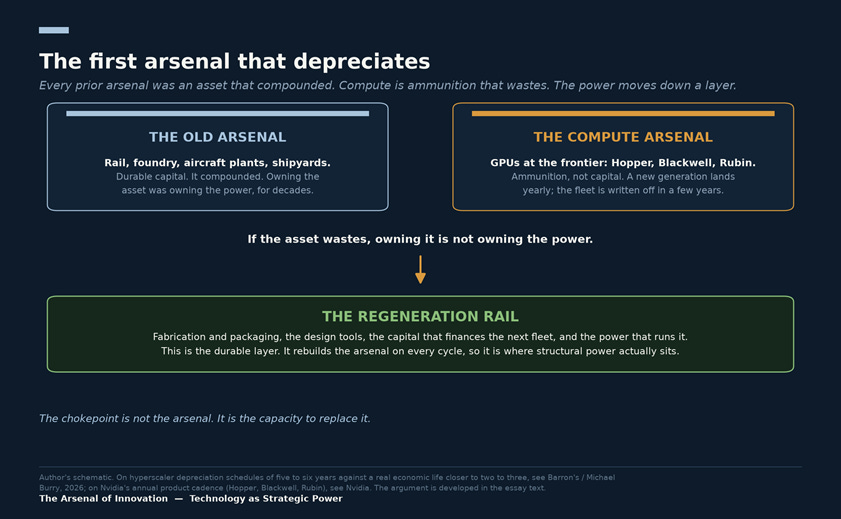
Every prior arsenal was durable. The rail that opened the interior, the foundries that poured its steel, the aircraft plants Roosevelt converted, these were assets that lasted decades, and power came from owning things that stayed valuable long enough to compound. Compute is different in kind. The accelerators at the heart of the machine obsolesce in years, not decades, and the pace is set by the seller. Nvidia has compressed its architecture cadence to roughly a year, Hopper to Blackwell to Rubin, and each generation redefines the economics of the last, so that a chip’s frontier usefulness is measured in a handful of quarters before it is cascaded down to cheaper work.⁸
How fast the machine loses value is now one of the most consequential arguments in finance, and the disagreement itself proves the point. The hyperscalers depreciate their AI servers over five to six years, a schedule they extended from the older three-to-four-year norm, a change that lifts reported earnings by lowering the annual charge.⁹ Michael Burry, who read the last great mispricing of an asset’s durability, argues the real economic life is closer to two or three years given Nvidia’s cadence, and that stretching the schedule understates depreciation across the sector by a sum he puts in the hundreds of billions.¹⁰ One does not have to settle the accounting to see the strategic content. Whether the arsenal wastes in three years or six, it wastes, and it must be rebuilt on a cycle no earlier arsenal ever faced. The machine is not the cathedral. It is the ammunition.
The cascade is also what keeps the ammunition worth making. A chip retired from training the next frontier model is not scrap; it drops down a value ladder into inference and general high-performance computing, where it earns for years running the applications that make compute worth financing at all, and Nvidia itself points to a robust secondary market to justify the schedules.¹¹ Those applications are the demand base beneath the whole edifice. Compute is already compressing the slow, expensive work of drug discovery, and it runs the optimisation, forecasting and autonomy that advanced manufacturing, agriculture, energy and the security base increasingly depend on.¹² Each of these consumes the cascaded machines long after they leave the frontier, which is why the depreciation curve bends rather than falls off a cliff, and why the layer worth owning is the one that keeps producing new ammunition for a demand base that only widens.
This is where the depreciation fact stops being an accounting quarrel and becomes a claim about power. Structural power, in the sense the political economist Susan Strange gave the term, comes from controlling the frameworks within which others must operate, and it accrues to whoever holds the step the system cannot skip, not to whoever owns the most assets.¹³ China’s leverage over the mineral economy is the clean example: it comes from controlling the refining step the rest of the chain has to pass through, not from owning every mine. Apply that lens to compute and the boxes fall out of the picture. A depreciating asset cannot be the chokepoint, because it is by design replaced. So the chokepoint is not the arsenal at all. It is the capacity to replace it. Depreciation moves the locus of structural power off the installed base and onto the rail that regenerates it, and the financiers, lending against the wasting layer while declining to own it, have priced exactly that.
Where the power actually sits
If the arsenal must be rebuilt every few years, then structural power belongs to whoever can rebuild it faster, cheaper and on their own terms than a rival can. Call that the regeneration rail. It is not the data centres full of chips that will be scrap by the end of the decade. It is the durable machinery that produces the next generation of the arsenal and every generation after it: the fabrication and advanced-packaging capacity that makes the accelerators, the energy and grid that power them, the critical-mineral midstream that supplies them, and the capital rail that recycles into each new vintage. These layers compound while the chips decay. They are what an owner should want.
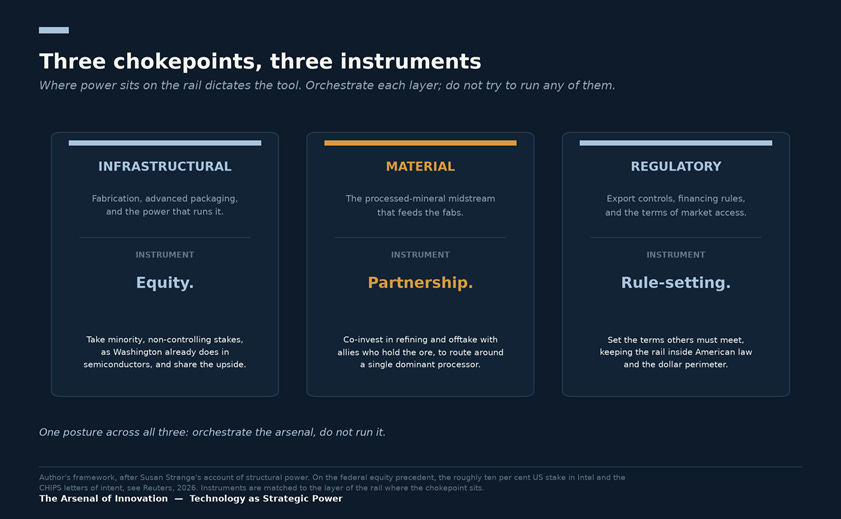
Strange’s framework tells you not just what to own but how, because the regeneration rail is built from three different kinds of chokepoint and each answers to a different instrument. Picture the arsenal as a foundry that has to be rebuilt around its own furnace every few years: the furnace, the ore that feeds it and the licence to fire it are held by three different hands, and no one who controls only one of them controls the foundry. Fabrication, packaging and the power system are infrastructural chokepoints: they are built slowly, they last, and they reward equity, a patient stake in assets that appreciate across many cycles of the chips they enable. The mineral midstream is a geographic and material chokepoint, largely inherited and today concentrated in a rival state; it is secured less by buying it than by building refining capacity and binding aligned suppliers. Export controls and the financing rules themselves are regulatory chokepoints, which can be constructed or reversed quickly and which the state already holds. The mistake the ownership debate keeps making is to argue over whether the state should own the boxes. The boxes are the one layer it should not own. The rail beneath them is the prize, and it calls for equity, partnership and rule-setting in different measure at each layer.
Orchestrate the arsenal, do not run it
None of this argues for a compute platform run from Washington, which would be a slow and politicised thing, nor for the state as a picker of winners. Strange’s own point cuts against that reading. Real power is the power to set the framework others operate inside, not to own or command every asset within it. The state that orchestrates the ecosystem, through patient capital, partnership architecture, the concentration of governance in a few capable hands, and hard performance discipline, shapes the choices made across the whole system without running any single plant. Ownership is one instrument inside that orchestration, not the whole of it, which is what dissolves the objection that a minority stake confers no control. The control does not come from the stake alone. It comes from holding equity in the durable layer, partnership over the material layer, and the regulatory levers over access, and from arranging the three so they reinforce each other.
Washington already has the equity instrument in hand. When the CHIPS incentive for Intel was restructured in August 2025, the government did not extend a larger grant; it converted unpaid funds into a federal equity stake of nearly ten per cent, the moment an incentive programme became a shareholding.¹⁴ The lesson is not that the state should take equity in everything, but that where it already deploys public support into the strategic build-out, through demand guarantees, loan authority, tax expenditure or appropriation, it should increasingly take that support as equity in the regeneration rail rather than as a grant that leaves the upside with the counterparty. Taking equity for support the government already provides is close to costless to the balance sheet and can return money to the Treasury rather than draw it down; it is a better price for support the public is already giving, not a new spending programme. The instrument exists. The asset class exists. What is missing is the decision to point the first at the durable layer of the second.
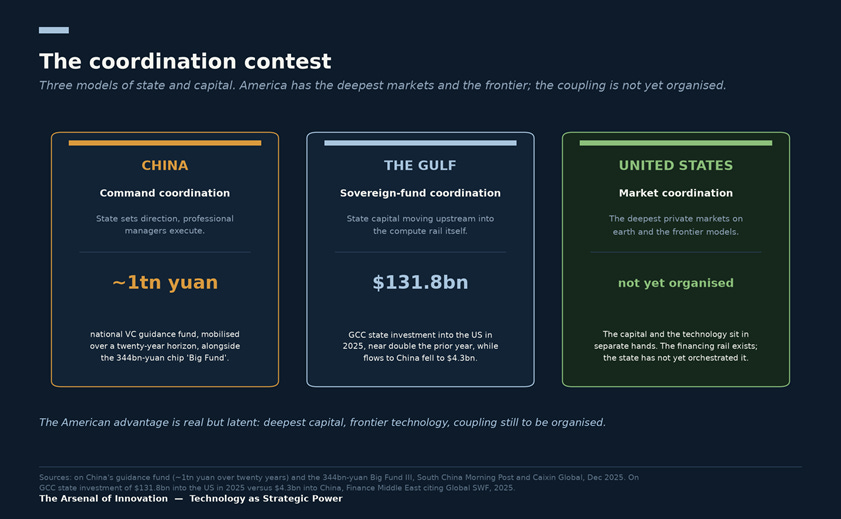
This is the part of the argument that reads as weakness at home but is in fact the American advantage abroad. The rivals coordinate capital and purpose already, in the two ways the United States has always distrusted. China runs it by command: a national venture-capital guidance fund launched at the end of 2025 is built to turn central money into roughly a trillion yuan of directed investment across semiconductors, artificial intelligence and biotechnology over a twenty-year horizon, sitting alongside a state chip fund that already carries tens of billions of dollars.¹⁵ The Gulf runs it through sovereign funds that fuse patient capital with a national strategy. But command misallocates, because the planner cannot price what has not been invented yet, and sovereign capital alone cannot conjure the science, as the fabrication story below makes plain. The United States holds the one combination neither rival can assemble, the deepest private capital markets on earth and a technology base at the frontier, and has never organised the coupling between the two. Orchestration is not central planning imported late; it is the seam the American system leaves on the table, and the case for closing it is that the states setting the pace have already closed theirs.
Allies inside the perimeter
The rail is too large for any single treasury, which makes the choice of partners a strategic act rather than a financing convenience, and here the competition splits in two. China is the rival whose coordination model the United States has to out-perform. The Gulf funds are not a rival at all; they are the largest pool of mobile strategic capital in the world, and the contest is over whose order it serves. That capital is already answering: GCC sovereign funds directed the great bulk of their strategic money to the United States in 2025, on the order of a hundred and thirty billion dollars, close to double the prior year and far ahead of what they placed in China, whose share fell.¹⁶ The test for a partner is not the passport on the cheque but whether the capital is aligned or answers, in the end, to a rival. The Gulf funds are already inside the build, with MGX in the Aligned acquisition and Abu Dhabi’s vehicles as structural participants, which makes the United Arab Emirates a platform partner whose alignment against hostile access can be priced into the terms rather than assumed away.¹⁷ Such partners construct within the American-led order rather than against it, and their value rises precisely because a credible drift towards another pole would cost the system something. Bringing that capital inside the perimeter, rather than leaving it to drift towards Beijing, is itself a move in the contest with China, not a departure from it.
The boundary of that logic is visible in a case that ran the other way. Saudi Arabia’s Public Investment Fund, through its manufacturing arm Alat, spent two years trying to buy its way into semiconductor fabrication, and in early 2026 abandoned the effort, reassigning the team and pivoting to data centres after repeated attempts to secure chipmakers and build fabs failed against the subsidies and technology positions of the established producers.¹⁸ Capital alone could not conjure a fab. The regeneration rail is guarded by the holders of the technology, not merely the holders of the cheque, which is the deepest reason the United States should orchestrate the rail rather than assume money will always be able to rent it. Money finances the boxes. The rail answers to whoever holds the science, the tooling and the rules, and that is a position the United States can hold with allies or cede to a rival, but cannot buy back cheaply once lost.
Why this is good for America
The case for owning the regeneration rail is not an abstraction about structural power. It is the difference the arrangement makes to ordinary Americans, every cycle, in terms they can feel.
It turns a one-off construction boom into recurring industrial employment, and it leaves the country with power it keeps. The boxes are built once and scrapped; the rail is rebuilt continually. Fabs re-tool for each new generation, power plants run for decades, refineries and packaging lines and grid crews work across every cycle of the chips they serve. The financing decides who owns the asset; it does not change where the concrete is poured or the copper is pulled.¹⁹ Energy is the binding constraint on the whole build-out, and no securitisation delivers electrons a grid cannot carry, so the arsenal forces the kind of long-postponed investment in power that serves the home as much as the data centre.²⁰ Directing the build onto domestic ground, and owning a share of the durable layer, keeps the payroll, the generation and the appreciation inside the country that carries the strategic burden of hosting the machines.
It lets the citizen who funds the arsenal own a share of it. The build is too large for the state and the banks combined; it will be carried in the end by private credit and by the savings of ordinary households, through pensions and retirement accounts, whether or not the public captures any of the upside. Taking public support as equity in the durable layer, and widening access to the asset class, is what turns the saver from a lender into a shareholder in the machine their money is building.
It puts the frontier within closer reach at home. A country that owns and regenerates the arsenal on its own ground builds and prices intelligence domestically, so the gains it throws off land here first and cheapest rather than being rented back from elsewhere. Those gains are already concrete. In pharmaceuticals the compute layer is compressing the slowest and most expensive stage of discovery, with the applications that run on cascaded machines turning years of screening into months and cutting early costs by a large margin.²¹ In agriculture it drives yield and precision-input models; in advanced manufacturing, design and process optimisation that lifts throughput and cuts waste; in energy, the forecasting and grid-balancing the build-out itself will need. A nation that owns the rail feeding all of these is not merely hosting other people’s data centres. It is manufacturing the input to its own next decade of productivity.
And it buys security that shows up as ordinary life. Compute is now defence infrastructure; the models that will run logistics, targeting and intelligence fusion depend on the same accelerators and the same fabs, grid and minerals as the commercial market. An owner of the rail can defend it, ration it in a crisis and say who else may use it. The daily dividend of that control is the shock that does not happen, the supply that does not fail, the price that does not spike.
What it comes to
The financing rail the arsenal needed has arrived, larger and more formal than anticipated, and the houses that built it read the asset correctly: compute is a wasting thing, and the right way to fund a wasting thing is to lend against it. Their clarity exposes the state’s confusion. The ownership debate has been fought over the boxes, which are the one layer no one should want to own, while the layer that actually confers structural power, the capacity to rebuild the arsenal faster and on better terms than any rival, sits unclaimed. To own the regeneration rail is not to run data centres from Washington. It is to hold equity in the fabs, the packaging and the power that compound while the chips decay, to secure the mineral midstream through capacity and aligned partners, to keep the regulatory levers that decide access, and to arrange the three so they reinforce one another, with capable allies inside the perimeter rather than outside it.
Roosevelt’s generation did not rent the arsenal of democracy from the firms that ran it; the nation built it and kept a claim on what it produced. The intelligence age asks the same in a harder register, because this arsenal is an asset class and the equity can leave the country as easily as a wire transfer, and harder still because this arsenal has to be rebuilt again and again. Get it right and the build-out compounds American power, renews American industrial employment every cycle, delivers power and cheaper intelligence into ordinary life, and lets the citizens who finance the machine own a share of it. Get it wrong and the country rebuilds the source of its own advantage on a permanent clock, forever, at a price set by whoever holds the rail. The great deal made compute an asset class and priced it, correctly, as ammunition. The task that remains is to own the arsenal that makes it. China is coordinating capital and purpose by command and the Gulf by sovereign fund; the one thing neither can copy is a state that couples the deepest private markets on earth to a technology base at the frontier, and the country that owns its regeneration rail first sets the terms everyone else builds on.
Notes
- 1Franklin D. Roosevelt, ‘Fireside Chat on National Security’ (‘Arsenal of Democracy’), 29 December 1940, transcript at the American Presidency Project, UC Santa Barbara; wartime production figures from The National WWII Museum, ‘Becoming the Arsenal of Democracy’, 11 July 2018.
- 2NVIDIA, ‘NVIDIA Partners With Apollo, BlackRock, Blackstone, Brookfield, Goldman Sachs and KKR to Establish AI Compute Infrastructure Financing Platforms to Mobilize Over $500 Billion of Third-Party Capital’, 10 August 2026.
- 3NVIDIA, ‘NVIDIA Partners With Apollo, BlackRock, Blackstone, Brookfield, Goldman Sachs and KKR’, 10 August 2026 (compute as ‘an investable asset class for global capital’).
- 4NVIDIA, ‘NVIDIA Partners With Apollo, BlackRock, Blackstone, Brookfield, Goldman Sachs and KKR’, 10 August 2026 (Jensen Huang: ‘In AI, compute is revenue’).
- 5On the earlier deals, see Apollo, ‘Apollo Backs $5.4 Billion Valor and xAI Data Center Compute Infrastructure Transaction with $3.5 Billion Capital Solution’, 7 January 2026; Reuters, ‘KKR launches $10 billion AI infrastructure company with Nvidia, Vistra’, 11 June 2026; and Reuters, ‘BlackRock, Nvidia-backed group strikes $40 billion AI data center deal’, 15 October 2025.
- 6On the debt structure, compute as collateral, special-purpose entities leasing to Nvidia’s customers, and Nvidia’s option to backstop up to roughly a quarter of the deals, see Fortune, ‘Nvidia taps Wall Street for $500 billion funding commitment’, 11 August 2026; and Reuters, ‘Private credit roundup: Nvidia’s half trillion for chips financing, plus others’, 14 August 2026.
- 7On the $500 billion figure as a multi-year programme envelope underwritten deal by deal, and on Goldman Sachs as the sole bank among the sponsors, see The Cryptonomist, ‘Nvidia AI Financing Unlocks $500B in Infrastructure Capital’, 11 August 2026; and Fortune, ‘Nvidia taps Wall Street for $500 billion funding commitment’, 11 August 2026.
- 8On Nvidia’s roughly annual architecture cadence (Hopper, Blackwell, Rubin) and the resulting compression of frontier usefulness before older accelerators are cascaded to cheaper inference work, see The Cube Research, ‘Resetting GPU Depreciation: Why AI Factories Bend, But Don’t Break Useful-Life Assumptions’, 22 November 2025.
- 9On hyperscaler server useful-life schedules of five to six years, extended from the older three-to-four-year norm, and the resulting earnings effect, see Introl, ‘GPU Depreciation Strategies: Optimizing Asset Lifecycles’, 29 January 2026; and CNBC, ‘The question everyone in AI is asking: How long before a GPU is obsolete?’, 14 November 2025.
- 10On Michael Burry’s argument that hyperscalers understate depreciation by stretching useful-life assumptions beyond a realistic two-to-three-year economic life, see CNBC, “‘Big Short’ investor Michael Burry accuses AI hyperscalers of artificially boosting earnings”, 11 November 2025.
- 11On the ‘value cascade’ in which accelerators retired from frontier training are redeployed to inference and general high-performance computing, and on Nvidia pointing to a robust secondary market to justify hyperscaler depreciation schedules, see Center for Information Technology Policy, Princeton University, ‘AI Chip Lifespans: A Note on the Secondary Market’, 18 December 2025; and SiliconANGLE, ‘Resetting GPU depreciation: Why AI factories bend, but don’t break useful-life assumptions’, 22 November 2025.
- 12On AI workflows compressing the earliest stages of drug discovery from roughly five years towards twelve to eighteen months and reducing costs by up to around forty per cent, see AI-enabled drug and molecular discovery: computational approaches and applications (Discover Chemistry, 2025); and, on AlphaFold shortening the discovery and preclinical stages, C. Zhu and others, ‘Drug development in the AI era: AlphaFold 3 is coming!’, 2024. On the persistence of high clinical attrition, roughly ninety per cent of candidates entering clinical development still failing to reach approval, see F. Pognan and others, ‘AI in Drug Discovery: Clinical Failures, Regulatory Reality’, 2026.
- 13On structural power as control over the frameworks within which others operate, and on the four structures of security, production, finance and knowledge, see Susan Strange, States and Markets (London: Pinter, 1988); and Susan Strange, The Retreat of the State: The Diffusion of Power in the World Economy (Cambridge: Cambridge University Press, 1996).
- 14On the restructuring of the Intel arrangement into a federal equity stake of nearly ten per cent, see Intel Newsroom, ‘Intel and Trump Administration Reach Historic Agreement’, 22 August 2025.
- 15On China’s national venture-capital guidance fund, launched in December 2025 with roughly 100 billion yuan of central capital and designed to mobilise about 1 trillion yuan over a twenty-year horizon into semiconductors, artificial intelligence, biotechnology and other strategic sectors, with the state setting policy direction and professional managers executing, see South China Morning Post, ‘China launches venture capital fund to lead the charge on tech investment’, 26 December 2025; and Caixin Global, ‘China Launches $14 Billion State Fund to Back Strategic Tech Industries’, 26 December 2025. On the state chip fund it sits alongside, the China Integrated Circuit Industry Investment Fund (‘Big Fund’), whose third phase was established in 2024 with registered capital of 344 billion yuan, see China Integrated Circuit Industry Investment Fund (Wikipedia).
- 16On the concentration of Gulf sovereign capital in the United States, with state-owned investors directing some 131.8 billion dollars to the United States in 2025, close to double the prior year, while investment into China fell to 4.3 billion dollars from 10.3 billion in 2024, see Finance Middle East, ‘AI Anchors GCC Sovereign Wealth Fund Strategy in 2025’, citing Global SWF. On Gulf funds moving upstream from passive stakes into the compute infrastructure itself, see Forbes, ‘How Gulf Funds Are Buying The Backbone Of AI’, 17 June 2026.
- 17On MGX and Abu Dhabi’s participation in the compute build, including the $40 billion Aligned Data Centers acquisition, see Reuters, ‘BlackRock, Nvidia-backed group strikes $40 billion AI data center deal’, 15 October 2025.
- 18On Saudi Arabia’s Public Investment Fund abandoning Alat’s semiconductor-fabrication plans and pivoting to data centres in early 2026 after attempts to invest in chipmakers and build fabs failed against foreign competition, see Enterprise, ‘PIF pivots Alat from chip manufacturing to data center buildout’, 10 April 2026.
- 19On the build-out requiring a skilled workforce, see BlackRock’s statement in NVIDIA, ‘NVIDIA Partners With Apollo, BlackRock, Blackstone, Brookfield, Goldman Sachs and KKR’, 10 August 2026.
- 20On energy, grid interconnection and power draw as the binding constraint on the data-centre build-out, see Morgan Stanley, Bridging the Data Center Gap, 16 July 2025.
- 21On AI compressing the slowest and most expensive stage of pharmaceutical discovery, see AI-enabled drug and molecular discovery: computational approaches and applications (Discover Chemistry, 2025); and, for a peer-reviewed overview of AI applications across the preclinical pipeline, S. Zhang and others, ‘From Algorithms to Assets: A Comprehensive Review of AI’s Role in Preclinical Drug Discovery’, 2026.