A standalone essay on the media and information sector, where artificial intelligence, national security, and private investment now meet.
There is an old habit of mind that files the media industry under culture. Films, feeds, broadcasters and news wires belong, in this view, to the soft world of entertainment and opinion, adjacent to power but not part of it. That habit is now a liability. The same infrastructure that distributes a pop video distributes a rumour that can move a currency. The same model that dubs a film into forty languages can generate a video that was never shot. The sector that the twentieth century treated as leisure has become, in the twenty-first, a theatre of statecraft, and the people who understand this first are not culture ministers but security officials and the investors who follow them.
The argument of this essay is that media and information infrastructure has become strategic terrain, contested by states and financed by private capital in the same breath. Three forces converge on it. Artificial intelligence has collapsed the cost of producing and personalising content to near zero. National security has expanded to treat the flow of information, and the algorithms that shape it, as a domain to be defended and, where possible, controlled. And private investment, sensing both a commercial boom and a geopolitical premium, has poured into the firms that build the tools. The result is a field where a video-generation startup, a sovereign wealth fund and a national regulator are all playing the same game, and increasingly, on the same board.
When a social app became a security case
The clearest sign that media had crossed into security was the long fight over a single application. TikTok, owned by China’s ByteDance, was not treated by Washington as a cultural nuisance but as a strategic exposure, on two grounds: the data it held on American users, and the recommendation algorithm that decided what a hundred and seventy million of them saw. The Protecting Americans from Foreign Adversary Controlled Applications Act, signed in April 2024, forced a divestiture, and in January 2025 the Supreme Court upheld it in a unanimous opinion.[1] The point worth holding onto is not the ban but its logic. A ranking algorithm had been reclassified as a national-security asset.
The resolution was more revealing still. Rather than a simple prohibition, the outcome was a restructuring of ownership. Under a framework set out in late 2025, the American business was spun into a new vehicle, TikTok USDS Joint Venture LLC, which closed in January 2026.[2] Oracle, Silver Lake and the Abu Dhabi fund MGX took fifteen per cent each, ByteDance was cut to 19.9 per cent, and the remaining 35.1 per cent was spread across a roster of American and allied investors including Michael Dell and Andreessen Horowitz affiliates, leaving non-Chinese hands with more than eighty per cent.[3] The US business was valued at roughly fourteen billion dollars.[4] A security problem, in other words, was solved with a capital table. The state set the terms; private money supplied the ownership. This is the pattern the rest of the essay traces.
What the technology actually is
To see why media crossed into security, it helps to look under the hood, because the thing that changed is not the media but the machine that makes it. Almost every impressive AI image and video system of the mid-2020s, from Sora to Google’s Veo to Kling and Runway, runs on one architecture: the diffusion transformer, or DiT.[5] Diffusion is a method that generates a picture backwards, starting from pure static and removing a little noise at each of dozens or hundreds of steps until an image emerges. The older versions of this ran on a convolutional network called a U-Net. The shift that defined the modern era, introduced in a 2023 paper by William Peebles and Saining Xie, was to swap that backbone for a transformer, the same class of model that powers large language systems.[5]
That swap is what makes the technology strategically distinct, and the reason is scaling. Because a diffusion transformer is a transformer, it obeys the same clean power-law relationships that govern language models: research presented at CVPR in 2025 showed that video DiT quality improves predictably with model size, training compute and dataset size, so that one can forecast, before spending a dollar, how much better a model a given tranche of compute will buy.[6] Media generation has thereby been converted from an artisanal problem into an industrial one. It rewards whoever can marshal the most compute, the most data and the widest distribution, which is precisely why it attracts the same concentrated capital, and the same state attention, as frontier AI itself. Video is the most demanding case of all, since a model must denoise hundreds of frames coherently across space and time at once, which is what pushes the technology into the energy problem examined later in this essay.
The result is a set of moats that look less like Hollywood and more like heavy industry. The frontier is concentrating in four to six laboratories, because only they can afford the compute and the capital, while the value that reaches ordinary businesses accrues in an applied layer of tools built on top: dubbing, localisation, visual effects, advertising and corporate video.[7] The barrier to entry at the top is no longer talent alone but the ability to buy scale, and that is a barrier only states and the largest pools of private capital can clear.
The scramble for authenticity
Governments have not waited for the threat to mature. The arrival of convincing synthetic content at scale prompted a wave of law, and the striking thing is its universality. The United States criminalised non-consensual intimate deepfakes through the TAKE IT DOWN Act in 2025, and by early 2026 forty-six states had deepfake statutes of their own.[8] The European Union’s AI Act imposes transparency and labelling duties on synthetic content, enforceable from August 2026 with fines up to three per cent of worldwide turnover.[9] China moved earliest and hardest, requiring both visible and embedded labels on all AI-generated content under a mandatory national standard in effect from September 2025.[10] Three rival systems, arriving by different routes at the same instinct: the provenance of information is now a matter of state.
Where the state legislates the demand for authenticity, private infrastructure supplies it, and here the pattern inverts. Rather than a government drafting a standard into being, an industry consortium built one and the state adopted it. The Coalition for Content Provenance and Authenticity, founded in 2021 by Adobe, the BBC, Microsoft and others, had grown to more than six thousand members by its fifth anniversary in early 2026, and its Content Credentials standard is being fast-tracked into an international norm.[11] Its steering committee now reads like a census of the sector’s powers: Adobe, Amazon, Google, Meta, Microsoft, OpenAI, Sony and the BBC among them.[12]
The significance is that a security function, verifying that a piece of media is what it claims to be, is being delivered by private infrastructure, then ratified by public authority. The United States defence establishment has published guidance endorsing the approach; camera makers from Leica to Nikon to Canon are baking it into hardware.[13] The provenance layer of the information system is being built by the same firms that build the generation tools, an arrangement that is efficient and uneasy in equal measure. The arsonist, one might say, is selling the smoke detector.
Private capital finds the geopolitical premium
Underneath the policy sits a torrent of money, and its scale is the point that reframes everything else. Global venture funding into generative AI reached a record eighty-seven billion dollars in the first eleven months of 2025.[14] A large share of it flows to the firms that make media: the models that write, draw, speak and film. OpenAI, whose Sora system generates video, reached a five-hundred-billion-dollar valuation through a secondary share sale in October 2025.[15] The voice-generation firm ElevenLabs raised at an eleven-billion-dollar valuation in early 2026; the video startup Runway raised at more than five billion; the corporate-video firm Synthesia crossed four billion.[16] These are private firms funded by private money, yet their products are dual-use by nature. The tool that localises a training video also localises a lie.
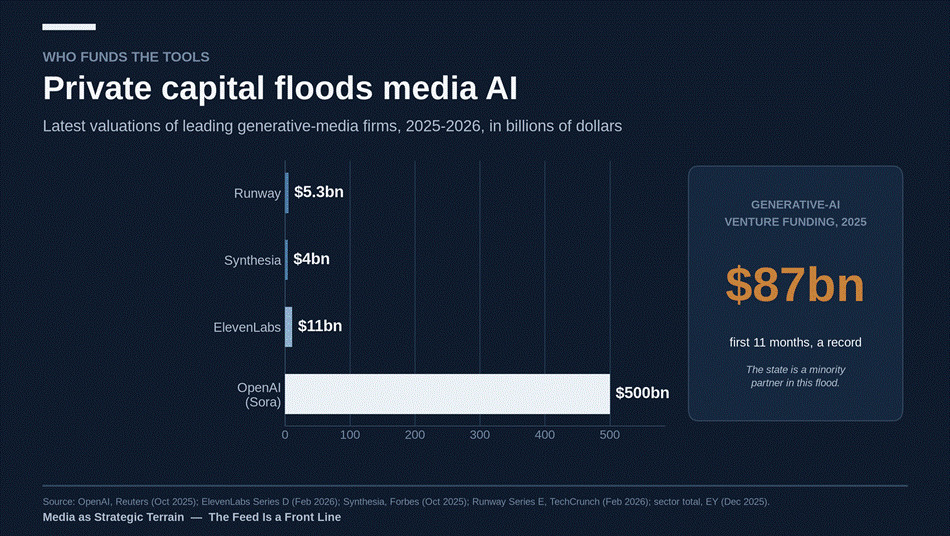
What draws capital here is not only the size of the media market but the leverage of the tools over it. A single video model can serve advertising, film production, corporate training and, in the wrong hands, disinformation, without changing a line of code. That dual-use quality is precisely what gives the sector its geopolitical premium: an investor backing a generation model is backing an instrument whose value rises with its strategic salience, not merely its subscriber count. It is why the same firms attract both growth-equity funds chasing returns and sovereign vehicles chasing position. The capital is commercial in form and strategic in consequence, and the two motives have stopped being separable.
The state is not the main source of this capital. It is a minority partner in a private flood, and its leverage lies not in funding the build-out but in shaping the terms on which private money is raised, screened and deployed. That is the same discipline visible in the TikTok settlement: the market supplies the money, the state supplies the constraint. The most consequential investors in media AI are not governments but venture firms, growth-equity funds and the strategic arms of the incumbents, WPP taking a stake in Stability AI, Comcast and the talent agency CAA backing the video firm Moonvalley.[17] When advertising conglomerates and Hollywood agencies are venture investors in generative models, the line between the culture industry and its tooling has already dissolved.
The investment ecosystem, in two layers
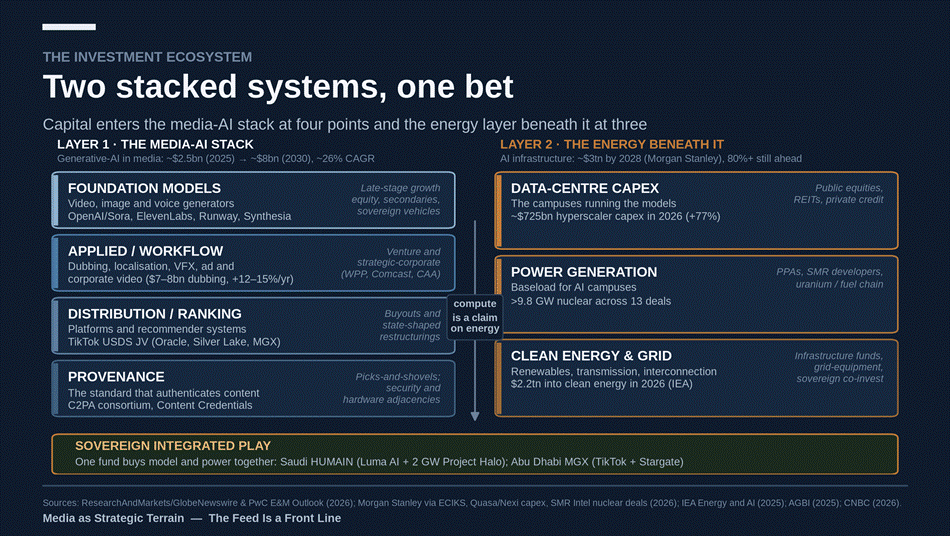
Stand back from the individual deals and the money organises itself into two stacked systems. The first is the media-AI stack, the layer that generates, ranks and authenticates content. The second is the energy layer beneath it, the power that makes the compute possible. Capital increasingly treats the two as a single bet, because a video model is worth nothing without the megawatts to run it, and the same investors are learning to underwrite both at once.
The drivers behind the first layer are now measurable. The generative-AI segment of media and entertainment was worth around two and a half billion dollars in 2025 and is forecast to reach roughly eight billion by 2030, compounding at about twenty-six per cent a year, a pace that sits inside a wider entertainment-and-media economy heading toward four point two trillion dollars by 2030 as advertising spend passes a trillion dollars a year on the strength of real-time personalisation.[18] What pulls capital in is less the raw size of the market than the leverage of the tools over it: studios report production-cost reductions of fifteen to thirty per cent from generative workflows, rising to fifty to seventy per cent in pre-visualisation, visual effects and dubbing, while the dubbing and localisation market alone, worth seven to eight billion dollars, is growing at twelve to fifteen per cent a year.[19] These are the returns that convert a novelty into an industry.
Within the media stack, capital enters at four distinct points, each with its own risk profile. At the frontier sit the foundation models, the video, image and voice generators concentrating in a handful of laboratories: OpenAI, whose Sora reached its five-hundred-billion-dollar mark, alongside ElevenLabs in voice, Runway in video and Synthesia in corporate film, priced for a winner-take-most outcome and reachable mainly through late-stage growth equity, secondaries and sovereign vehicles.[20] Above them lies the applied layer, the tools that wrap a model for a use case, dubbing, localisation, visual effects, advertising, where revenue is clearer and classic venture and strategic-corporate money does the work. A third point is distribution and ranking, the platforms and recommender systems whose ownership is settled through buyouts and state-shaped restructurings such as the TikTok joint venture. The fourth is provenance, the authentication layer built as shared infrastructure by the C2PA consortium, a picks-and-shovels position adjacent to security and hardware.[21]
The second layer, energy, is where the largest sums now move, and it is the reason the media story cannot be told as a software story. Morgan Stanley estimates that close to three trillion dollars of AI-infrastructure investment will flow through the global economy by 2028, with more than eighty per cent of it still ahead, some eight hundred billion of it addressable by private credit and a further three hundred and fifty billion by private equity, venture and sovereign investors.[22] The four largest American hyperscalers alone are guiding toward roughly seven hundred and twenty-five billion dollars of capital expenditure in 2026, a seventy-seven per cent jump on the year before, most of it flowing into AI data centres and the power to run them.[23] Beneath the campuses sits generation: hyperscalers have contracted more than nine gigawatts of nuclear capacity across thirteen deals in eighteen months, from Microsoft’s sixteen-billion-dollar Three Mile Island restart to Meta, whose commitments of several gigawatts make it the largest corporate nuclear buyer among them, while the International Energy Agency expects two point two trillion dollars to flow into clean energy in 2026, nearly double the sum directed at fossil fuels.[24] For an investor the energy layer offers what the frontier cannot: long-duration, contract-backed, near-infrastructure returns.
The through-line is that compute has become a claim on energy, and the two layers are converging into one asset class. The clearest expression is the sovereign integrated play, in which a single fund buys the model and the power together: Saudi Arabia’s HUMAIN pairing its stake in the Hollywood-facing video firm Luma AI with a two-gigawatt data centre, or Abu Dhabi’s MGX sitting inside both the American TikTok and the Stargate compute consortium.[25] The ecosystem thus offers a spectrum rather than a single door, high-risk, high-multiple frontier models at the top, steadier revenue in the applied layer, and long-dated, power-backed returns at the energy floor, and the same pools of capital are increasingly present at every level.
The multipolar contest
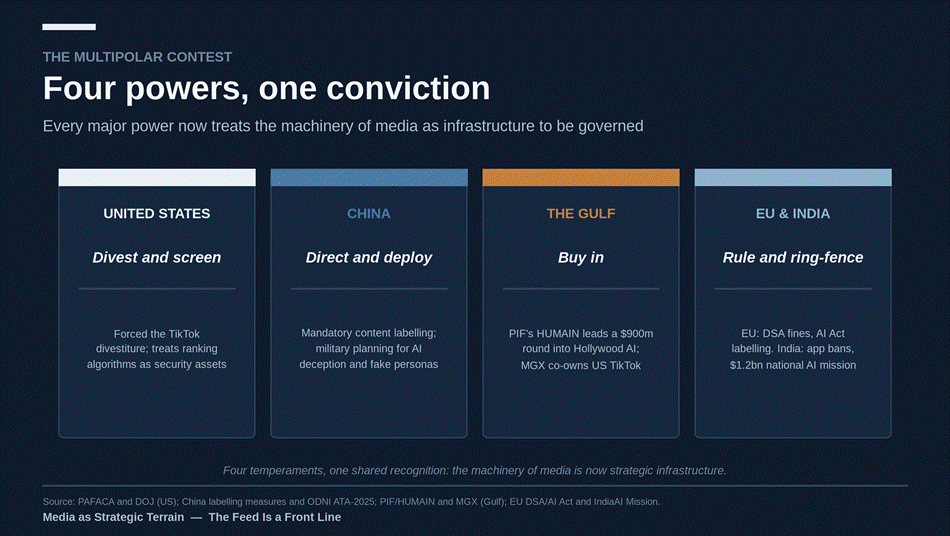
What turns this from an American story into a strategic one is that every major power is now playing, and the Gulf has moved from spectator to protagonist. Saudi Arabia’s Public Investment Fund launched a dedicated AI company, HUMAIN, in May 2025, and by November it had led a nine-hundred-million-dollar round into the Hollywood-facing video firm Luma AI, while jointly building a two-gigawatt data centre called Project Halo.[26] The kingdom paired the technology bet with a content one, launching a hundred-million-dollar film fund the same season.[27] Abu Dhabi’s MGX, a co-owner of the American TikTok, closed a forty-nine-billion-dollar fund in 2026 and sits inside the Stargate infrastructure consortium.[28] The Gulf is not buying media exposure for its returns alone. It is buying a seat at the table where the tools of narrative are forged.
The others follow their own grammar. China treats AI-enabled information operations as an explicit instrument: the 2025 United States threat assessment records that its military “probably plans to use large language models” to generate deception and fabricate personas, and researchers have documented state-linked systems profiling foreign legislators.[29] The European Union, characteristically, reaches for capacity and rules together, allocating over a billion euros to AI through its Apply AI strategy in 2025, including support for creative-sector “micro-studios”, while wielding the Digital Services Act as an enforcement weapon.[30] India, guarding the world’s largest media market, banned dozens of Chinese apps in 2020 and has since committed more than a billion dollars to its national AI mission.[31] Four powers, four temperaments, one shared conviction that the machinery of media is now infrastructure to be governed.
The pipes carry power
The final turn is that control of media increasingly means control of the ranking systems, not just the content. Europe has made this explicit. In December 2024 the Commission opened formal proceedings against TikTok over the civic risks of its recommender systems, and a year later it issued its first fine under the Digital Services Act, one hundred and forty million dollars against X, with the maximum penalty set at six per cent of global turnover.[32] The regulatory target is no longer a single false post but the algorithm that decides which posts a nation sees. A recommendation engine, like the TikTok algorithm before it, has become an object of statecraft.
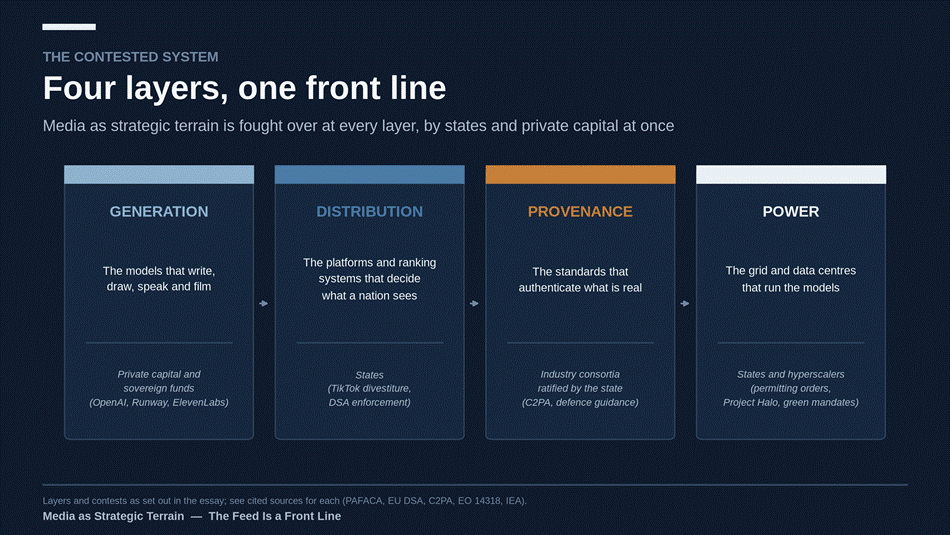
Here the strands begin to knot together. The model that generates the content, the platform that ranks it, and the standard that authenticates it are layers of a single contested system, and each is being fought over by states and financed by private capital at once. There is one layer deeper still. The commercial market for generative AI in media is real but modest, measured in the low billions and growing fast.[33] The strategic stakes are larger by an order of magnitude, because what is being allocated is not merely a market but a capacity: the ability to shape what a population believes it is seeing.
The front line runs on electricity
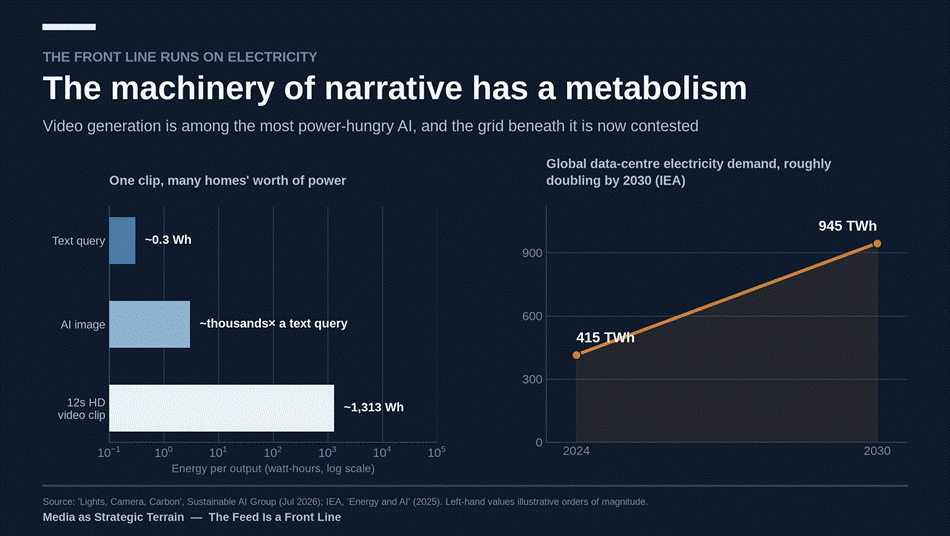
There is a floor beneath all of this, and it is physical. The generative-media boom is, at bottom, an energy story, because the tools that make synthetic film are among the most power-hungry ever built. Generating an image already consumes thousands of times the energy of a text query, and video is heavier still, since a model must denoise hundreds of frames across space and time at once.[34] One 2026 study estimated that a single twelve-second high-definition clip from a leading video model could draw more than thirteen hundred watt-hours, and that at a scale of four million users producing two short clips a day, the system would burn some six hundred gigawatt-hours over six months, the electricity of roughly a hundred and forty thousand American homes, spent purely on making short videos.[35] The machinery of narrative has a metabolism, and it is enormous.
That metabolism is remaking the grid. The International Energy Agency projects that global data-centre electricity demand will roughly double, from about four hundred and fifteen terawatt-hours in 2024 to around nine hundred and forty-five by 2030, with AI the primary driver and data centres approaching three per cent of world electricity.[36] This is where the media story rejoins the older resource story. The same sovereign funds financing video models are financing the power to run them: Saudi Arabia’s Project Halo is a two-gigawatt build, a large nuclear plant’s worth of capacity for a single AI campus. Compute has become a claim on energy, and energy has always been the hardest currency of geopolitics.
And here the regulator returns, this time as an energy authority. The physical layer of media is now governed as deliberately as its content. In the United States, an executive order in July 2025 moved to accelerate federal permitting for data-centre infrastructure, easing environmental review and opening federal land, explicitly framed as a matter of national security, while in June 2026 the Federal Energy Regulatory Commission ordered six regional grid operators to rewrite their rules for connecting large AI loads.[37] The European Union’s Cloud and AI Development Act, published in June 2026, commits to tripling data-centre capacity while attaching binding energy-efficiency obligations, and China’s planners have gone further still, directing that AI data centres draw directly on renewable power and meet mandatory green-electricity consumption standards, part of a drive to green the sector’s supply by the end of the decade.[38] The contest over media, in other words, now reaches all the way down to how the electrons are made. To govern the feed, a state must govern the grid beneath it.
What it comes to
The media sector has completed a migration that few of its own executives have fully registered. It has moved from the cultural periphery of national power to its centre, joining energy, chips and finance as strategic infrastructure, and drawing on the same grid as all three. The mechanism is familiar to anyone who has watched capital become statecraft elsewhere. Private money supplies the overwhelming bulk of the investment and builds the tools. The state supplies the constraint, the screening and the occasional ownership stake, steering a private torrent toward national ends it could never fund alone. The sovereign funds of the Gulf, the venture firms of California, the regulators of Brussels and the propaganda planners of Beijing are, for all their differences, converging on the same recognition.
The feed is a front line. The question for the next decade is not whether states will treat media as security terrain, they already do, but whether the private capital financing the build-out will be steered wisely or merely steered. The tools being funded today will decide, for a generation, who gets to shape what the world believes. That is too consequential to be filed under culture, and it no longer is.
Notes
- 1On the Protecting Americans from Foreign Adversary Controlled Applications Act, signed 24 April 2024, and the Supreme Court’s unanimous decision in TikTok Inc. v. Garland on 17 January 2025 upholding it, see European Parliament briefing, 2025 and the CFIUS acquisitions tracker, 2024-2026.
- 2On the 2025 divestiture framework and the formation of TikTok USDS Joint Venture LLC, closing in January 2026, see Data Center Dynamics, 23 January 2026.
- 3On the ownership split, Oracle, Silver Lake and MGX at fifteen per cent each, ByteDance at 19.9 per cent, and the remaining 35.1 per cent among American and allied investors including Michael Dell, see Data Center Dynamics, 23 January 2026.
- 4On the roughly fourteen-billion-dollar valuation of TikTok’s US business, see Data Center Dynamics, 2025.
- 5On the diffusion transformer (DiT) architecture underpinning modern AI image and video models including Sora, Veo, Kling and Runway, its replacement of the U-Net backbone, and its introduction in a 2023 paper by William Peebles and Saining Xie, see Lychee, ‘Diffusion Transformers (DiT): How AI Video Models Work’, 27 June 2026 and Peebles and Xie, ‘Scalable Diffusion Models with Transformers’, 2023.
- 6On video diffusion transformers following predictable power-law scaling between model size, training compute, dataset size and output quality, see Lychee, ‘Diffusion Transformers (DiT)’, 27 June 2026, citing ‘Towards Precise Scaling Laws for Video Diffusion Transformers’ (CVPR 2025).
- 7On the concentration of foundation-model capability in a handful of capital-intensive laboratories and the accrual of applied value in a workflow layer of tools built on top, see Second Talent, ‘AI Startup Funding and Investment’.
- 8On the TAKE IT DOWN Act (2025) and forty-six state deepfake laws by early 2026, see Responsible AI Labs.
- 9On the EU AI Act’s Article 50 transparency and deepfake-labelling obligations, applicable from 2 August 2026, with fines up to three per cent of worldwide turnover, see European Commission on AI-generated content and the Article 50 transparency rules.
- 10On China’s Measures for Labeling AI-Generated Synthetic Content, effective 1 September 2025 under mandatory standard GB 45438-2025, see Loeb & Loeb, March 2025.
- 11On the Coalition for Content Provenance and Authenticity, founded 2021, surpassing six thousand members by its fifth anniversary in early 2026, see C2PA, ‘Five Years’.
- 12On the C2PA steering committee membership and the fast-tracking of the specification as ISO 22144, see US Department of Defense / NSA Cybersecurity Information Sheet, January 2025.
- 13On US defence guidance endorsing Content Credentials and camera-maker adoption from Leica, Nikon and Canon, see US Department of Defense / NSA Cybersecurity Information Sheet, January 2025 and Lumethic on C2PA-enabled cameras.
- 14On record global generative-AI venture funding of eighty-seven billion dollars in the first eleven months of 2025, see EY, December 2025.
- 15On OpenAI’s five-hundred-billion-dollar valuation via a secondary share sale completed 2 October 2025, see Reuters, 2 October 2025.
- 16On ElevenLabs at an eleven-billion-dollar valuation (February 2026), see ElevenLabs, Series D; on Runway’s Series E at a 5.3-billion-dollar valuation (February 2026), see TechCrunch, 10 February 2026 and Crunchbase News, 10 February 2026; on Synthesia at a four-billion-dollar valuation (October 2025), see Forbes, 29 October 2025.
- 17On WPP’s investment in Stability AI, see WPP, 5 March 2025; on Comcast Ventures and CAA backing Moonvalley, see Deadline, July 2025.
- 18On the generative-AI media and entertainment market at roughly 2.5 billion dollars in 2025 rising to about 8.06 billion by 2030 at a 26 per cent compound rate, see ResearchAndMarkets via GlobeNewswire, 7 July 2026; on the wider entertainment-and-media economy reaching 4.2 trillion dollars by 2030 with advertising spend passing one trillion dollars a year, see PwC Global Entertainment and Media Outlook, 22 June 2026.
- 19On production-cost reductions of 15 to 30 per cent from generative workflows, rising to 50 to 70 per cent in pre-visualisation, visual effects and dubbing, see AI Learning Guides, ‘Media AI Playbook 2026’; on the dubbing and localisation market at 7 to 8 billion dollars growing 12 to 15 per cent a year, see Sukudo Studios, ‘Dubbing Industry Trends 2026’.
- 20On the valuations of the leading generative-media firms, see Reuters, 2 October 2025 on OpenAI, ElevenLabs, Series D on ElevenLabs, PitchBook on Runway and Forbes, 29 October 2025 on Synthesia.
- 21On the Content Credentials provenance standard built as shared infrastructure by the C2PA consortium, see C2PA, ‘Five Years’.
- 22On Morgan Stanley’s estimate of nearly 3 trillion dollars of AI-infrastructure investment through 2028, with over 80 per cent still ahead, roughly 800 billion addressable by private credit and a further 350 billion by private equity, venture and sovereign investors, see ECIKS, 6 July 2026.
- 23On the four largest US hyperscalers guiding toward roughly 725 billion dollars of 2026 capital expenditure, a 77 per cent year-on-year increase, see Quasa, ‘Beyond the Hyperscalers’ and Nexi, ‘AI Infrastructure Capex 2026’.
- 24On more than 9.8 gigawatts of nuclear capacity contracted across 13 hyperscaler deals, including Microsoft’s 16-billion-dollar Three Mile Island restart and Meta becoming the largest corporate buyer of nuclear power in US history, see SMR Intel, ‘Every Nuclear-Powered Data Center Deal in 2026’, 6 July 2026; on the IEA’s expectation of 2.2 trillion dollars flowing into clean energy in 2026, see ECIKS, 6 July 2026.
- 25On sovereign integrated plays pairing model stakes with power, see AGBI, 19 November 2025 on Saudi HUMAIN and Luma AI, and CNBC, 1 July 2026 on Abu Dhabi’s MGX and the Stargate consortium.
- 26On the launch of HUMAIN in May 2025 and its lead of Luma AI’s nine-hundred-million-dollar round alongside the two-gigawatt Project Halo, see PIF, May 2025 and AGBI, 19 November 2025.
- 27On Saudi Arabia’s hundred-million-dollar film fund launched in September 2025, see AGBI, 19 November 2025.
- 28On MGX closing a forty-nine-billion-dollar fund in 2026 and its role in the Stargate consortium, see CNBC, 1 July 2026 and Yahoo Finance / Bloomberg.
- 29On the US Annual Threat Assessment’s statement that China’s military ‘probably plans to use large language models’ for deception, and documented profiling of foreign legislators, see ODNI Annual Threat Assessment 2025 and The Diplomat, September 2025.
- 30On the EU’s Apply AI strategy rolling out roughly one billion euros in 2025, including creative-sector support, see Reuters, 8 October 2025; on the Digital Europe Programme’s 1.3-billion-euro allocation, see European Commission, March 2025.
- 31On India’s 2020 ban of fifty-nine Chinese apps including TikTok, see BBC, 29 June 2020; on the roughly 1.24-billion-dollar IndiaAI Mission, see Government of India, March 2024.
- 32On the EU’s December 2024 proceedings against TikTok’s recommender systems and its first Digital Services Act fine of one hundred and forty million dollars against X in December 2025, see European Commission, December 2024 and Reuters, 5 December 2025.
- 33On generative-AI-in-media market estimates in the low single-digit billions in 2025 with mid-twenties compound growth, see The Business Research Company and Precedence Research.
- 34On image generation consuming thousands of times the energy of text generation, and video generation being more intensive still because models denoise hundreds of frames across space and time simultaneously, see Jegham, Luccioni and Gamazaychikov, ‘Lights, Camera, Carbon’, Sustainable AI Group, 7 July 2026.
- 35On the estimate of more than 1,300 watt-hours for a single twelve-second 1080p video from a leading model, and roughly 602.6 gigawatt-hours over six months at a four-million-user scale, equivalent to the electricity of up to 142,000 average US households, see Jegham, Luccioni and Gamazaychikov, ‘Lights, Camera, Carbon’, Sustainable AI Group, 7 July 2026.
- 36On the projected rise in global data-centre electricity demand from roughly 415 terawatt-hours in 2024 to around 945 by 2030, driven chiefly by AI and approaching three per cent of world electricity, see International Energy Agency, ‘Energy and AI’, 2025 and International Energy Agency, data centres and networks.
- 37On Executive Order 14318, ‘Accelerating Federal Permitting of Data Center Infrastructure’, signed 23 July 2025 and framed around national prosperity and security, see Akin Gump Executive Order overview; on the Federal Energy Regulatory Commission’s 18 June 2026 show-cause orders directing six regional grid operators to reform large-load connection rules, see Institute for Energy Research, June 2026.
- 38On the EU Cloud and AI Development Act, published 3 June 2026, committing to at least tripling data-centre capacity alongside new energy obligations, see Jones Day, June 2026; on China’s National Development and Reform Commission and National Energy Administration directing direct renewable integration and mandatory green-electricity consumption standards for data centres, see Reuters, 25 June 2026.