Puerto Rico makes more pharmaceuticals by dollar value than any American state, more than Indiana and California combined, and more than any foreign country¹. Fourteen critical drugs are made nowhere else on earth¹. It sits ninety miles from a Venezuela holding the world’s largest proved oil reserves, astride the sea lanes the United States is now contesting with China across Latin America. In late 2025 the Pentagon reactivated a Cold War airfield on the island and deployed F-35s from it², ³. By any measure that matters to American power, this is one of the most strategically valuable pieces of ground under the U.S. flag.
And it is being allowed to decay. The island depopulates, its grid fails twice a year, and every dollar of value its pharmaceutical chokepoint generates flows to mainland shareholders. Puerto Rico is indispensable. It is also powerless to do anything with that fact.
That gap is the whole problem, and it has a name. Strategic capitalism, as I have argued elsewhere, is the art by which a state makes itself indispensable, not by owning every asset, but by orchestrating an ecosystem the rest of the system cannot route around. Susan Strange taught us that structural power is the power to set the rules others operate inside. The states that have mastered it in our century, the Gulf sovereign funds, Singapore, Taiwan’s foundries, Norway’s oil fund, controlled a step in a chain everyone else needs, then captured the value of that step for their own people. Indispensability is half the machine. Ownership is the other half. Puerto Rico has the first and none of the second.
This essay makes two arguments I take to be inseparable, and ends with a single institution that fuses them. The first is a national-security argument aimed at Washington: the United States is letting its most concentrated pharmaceutical chokepoint, its most underused platform for a contested hemisphere, and a latent defense-manufacturing base rot. The second is an ownership argument aimed at the island’s future: give Puerto Ricans an equity stake in the industries they host, and convert a population of workers into a population of owners. A strategic asset owned by the people who live on it is more resilient and more permanent than one owned by mobile capital that relocates the moment the incentive lapses. Security through ownership is the thesis.
An ecosystem built by federal fiat, and dismantled by it
The pharmaceutical cluster was not an accident of markets. Washington engineered it. Section 936 of the Internal Revenue Code, enacted in 1976, let U.S. corporations repatriate Puerto Rican profits nearly free of federal tax; combined with local law, the effective corporate rate approached zero⁴. Pharmaceutical firms took roughly half the credits⁵. At its peak the Section 936 economy reached 42 to 45 per cent of the island’s GDP and employed over 100,000 Puerto Ricans by the early 1990s⁶.
An ecosystem conjured by a single policy lever is hostage to that lever. Congress repealed Section 936 in 1996 with a ten-year phase-out, and pulled the keystone out from under the structure⁷. The National Bureau of Economic Research attributes roughly half the 34 per cent decline in the island’s pharma and medical-device establishments between 1995 and 2017 to the repeal⁵. What followed was an eleven-year recession, the loss of hundreds of thousands of people, and borrowing that metastasised into a roughly $70 billion debt crisis⁸. The Tax Foundation’s verdict is worth carrying forward: narrow, negotiated, opaque tax preferences made investment “artificially attractive, creating, in effect, an economic bubble” that burst when the preference was withdrawn⁹. A genuine strategic ecosystem builds capability that outlives the incentive. Puerto Rico’s was, in large part, a tax structure with factories attached.
Still the chokepoint
The cluster did not die, and that is what makes the case extraordinary. Puerto Rico remains the single largest source of U.S. pharmaceutical production. It hosts roughly 46 to 60 FDA-registered plants and eleven of the world’s top twenty pharmaceutical and medical-device companies, Amgen, J&J, Pfizer, Bristol Myers Squibb, AbbVie, Eli Lilly, AstraZeneca, Medtronic, and Boston Scientific among them¹⁰. Pharma is around 30 per cent of the island’s GDP and roughly three-quarters of its exports.
This is structural power in textbook form. After Hurricane Maria the FDA was monitoring around ninety medical products for shortage risk, including roughly thirty drugs and ten biologics deemed critical because Puerto Rico is the primary or sole manufacturing site, fourteen of them sourced only there¹. Roughly 8 per cent of Americans’ pharmaceutical spending goes to products made on the island. The leverage comes exactly where the theory says it should: from controlling a step the rest of the system cannot skip.
The difference is who holds the leverage, and who holds the equity. In a sovereign ecosystem the host state captures the rents and its citizens hold a stake in the value their territory generates. Puerto Rico does neither. Its indispensability is exercised on behalf of mainland shareholders, not marshalled by San Juan as statecraft. The island is the chokepoint. It is neither the hand on the valve nor the one that banks the profit.
The current moment sharpens the paradox. The Trump administration’s Section 232 pharmaceutical-tariff regime, finalised in an April 2026 proclamation, imposes duties as high as 100 per cent on patented imported medicines on national-security grounds¹¹. Because Puerto Rico sits inside the U.S. customs zone, its output is treated as U.S.-origin and is exempt¹². Overnight the island became the cheapest way for a multinational to make patented drugs tariff-free in America. Capital responded: Amgen committed $650 million to Juncos in September 2025, and Eli Lilly over $1.2 billion to Carolina in October 2025¹³,¹⁴. But that advantage rests on two federal pillars, Act 60’s 4 per cent corporate rate and the customs-zone status, both changeable in Washington without a single Puerto Rican vote. The island is indispensable at the pleasure of Congress. Section 936 taught us how that story ends.
Capital that captures rather than builds
If pharma is strategic capital that at least builds something, the island’s other great capital story is its shadow. Act 20 and Act 22, consolidated into Act 60, offer bona-fide residents a 4 per cent corporate rate and zero per cent on interest, dividends, and post-residency capital gains¹⁵. Between 2012 and 2024 the island granted 5,852 individual-investor decrees and 3,899 export-service decrees¹⁶.
The evidence that this built a durable ecosystem is thin. A GAO report from December 2025 found decree recipients’ average federal taxable income fell 39 per cent and their federal taxes paid fell 46 per cent after moving, the fingerprint of relocated wealth, not new value¹⁶. An independent study found the individual-investor programme produced fewer than three jobs per decree¹⁷. Meanwhile median rent rose 24 per cent from 2012 to 2023, and 37 per cent of investor recipients owned island homes averaging over $5 million¹⁶. Attraction that binds mobile capital into local capability is ecosystem-building. Attraction that rents jurisdiction to capital that could leave tomorrow is arbitrage. A people cannot become secure by hosting industries in which they hold no stake.
An ecosystem needs a grid
Every ecosystem rests on a physical substrate, and Puerto Rico’s is broken. When Hurricane Maria struck in September 2017 it caused the longest blackout in U.S. history: the last customers waited roughly eleven months for reconnection¹⁸. Nearly a decade on, it is still not fixed. The 2021 privatisation handed transmission to LUMA Energy, yet the island suffered two effectively island-wide blackouts within four months, on New Year’s Eve 2024¹⁹ and Easter 2025²⁰. Industrial power runs several times the mainland average, and the Jones Act makes it uneconomic to ship bulk U.S. liquefied natural gas to the island on compliant tankers²¹. Energy is named, across dozens of interviews, the single greatest barrier to growth, and it bites hardest on the strategic industries with their bioreactors and cold chains. No strategic ecosystem runs on a substrate that goes dark twice a year.
A base that cannot feed itself
The same fragility runs through the island’s food supply, and for a forward military platform that is a strategic liability, not a welfare footnote. Puerto Rico imports roughly 85 to 90 per cent of what it eats²². This was engineered too. Agriculture surpassed 40 per cent of the island’s GDP in the mid-1930s and employed close to half the workforce around 1940; Operation Bootstrap then converted the economy from an agricultural base to an industrial one, and by 2020 agriculture was a fraction of 1 per cent of GDP and under 2 per cent of employment²³,²⁴. The result is a chokepoint pointing the wrong way: an island that feeds itself almost entirely by ship, on the same Jones Act tankers that already inflate its costs. Maria exposed the danger in a single week, destroying roughly 80 per cent of the island’s crop value, around $780 million in agricultural losses, and pushing an already import-dependent territory to the edge of its supply lines²⁵,²⁶. A base that must import almost all its food across contested sea lanes is not a resilient platform. Food-security capacity, distributed storage, local production, and hardened supply, belongs in the strategic stack alongside the grid and the factories.
A proven security asset
The forward-platform argument is not a hypothesis. Puerto Rico has been a working U.S. security asset for more than a century, and that record is part of the argument.
The United States took the island in 1898 for an explicit strategic reason. The Treaty of Paris forced Spain to cede it, and the acquisition followed the Mahanian sea-power doctrine then dominant in Washington. The State Department’s own history records that the 1898 victory gave the United States “the coaling stations and naval bases that Mahan had discussed, such as Puerto Rico”²⁷. For the next century the island was an integrated forward platform. Roosevelt Roads in Ceiba grew to 8,650 acres and was, before its closure, “one of the largest U.S. naval bases globally,” intended as “the keystone of the Caribbean Defense System”²⁸. Ramey Air Force Base hosted Strategic Air Command B-52 bombers; Fort Buchanan became home to U.S. Army South under U.S. Southern Command in 1999²⁹; and a Navy over-the-horizon radar was installed specifically to detect drug activity in Peru, Bolivia, and Colombia³⁰.
The human contribution was as real as the geography. The 65th Infantry Regiment, the “Borinqueneers,” fought in World War I, World War II, and Korea, where it conducted what the Army calls “the last U.S. Army battalion-sized bayonet charge in history.” Some 61,000 Puerto Ricans served in the Korean War, over 740 of them killed; the regiment received the Congressional Gold Medal in 2014³¹. More than 1,225 Puerto Ricans have died in U.S. service³².
Here the history stops being a tribute and becomes the argument. The island bore the costs of being a security asset without holding the ownership or the voice that would make it a partner. The Navy used the eastern side of Vieques as a bombing range for sixty years, leaving contamination that made the range a Superfund site in 2005, with cancer rates reported roughly 25 per cent higher than on the main island³³. Through all of it, island residents held no vote for the commander-in-chief they served under and no voting representation in the Congress that ordered their deployments³⁴. This is the inversion at the centre of the theory made concrete: a place that supplied the substance of security without ever holding the sovereignty to convert that service into standing.
The pattern is now vivid. Washington drew down the whole apparatus between 1971 and 2004³⁵. Then, in 2025, it reactivated the very same Roosevelt Roads runway for operations aimed at Venezuela, with over 10,000 personnel reported across the region and F-35s deployed to the Cold War-era base²,³. The Pentagon’s own choice of site is proof the island’s strategic value never disappeared. It was simply left unowned and unbuilt.
The sovereignty ceiling
The deepest reason Puerto Rico cannot convert indispensability into strategic power is that it lacks the sovereign levers every successful strategic-capitalist state has used. It cannot set trade policy: the Jones Act functions as a roughly 30 per cent de facto tariff, costing the island on the order of $1.4 billion a year³⁶. It cannot control its own budget: under PROMESA (2016), a seven-member federal Oversight Board holds authority over budgets, fiscal plans, and major contracts, with the elected governor sitting only as a nonvoting member³⁷. It cannot set its own tax independence, as Section 936 and Act 60 both demonstrate. And it controls neither monetary nor immigration policy.
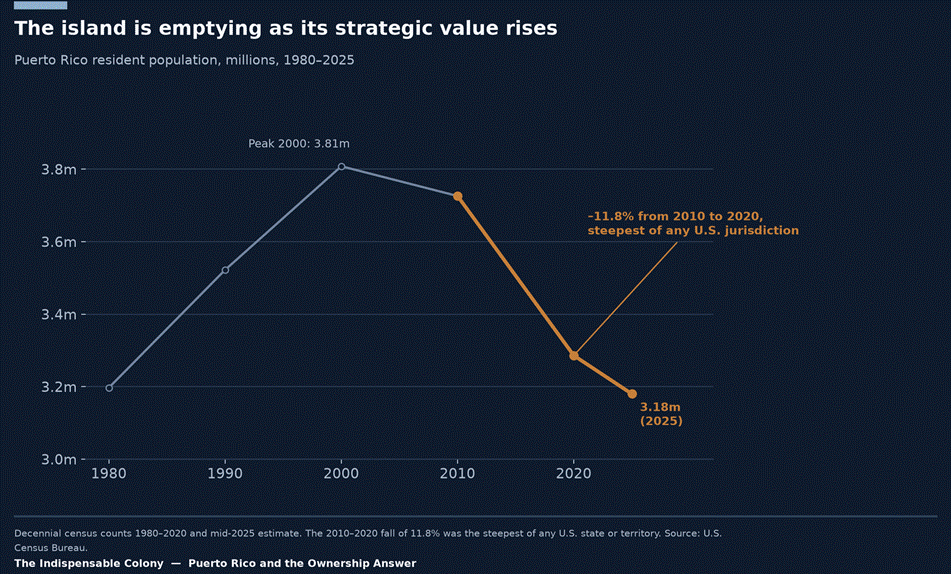
Nor does the island have political voice to compensate. Statehood has won all four twenty-first-century plebiscites, most recently 58.6 per cent in 2024, yet Congress has not acted³⁸. The result is a self-reinforcing spiral. The population fell 11.8 per cent between the 2010 and 2020 censuses, the steepest decline of any U.S. jurisdiction, and continued down to roughly 3.18 million by mid-2025³⁹,⁶⁵. Strategic capitalism requires a strategist: an entity with the autonomy to allocate patient capital, set the rules of its ecosystem, and capture rents on behalf of a people who own a share of the result. Puerto Rico has the ecosystem but not the strategist, and its people have the jobs but not the equity. Indispensability without agency, and without ownership, is not power. It is dependency dressed as importance.
That indictment can be sharpened. Current policy does not simply fail Puerto Rico. It degrades the United States’ own security position in its own hemisphere. At the very moment Washington is reactivating Roosevelt Roads and calling Camp Santiago the future “main training center in the Americas,” its policy framework is draining the human capital, hollowing the industrial base, and raising the cost structure of the platform it is trying to stand up. A depopulating, deindustrialising, blackout-prone Puerto Rico is a weaker forward base and a less credible bridge to the region.
The ownership Puerto Ricans have already built
The same island already contains the raw material for the cure. Beneath the multinational enclave, Puerto Rico has quietly built one of the deepest cultures of cooperative and community ownership anywhere under the U.S. flag. This is working practice, not utopian theory.
Start with finance. The island’s cooperativas de ahorro y crédito, member-owned credit unions, are not a fringe. By the end of 2025 there were 91 of them holding roughly $12.5 billion in assets, with over 1.16 million socios, member-owners who hold equity, receive dividends, and elect their boards, on an island of about 3.2 million people⁴⁰. When Maria knocked out the banks, the co-ops became “financial first responders,” reopening on average within about forty-eight hours⁴¹. Then look at energy, the very substrate that is failing. In Adjuntas the environmental group Casa Pueblo led the creation of Puerto Rico’s first community-owned solar microgrid, a roughly $2 million system that sells power to its own member-owners below the utility rate⁴². In January 2026 the Puerto Rico Energy Bureau cleared the island’s first electric cooperative to run an intermunicipal microgrid across four mountain towns⁴³.
Puerto Ricans do not need to be taught ownership; they practise it at scale in exactly the sector where the state has failed most completely. What is missing is a mechanism that connects this proven capacity to the island’s strategic industries, the pharma, energy, and compute value that currently flows entirely off-island. That mechanism does not yet exist. It should.
A United States–Puerto Rico Security Sovereign Defense Fund
The United States and Puerto Rico should jointly create a Security Sovereign Defense Fund: a national-security investment institution, co-capitalised by Washington and San Juan and governed at arm’s length from politics, that finances and part-owns the strategic ecosystem the island hosts and increasingly projects into the hemisphere, while holding that equity on behalf of every Puerto Rican and paying a citizen dividend. Its purpose is twofold and deliberately fused. Inward, it converts the island’s indispensability into an asset its own people own. Outward, it treats the island as a forward platform for U.S. engagement across Latin America, and finances the ecosystem that platform requires.
It is a defense fund, not merely a wealth fund, because its investments are national-security infrastructure in which Washington has a direct stake. The mandate should span the full strategic stack the island can host or project: pharmaceutical and advanced manufacturing; semiconductor and advanced-electronics capacity; energy generation, including the distributed solar-plus-storage and hydro the grid needs; the base infrastructure now being rebuilt at Roosevelt Roads, Fort Buchanan, and Camp Santiago; food-security capacity; light defense manufacturing and forward sustainment; and critical-minerals refining. A fund with this mandate is not a subsidy programme. It is the financing arm of a strategy.
The model is Alaska, disciplined by Norway. Alaska’s Permanent Fund is the proof of concept for treating residents as equity holders in resource wealth. Capitalised by a constitutionally locked share, at least 25 per cent, of state mineral royalties, it stood at roughly $85 to $91 billion in 2025–26 and has paid every resident an annual dividend, ranging from $1,000 in 2025 to $3,284 in 2022⁴⁴, ⁶⁶. Norway’s roughly $2.2 trillion oil fund supplies the discipline: deposit the revenue gross, invest it in a globally diversified portfolio, and spend only the expected real return, about 3 per cent a year, so the principal compounds forever⁴⁵. The cautionary twin is Alberta, whose Heritage Fund stagnated because contributions were discretionary and its income was raided for the budget⁴⁶. The design rule is unambiguous in the World Bank’s cross-country evidence: constitutional locks, an arm’s-length professional manager, and a hard spending rule. Without them, such funds get raided⁴⁷.
Puerto Rico has no oil royalty and cannot afford to tax its pharma anchors into leaving. The fund must therefore be capitalised through forward-looking, opt-in, non-tax mechanisms: a dedicated statutory slice of the royalty and withholding streams already flowing under Act 60; negotiated public-interest equity stakes in newly incentivised energy and data-centre build-outs, taken at the moment of maximum leverage when new capital seeks a new decree; federal seed capital as a co-equal anchor, because the fund’s investments are national-security infrastructure Washington is already paying to build; and a ring-fenced hemispheric investment window that co-invests alongside the Development Finance Corporation. The Center for a New Economy has proposed funding an Alaska-modelled development fund partly from the rum cover-over, the federal excise taxes on Puerto Rican rum returned to the island, a real, recurring, non-tax stream that could seed the fund without touching the cluster⁴⁸. The vehicle does not require independence, only political will and a disciplined design.
Ownership must also reach the shop floor. Local-content conditions on incentive decrees, modelled on Norway’s petroleum regime, which drove local content to roughly half of offshore value added⁴⁹; anchor-institution procurement, as in the UK’s Preston Model, which redirected more than £70 million into its local economy⁵⁰; and worker cooperatives, which the island already has the infrastructure to administer.
How big, and what would a citizen own?
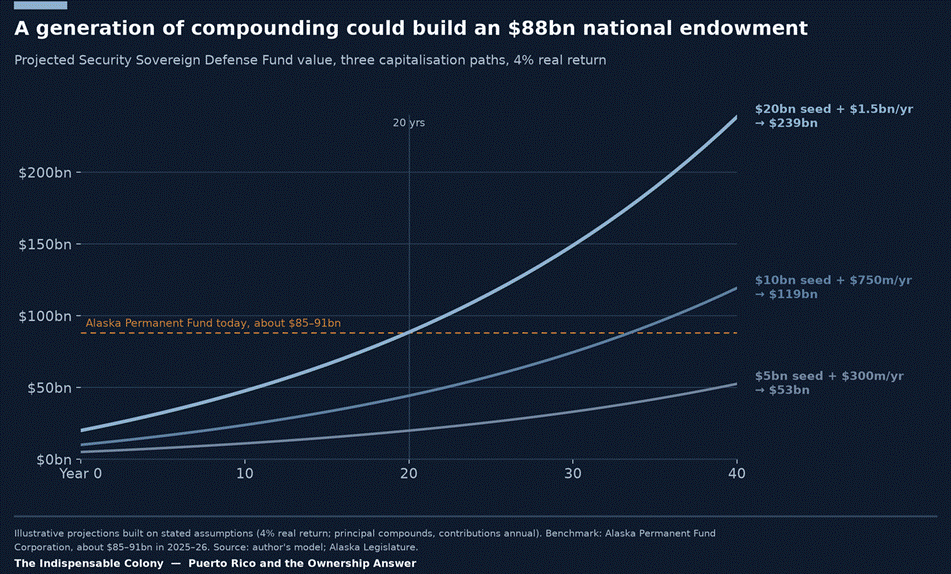
A proposal that puts no numbers on the table does not deserve to be taken seriously. What follows carries every assumption in the open, with one caveat throughout: these are illustrative projections, not forecasts. Take the Norwegian discipline as the engine, and grow the principal at a conservative 4 per cent real return. The fund’s size at maturity is then almost entirely a function of how much goes in and for how long. A $5 billion seed plus $300 million a year compounds to roughly $20 billion in 20 years and $53 billion in 40. A $10 billion seed plus $750 million a year reaches about $44 billion in 20 years and $119 billion in 40. A $20 billion seed plus $1.5 billion a year, plausible if a meaningful slice of the pharma, grid, base, and minerals spending Washington is already committing were routed through the fund as equity, reaches roughly $88 billion in 20 years and well over $200 billion in 40. For reference, Alaska reached roughly $85–91 billion over roughly 45 years from a standing start of $734,000 in 1977. A $20–90 billion Puerto Rican fund over a generation is not fantastical.
Now the number that matters to a person. Divide the fund across roughly 3.2 million residents. As a notional equity stake, the citizen’s share runs from about $6,250 per resident at a $20 billion fund to about $28,000 at $90 billion. As an annual dividend, at a Norway-style payout of 3 to 5 per cent of fund value, it runs from roughly $190–310 per resident at $20 billion, to $470–780 at $50 billion, to $840–1,400 at $90 billion. For a family of three at the middle-to-upper range, that is on the order of $1,400 to $4,200 a year.
A structural limit deserves plain statement, because the arithmetic forces it. Puerto Rico’s population is more than four times Alaska’s, so the same fund size buys a much smaller per-person dividend: Alaska’s fund works out to roughly $120,000 of assets per resident, against $6,000–28,000 in these scenarios. The per-capita dividend will not, on its own, be life-changing. That is why the dividend is the least important of the fund’s three functions. The dividend anchors population and makes ownership tangible. The compounding principal builds a permanent national endowment. The equity stakes give Puerto Ricans, and the federal co-investor, a returning position in the strategic industries the island hosts. Against a still-declining population, an annual, growing stake in the island’s future is a direct counterweight to the out-migration hollowing the very workforce the ecosystem depends on. Ownership is a retention strategy, a supplier-development strategy, and a workforce strategy at once.
Could Puerto Rico manufacture defense hardware?
If the fund is to finance a defense ecosystem, the fair question is whether the island can actually make anything for defense, or only host bases. It can, in a bounded way. Puerto Rico already hosts an aerospace-and-defense cluster of roughly 5,983 workers as of mid-2022, with sales around $625 million, up from about 700 employees a decade earlier⁵¹. Honeywell, Collins Aerospace, Pratt & Whitney, Lockheed Martin, and Raytheon/RTX units all appear in the island’s defense-sector profile, which operates in EAR/ITAR compliance. Layered on top is a deep, FDA-regulated precision base: the medical-device industry alone employs around 13,317 workers and exported roughly $6 billion in fiscal 2024⁵², and its precision-machining skills transfer directly to defense components.
The strategic opening is genuine. The Pentagon’s first-ever National Defense Industrial Strategy calls to diversify the supplier base and draw in “nontraditional suppliers”⁵³. The submarine industrial base is capacity-constrained, and shipbuilders are already outsourcing work to relieve physical limits⁵⁴. Puerto Rico’s decisive advantage is legal: as U.S. soil it automatically clears the “domestic source,” ITAR, and EAR hurdles that would block a foreign Caribbean site, while sitting inside the SOUTHCOM theatre².
The ceiling deserves stating as plainly as the opportunity. The plausible verticals are light and high-value: small-drone and counter-drone assembly, forward maintenance-repair-overhaul, defense electronics, and sub-tier components. The cautionary evidence sits in the drone case itself. Red Cat Holdings, which won a U.S. Army short-range-reconnaissance programme of record, was headquartered in Puerto Rico but built its drones in Salt Lake City and relocated its own headquarters off the island in May 2026⁵⁵, a warning that without cheaper power and a deeper workforce even Puerto Rico-based defense firms migrate. Heavy platforms are largely aspirational, blocked above all by the island’s electricity, which runs nearly 50 per cent above the U.S. average on a grid that fails twice a year⁵⁶. Defense manufacturing, like every other ecosystem here, waits on the grid.
Why the mainland comes out ahead
Every proposal that asks Washington to spend must answer what the mainland gets. Puerto Rico is inside the U.S. economy: its output is U.S. domestic production, and reshoring a pharmaceutical line or a magnet-processing plant to San Juan instead of Shenzhen is reshoring to America. The supply chain flows back to the mainland, since defense and advanced-manufacturing supply chains are mainland-heavy; a node in Puerto Rico buys its capital equipment, tooling, and engineering from firms in California, Texas, Connecticut, Ohio, and Arizona. It relieves mainland industrial-base bottlenecks rather than competing with them, adding ITAR-compliant capacity the mainland cannot build fast enough on its own⁵⁴. Forward production and MRO near SOUTHCOM save the Defense Department money on transport and readiness. The fund’s returns flow partly to the federal co-investor, reframing the seed capital as an investment with upside rather than a subsidy. And a stabilised Puerto Rico reduces mainland fiscal drag: the status quo of debt restructuring, disaster bailouts, and out-migration into mainland social systems is a recurring bill the fifty states already pay. The direct job numbers are modest against a fifty-state economy; the mainland case rests on strategic-dependency reduction, the supply-chain multiplier, and avoided fiscal cost. On every one of those channels the mainland is a net winner, not a donor.
Objections, and their mitigants
A proposal this ambitious should be judged against its strongest critics.
The fiscal board will not permit new spending.
The fund is capitalised from new federal strategic co-investment and a statutory slice of existing incentive revenue, not from general funds, and is structured as an equity investment with federal upside, not deficit spending. It would be certified alongside debt resolution⁵⁷.
It will be raided or captured, look at the pension collapse.
The island’s main pension system was funded to roughly 1.4 per cent of its obligation by 2017 after decades of skipped contributions⁵⁸. The answer is the Norway/Alaska design rule the World Bank validates: a constitutional-style lock, a hard spending rule, and an independent manager⁴⁷.
Pharma will flee if you tax it.
Capitalisation is non-tax, opt-in, and forward-looking: a sliver of existing royalty flows plus equity taken only on new incentivised build-outs. Existing Act 60 decrees are left untouched.
It is just a subsidy dressed up as a fund.
The federal stake earns returns, and the fund reduces recurring bailout and disaster costs. It is an investment with a balance-sheet return.
The per-person dividend is too small to matter.
True on its own. But the dividend is the least important function; the ownership stake, the compounding endowment, and the retention effect are the point.
A mandate this broad is an undisciplined slush fund.
The same arm’s-length board and strict investment mandate that prevent raiding also prevent mandate creep. A fund too narrow to matter would be the worse outcome.
None of this works without resolving status.
The fund can begin under the current territorial status; it requires only statutory authorisation and fiscal-board certification. Status resolution would strengthen it, but is not a precondition.
The hemispheric contest, and the ownership answer
The case for a defense fund, rather than a generic wealth fund, rests on something happening outside Puerto Rico’s shores. The hemisphere faces a convergent three-front challenge that runs through the waters Puerto Rico commands. Venezuela holds the world’s largest proved oil reserves, roughly 303 billion barrels, even as its collapse drives a hemisphere-wide migration and narcotics crisis⁵⁹. Cuba remains the long-standing anchor of an anti-U.S. narrative. And China’s presence in Latin America is now physical: its state-owned COSCO majority-owns the Chancay deep-water port in Peru, a roughly $1.3 billion project the Pentagon has flagged for its “dual-use potential”⁶⁰.
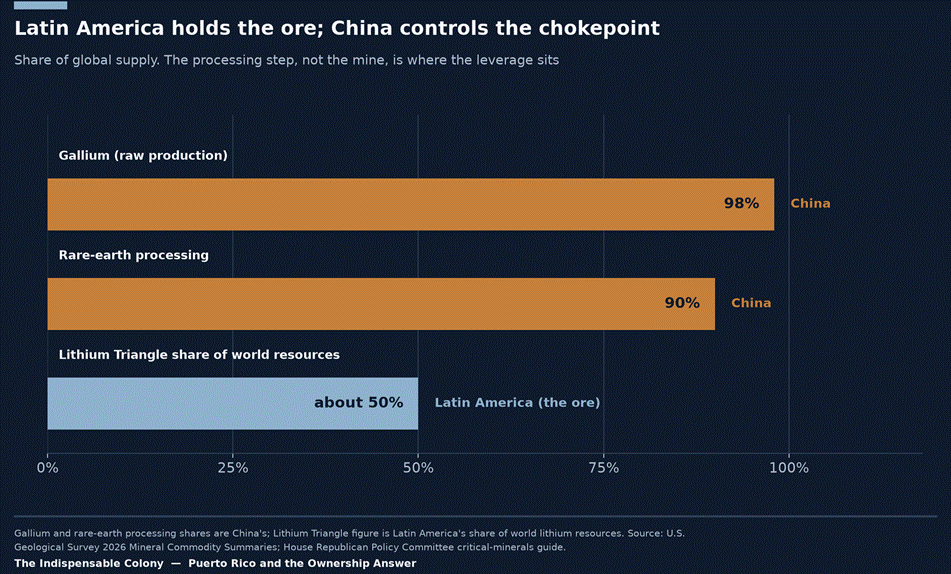
Here the inward and outward arguments fuse. Latin America holds an extraordinary share of the raw minerals the energy and defense transitions require: the Lithium Triangle holds close to half the world’s lithium resources⁶¹,⁶⁷, and Brazil accounts for around 93 per cent of global niobium production⁶². But raw ore is not the chokepoint. Processing is. China controls roughly 90 per cent of the world’s rare-earth processing and produces about 98 per cent of raw gallium⁶³. Whoever controls the refining step controls the supply chain, regardless of who digs the ore. The United States lacks a processing and logistics platform of its own inside the hemisphere and inside its own customs and legal territory⁶⁴. Puerto Rico is the obvious candidate: on U.S. soil, so refined output automatically clears domestic-source and ITAR requirements; with a chemical-processing workforce whose skills transfer directly to hydrometallurgical refining; with deep-water port infrastructure; and with bilingual institutions to manage offtake relationships across the region. The single most valuable thing the island could build is not another tax-driven pharma plant. It is the refining node that breaks a Chinese monopoly.
Every argument made so far can be met by a single counter-narrative, the one Havana and Caracas have run for sixty years: that U.S. engagement in Latin America is extraction dressed as partnership. It is a potent story precisely because it is not wholly false, and the current status of Puerto Rico is the best evidence that narrative has. The island is indispensable to U.S. supply chains, yet its people own none of the value they generate; it hosted the bombing range on Vieques for sixty years while its residents could not vote for the commander-in-chief who ordered the ordnance dropped. A Spanish-speaking observer in Bogotá or Santiago, asked what alignment with Washington delivers, can simply point at Puerto Rico. Material facts do not speak for themselves; they are given meaning by the stories told about them, and right now Puerto Rico’s story validates the adversary’s frame.
Local ownership is therefore the sharpest strategic instrument in the entire argument, not a domestic-equity footnote. Constructivist international-relations theory holds that alignment is built on shared meanings and identities rather than on coercion or material payoffs alone. A prosperous, self-owning Puerto Rico would rewrite the meaning the whole hemisphere reads off the U.S. relationship. It would convert the island from the exhibit for the prosecution into the exhibit for the defence. Where Cuba and Venezuela offer a narrative of grievance, a Puerto Rico whose citizens hold equity in their own strategic industries offers a demonstration of partnership, Spanish-speaking, culturally proximate, and visible across the region.
The ownership answer has a property the extraction narrative cannot match. It is falsifiable. The Cuban and Venezuelan story is a claim about intentions, endlessly re-assertable and impossible to disprove by argument. A dividend cheque landing in three million households, an equity stake that appreciates, a refining plant owned partly by the people who work in it: these are facts that either exist or do not. The strongest rebuttal to “the United States extracts” is a Puerto Rican family that can point to the ownership stake the United States helped them build. The scepticism this invites is fair, and demonstration effects are soft; no foreign ministry aligns with Washington because Puerto Ricans got a dividend. The fund stands on hard grounds alone, on supply-chain security, defense-industrial diversification, and mainland fiscal returns, entirely independent of any hemispheric signalling. But soft power compounds precisely where hard power reaches its limits. The United States can remove its single most damaging counter-example and replace it with a working model.
This began with a boundary case. Puerto Rico tests the theory of strategic capitalism at its edge, where an actor is indispensable to a great power’s supply chains and yet cannot convert that indispensability into prosperity, agency, or ownership. The lesson is the thesis defended throughout: structural position is not the same as structural power, and indispensability without ownership is not leverage but exposure.
The deeper point is that this is a choice, not a fate. The same island that today validates the story America’s rivals tell about it could, with the right institution, become the story America wants told: a Spanish-speaking, culturally proximate demonstration that the United States builds ownership rather than extracting it, sitting at the strategic centre of a hemisphere it is contesting with China. The instrument is not another tax incentive or another base. It is ownership: a fund that makes Puerto Ricans equity holders in the strategic value their territory generates, and in doing so makes the island a platform for American power that its own people, and the hemisphere watching, have reason to defend. Indispensability was never the achievement. Ownership is.
Notes
- 1FDA, Securing the Future. https://www.fda.gov/media/108975/download
- 2Reuters. https://www.reuters.com/graphics/USA-CARIBBEAN/MILITARY-BUILDUP/egpbbnzyrpq/
- 3Military.com. https://www.military.com/daily-news/investigations-and-features/2025/11/03/us-deploys-f-35-fighters-cold-war-era-puerto-rico-base-venezuela-tensions-escalate.html
- 4Citizens for Tax Justice. https://ctj.org/puerto-rico-and-section-936-a-taxing-lesson-from-history/
- 5NBER. https://www.nber.org/papers/w29107
- 6El Archivo de Borinquen. https://archivodeborinquen.org/en/territories/puerto-rico/events/section-936-repeal.html
- 7GAO. https://www.gao.gov/assets/ggd-97-101.pdf
- 8St. Croix Times. https://www.stcroixtimes.com/post/a-taxing-lesson-did-the-end-of-section-936-break-puertorico
- 9Tax Foundation. https://taxfoundation.org/blog/tax-policy-helped-create-puerto-rico-fiscal-crisis/
- 10DDEC Pharmaceutical Profile 2025. https://docs.pr.gov/files/DDEC/DEDC PUERTO RICO DATA CENTER/Puerto Rico Industry Profiles/Puerto Rico’s Pharmaceutical Profile 2025.pdf
- 11Mayer Brown. https://www.mayerbrown.com/en/insights/publications/2026/04/trump-administration-implements-tariffs-on-imported-patented-medication-and-pharmaceutical-ingredients-under-section-232-of-the-trade-expansion-act-of-1962
- 12White House Proclamation. https://www.whitehouse.gov/presidential-actions/2026/04/adjusting-imports-of-pharmaceuticals-and-pharmaceutical-ingredients-into-the-united-states/
- 13Amgen. https://www.amgen.com/newsroom/press-releases/2025/09/amgen-announces-650m-expansion-of-us-manufacturing-creating-hundreds-of-new-jobs
- 14Reuters. https://www.reuters.com/sustainability/boards-policy-regulation/eli-lilly-invest-12-billion-puerto-rico-part-us-manufacturing-push-2025-10-29/
- 15IRS. https://www.irs.gov/pub/irs-pgld/introduction-to-puerto-rico-acts-20-and-22.pdf
- 16GAO. https://bvirtualogp.pr.gov/ogp/Bvirtual/reogGubernamental/PDF/Informes y Estudios/gao-26-107225.pdf
- 17Rep. Velázquez et al.. https://velazquez.house.gov/sites/evo-subsites/velazquez.house.gov/files/evo-media-document/final-fy26-rl-request-tax-avoidance-in-pr-5.16.25.pdf
- 18U.S. Army Corps of Engineers. https://www.usace.army.mil/Media/Fact-Sheets/Fact-Sheets-View/Article/4463352/154-the-longest-blackout-in-us-history-hurricane-maria/
- 19CNN. https://www.cnn.com/2024/12/31/us/puerto-rico-power-outage
- 20NPR. https://www.npr.org/2025/04/17/g-s1-60823/power-blackout-hits-all-of-puerto-rico-as-residents-prepare-for-easter-weekend
- 21AEI. https://www.aei.org/economics/the-jones-act-is-a-lose-lose-for-puerto-rico-and-us-lng/
- 22Marketplace. https://www.marketplace.org/story/2024/01/10/puerto-rico-looks-to-go-local-to-reduce-food-import-dependence
- 23USDA Economic Research Service. https://www.ers.usda.gov/media/7657/ap-114-report-summary.pdf?v=55011
- 24Puerto Rico Report. https://puertoricoreport.com/a-page-from-history-operation-bootstrap/
- 25The New York Times. https://www.nytimes.com/2017/09/24/us/puerto-rico-hurricane-maria-agriculture-.html
- 26Council of State Governments. https://csg-erc.org/puerto-ricos-agriculture-sector-devastated-by-hurricane-maria/
- 27U.S. State Department, Mahan. https://history.state.gov/milestones/1866-1898/mahan
- 28U.S. Navy BRAC Program Management Office. https://www.bracpmo.navy.mil/BRAC-Bases/Southeast/Former-Naval-Station-Roosevelt-Roads/
- 29U.S. Army. https://home.army.mil/buchanan/about/history
- 30U.S. Federal Register. https://www.govinfo.gov/content/pkg/FR-1998-02-17/html/98-3903.htm
- 31Congress.gov, H.R.1726. https://www.congress.gov/bill/113th-congress/house-bill/1726/text/enr
- 32U.S. Department of Defense. https://www.war.gov/news/news-stories/article/article/974518/puerto-ricans-represented-throughout-us-military-history/
- 33USA Today. https://www.usatoday.com/story/news/health/2023/06/12/vieques-puerto-rico-navy-bombing-cancer-rates/70227463007/
- 34U.S. Commission on Civil Rights. https://www.usccr.gov/files/2026-05/eng-puerto-rico-report-brief.pdf
- 35Los Angeles Times. https://www.latimes.com/archives/la-xpm-2004-apr-01-na-roads1-story.html
- 36Cato Institute. https://www.cato.org/blog/new-paper-examines-jones-acts-cost-puerto-rico
- 37CRS. https://www.everycrsreport.com/reports/LSB10555.html
- 38Puerto Rico Report. https://puertoricoreport.com/certified-results-of-puerto-ricos-2024-plebiscite/
- 39U.S. Census. https://www.census.gov/library/stories/state-by-state/puerto-rico.html
- 40AAFAF/COSSEC. https://www.aafaf.pr.gov/aafafinthenews/depositos-y-acciones-en-cooperativas-superan-los-11-100-millones
- 41Inclusiv. https://inclusiv.org/sites/default/files/wp-content/Inclusiv-Puerto-Rico-CDFI.pdf
- 42Nextcity. https://nextcity.org/features/grassroots-movement-puerto-ricos-first-community-owned-solar-microgrid
- 43Co-operative News. https://www.thenews.coop/puerto-ricos-first-electric-co-op-cleared-to-run-its-microgrids/
- 44Alaska Legislature. https://www.akleg.gov/basis/get_documents.asp?docid=10126
- 45IMF. https://www.imf.org/-/media/files/publications/cr/2025/english/1norea2025002-source-pdf.pdf
- 46Canadian Centre for Policy Alternatives. https://www.policyalternatives.ca/news-research/alberta-squandered-the-heritage-fund-but-its-not-too-late-to-fix-it/
- 47World Bank. https://thedocs.worldbank.org/en/doc/661f109500bf58fa36a4a46eeace6786-0050012024/related/GEP-Jan-2024-Box4-2.pdf
- 48CNE. https://grupocne.org/author/sergiomarxuach/
- 49IISD. https://www.iisd.org/sites/default/files/publications/case-study-norway-horizontal-linkages.pdf
- 50CLES. https://cles.org.uk/the-preston-model/
- 51Puerto Rico Aerospace & Defense Report 2023. https://docs.pr.gov/files/DDEC/Aeroespacial/PUERTO RICO AEROSPACE AND DEFENSE REPORT 2023.pdf
- 52Puerto Rico Medical Devices Profile 2025. https://docs.pr.gov/files/DDEC/DEDC PUERTO RICO DATA CENTER/Puerto Rico Industry Profiles/Puerto Rico’s Medical Devices Profile 2025.pdf
- 53Congressional Research Service. https://www.congress.gov/crs_external_products/IN/PDF/IN12310/IN12310.1.pdf
- 54GAO. https://files.gao.gov/reports/GAO-25-106286/index.html
- 55Unmanned Systems Technology. https://www.unmannedsystemstechnology.com/company/red-cat-holdings/
- 56FindEnergy. https://findenergy.com/pr/
- 57CRS. https://www.congress.gov/crs_external_products/R/PDF/R46788/R46788.5.pdf
- 58Reason Foundation. https://reason.org/commentary/the-cautionary-tale-of-puerto-ricos-pensions/
- 59U.S. Energy Information Administration. https://www.eia.gov/international/content/analysis/countries_long/Venezuela/venezuela_exe.pdf
- 60American Foreign Policy Council. https://www.afpc.org/publications/articles/chinas-concrete-empire-in-south-america
- 61U.S. Geological Survey. https://pubs.usgs.gov/periodicals/mcs2026/mcs2026-lithium.pdf
- 62U.S. Geological Survey. https://pubs.usgs.gov/periodicals/mcs2026/mcs2026-niobium.pdf
- 63House Republican Policy Committee. https://republicanpolicy.house.gov/sites/evo-subsites/republicanpolicy.house.gov/files/evo-media-document/criticial-minerals-in-lac-guide-v2.pdf
- 64CSIS. https://www.csis.org/analysis/de-risking-critical-mineral-supply-chains-role-latin-america
- 65CentroPR, Hunter College. https://centropr.hunter.cuny.edu/reports/puerto-ricos-2020-population-decennial-analysis/
- 66Alaska Permanent Fund Dividend Division. https://pfd.alaska.gov/Division-Info/summary-of-dividend-applications-payments
- 67AIB Insights. https://insights.aib.world/article/146203-geopolitics-host-country-policy-and-critical-mineral-investment-in-latin-america
Sources are numbered in the notes above. The fund-size and per-person figures are illustrative projections built on stated assumptions (4 per cent real return; 3–5 per cent payout; approximately 3.2 million residents) and benchmarked to the Alaska Permanent Fund Corporation, Norway’s petroleum authorities and the IMF, and the World Bank. Pharma, energy, food, and fiscal figures draw on the FDA, USDA Economic Research Service, GAO, CRS, the Financial Oversight and Management Board, and the U.S. Census Bureau. The security-asset history draws on the U.S. State Department Office of the Historian, the U.S. Navy BRAC office, the CRS, Congress.gov statute text, the U.S. Army, the U.S. Commission on Civil Rights, and reporting from Reuters, the Los Angeles Times, Military.com, and USA Today. Defense-manufacturing figures draw on Puerto Rico’s DDEC profiles, the CRS, GAO, and defense-trade reporting. Hemispheric and minerals figures draw on the USGS 2026 Mineral Commodity Summaries, CSIS, the House Republican Policy Committee critical-minerals guide, the EIA, and the American Foreign Policy Council. The constructivist argument is advanced as interpretation built on those sourced facts.