The proposition
Israel is the reference case because it solved the exact problem Puerto Rico has: a small domestic market, few natural resources, a security predicament that demanded a technology base, and no private venture industry to build one. In 1993 the Israeli government created a programme called Yozma, Hebrew for initiative, and put roughly one hundred million dollars into it. About twenty million seeded a government fund directly. The other eighty million was used to match foreign and domestic investors, at around forty per cent, so that ten private venture funds were created rather than one state one¹. The government took equity but wrote in a buy-back clause: the private managers could purchase the state’s stake within five years, and most did. Yozma privatised in 1997. The industry it triggered did not.
The design choice that matters is the one most governments get wrong. Yozma did not try to be a permanent state investor picking winners. It used public money to de-risk private money, then removed itself. The Israel Innovation Authority relaunched the model as Yozma 2.0 in 2024, with about one hundred and fifty-five million dollars of government funds aiming to draw seven hundred million from private institutional investors at a thirty per cent match¹. The Organisation for Economic Co-operation and Development, reviewing the original programme, concluded that Israel’s venture industry was built through government funding that leveraged foreign financing, primarily American, accompanied by equity guarantees and, from 2002, a permanent capital-gains exemption for foreign venture investors². This was not a market process that the state happened to bless. It was a directed policy that manufactured a market and then let it go³.
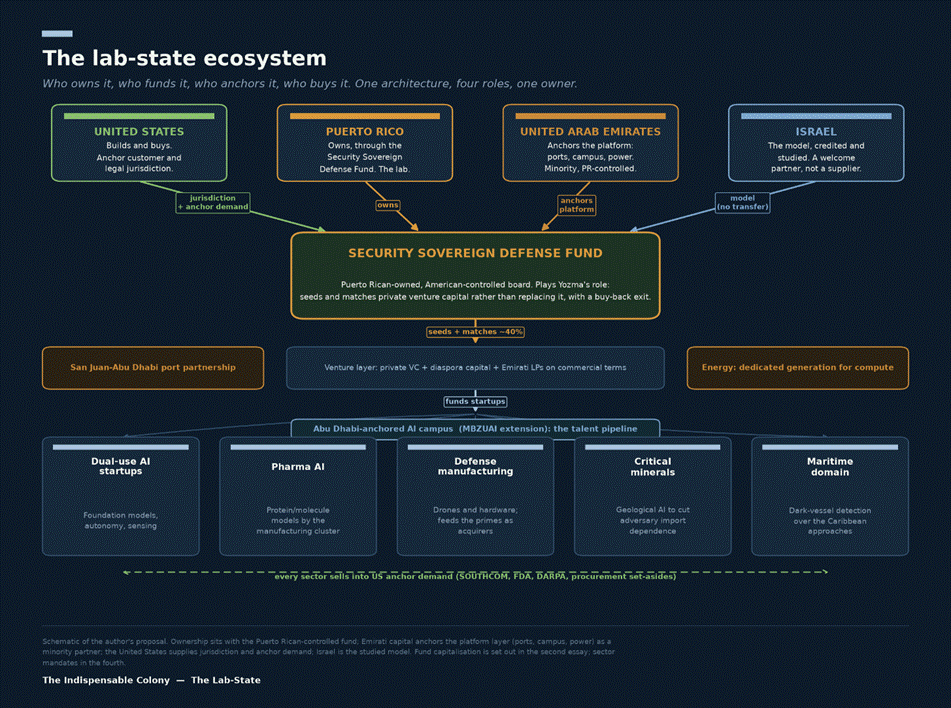
The proposition of this essay is that the Security Sovereign Defense Fund should play Yozma’s role for Puerto Rico. It should seed private venture funds rather than become one, match private and allied capital rather than replace it, and hold its stakes as an owner accountable to Puerto Ricans rather than as a ward of the Pentagon budget. The companies it backs would build security and dual-use technology, and their anchor customer would be the United States government. The point is worth stating carefully, because it is easy to misread. This is not a proposal to import Israeli technology or to lean on Israeli firms to do American work. It is a proposal for the United States to build its own version of a model an ally proved, so that the primary guarantor of Western security is itself a harder target and a faster builder. Learning from Israel here is a form of respect, and a stronger America is, in the end, Israel’s deepest strategic interest. The rest of this essay defends each half of the proposition, beginning with the objection that ought to occur first: if this model is so good, why does it not exist on the mainland already.
Why the mainland cannot build this
The United States has more venture capital, more elite engineers, and more defence spending than any country in history, and it has still never produced an Israeli-style ecosystem, a place where security demand, technical talent, and risk capital sit close enough together to compound. The reasons are structural, and they are worth stating because they are exactly the reasons Puerto Rico is different.
The mainland market is too large to concentrate. Israel’s ecosystem works partly because everyone is within an hour of everyone else and the state is the obvious first customer. American innovation is dispersed across a dozen hubs with different tax regimes, different politics, and no single instrument a policymaker can pull. Federalism compounds the dispersion: there is no national industrial-policy lever that reaches a firm in Austin and a firm in Boston on the same terms, because the tax and incentive architecture is split between Washington and fifty states. Civil-military relations add a cultural brake. The idea that the state should seed private companies and then buy their output runs against a deep American preference for keeping the two apart, a preference Silicon Valley spent two decades enforcing before the last few years began to erode it. And the sheer scale of the American economy means that no plausible public fund is large enough to move the needle nationally. A hundred million dollars built Israel’s venture industry. A hundred million dollars is a rounding error against American venture flows.
None of these obstacles is fatal in principle. Each is fatal in combination, at continental scale. Shrink the jurisdiction and they weaken one by one. That is the case for doing this on an island.
Why Puerto Rico structurally can
Puerto Rico is small enough to concentrate, has its own tax code, and already runs the kind of aggressive incentive regime that the mainland cannot. The island is a single jurisdiction the size of a mid-sized American city’s metro area, where a campus, a port, and a cluster of firms could sit within an hour of one another in the way Tel Aviv’s do. It is inside the United States for security and customs purposes and outside it for income tax, a combination no state can replicate.
The tax architecture is the part most often misdescribed, so it is worth being precise about what currently exists. Under Section 933 of the Internal Revenue Code, a bona fide resident of Puerto Rico pays no federal income tax on Puerto Rico-source income. Act 60, the 2019 consolidation of the island’s incentive laws, adds a local layer: its resident-investor chapter, the former Act 22, drops Puerto Rico tax on qualifying passive income, including post-relocation capital gains, to zero⁴. For a US citizen, the two together can mean an effective rate near zero on Puerto Rico-source capital gains, dividends and interest, a structure with no mainland equivalent⁵.
That regime is now changing, and the change is the argument for this essay rather than against it. In March 2026 Governor Jenniffer González-Colón signed Act 38-2026, which extends the resident-investor programme to 2055 but, for the first time, introduces a four per cent tax on certain investment income for applicants who arrive from January 2027 onward. Existing decree-holders keep their terms⁶. The four per cent crack matters because it signals that the pure tax-haven model is under political strain. That model, the one built around Act 22, largely imported wealthy individuals who realised capital gains on the island and built very little durable local industry, generating displacement and resentment rather than an ecosystem. A sceptic is right to say that Puerto Rico’s incentive history is a warning. The response is that the incentive regime is live, valuable, and now being repriced, which is precisely the moment to point it at something productive that Puerto Ricans own, rather than at passive wealth migration that they resent.
The idea of turning Puerto Rico into a startup nation on the Israeli template is not new, and its failure so far is the most useful evidence this essay has. The development-economics literature has urged the comparison for years: a 2018 World Economic Forum analysis explicitly told the island to copy Israel, Chile and Colombia, matching private venture money and converting brain drain into the diaspora “brain circulation” that Senor and Singer described in Startup Nation⁷. The island acted on some of it. It stood up an accelerator, Parallel 18, and layered incentive on incentive. What it did not produce was an ecosystem.
That failure is not peculiar to Puerto Rico. The Israeli model has resisted copying almost everywhere it has been tried, and understanding why is the key to grafting it successfully. Governments from Europe to the Gulf have funded Yozma-style matching programmes and built accelerators, and most have produced a layer of subsidised funds without the compounding density that makes Tel Aviv work. Three things travel badly. The first is the demand-pull. Israel’s ecosystem was pulled into existence by a defence customer whose need was existential, urgent, and willing to buy from a two-year-old company, and a matching fund cannot manufacture that appetite where the state is a reluctant or bureaucratic buyer. The second is the talent engine. Unit 8200 and its sister formations hand the economy a security-cleared technical elite every year, pre-selected and pre-networked, and no scholarship scheme reproduces the density or the trust that shared conscription creates. The third is culture and scale, the informal networks and risk tolerance that come from a small country where the army, the universities and the funds are effectively one social graph. Copies fail when they import the instrument, the matching fund, without the two forces that gave the instrument something to work on. Chile’s CORFO came closest precisely because it paired the matching money with an aggressive effort to import founders and build deal flow, and even it did not produce a defence-technology base, because it never had the customer.
This is the diagnosis that makes Puerto Rico interesting rather than doomed. The prior island proposals failed for the general reason and a local one: they treated Puerto Rico as a development problem, to be solved by attracting capital and training founders, and they lacked the two ingredients that the Israeli model needs and rarely finds abroad. A demand-pull urgent enough to de-risk the first sale, and a structure that makes the value accrue to the place rather than leak away. This essay’s claim is not that the startup-nation idea is original. It is that the idea has been tried, at home and abroad, without a customer and without ownership, and that American security procurement supplies the first while the Security Sovereign Defense Fund supplies the second. The campus, argued in the previous essay, is the nearest institutional substitute available for the talent engine that cannot be conscripted.
There is a further reason to build now rather than later, and it is worth stating in the language of the analysts who study how these competitions unfold. Jared Jaeger’s work on frontier-technology competition offers two useful lenses. The first, his IET analytic model, treats strategic technology not as a set of sectors but as four layers, the decisions states make, the firms that execute, the material dependencies underneath, and the geopolitical environment around them, and argues that the dependency layer, the compute, energy, minerals and manufacturing base, is the one conventional analysis ignores until it is under strain, which is exactly when it is too late to fix.⁸ The Security Sovereign Defense Fund is, in that vocabulary, a dependency-layer instrument: it does not bet on a single product but takes a position in the substrate, the energy, the minerals, the fabrication-adjacent capacity, on which every sector above it draws. That is the layer Jaeger says rewards early attention most and receives it least.
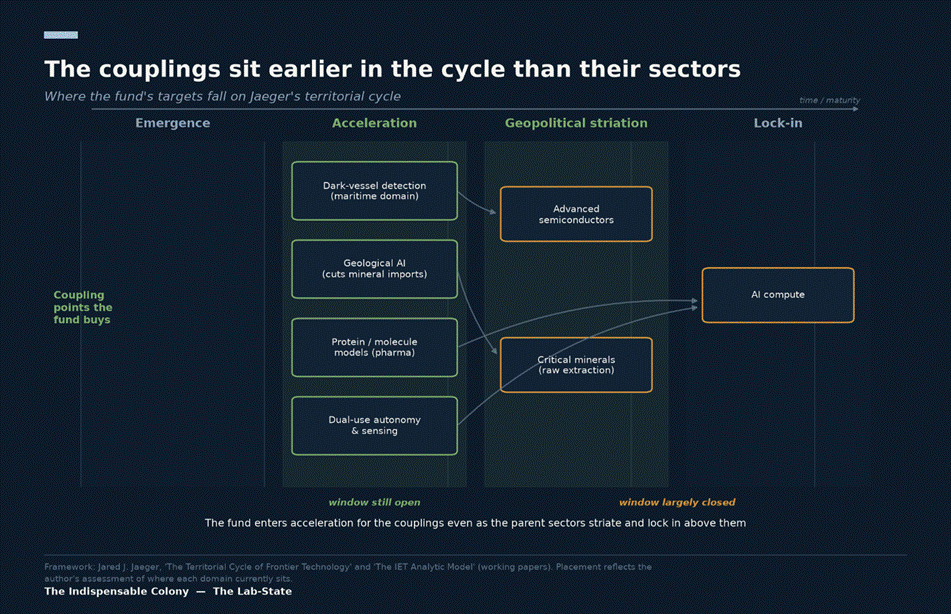
The second lens, which he calls the territorial cycle of frontier technology, is a phase model. Jaeger argues that strategic technologies move through emergence, acceleration, geopolitical striation, and lock-in, and that the window of greatest leverage sits at the transition from acceleration to striation, before positions harden but after their significance becomes legible.⁹ Interventions made after that window closes are both more expensive and less effective, because the geography and ownership of capability have already set. The model carries a sharper corollary that speaks directly to this series. State-directed systems complete striation earlier than market-gated ones, because a market economy must clear two thresholds, commercial viability and then strategic recognition, before the state commits capital, whereas a state-directed rival commits from the start. China’s Made in China 2025 preceded the comparable American commitment by the better part of a decade for exactly this reason. The fund is a deliberate answer to that asymmetry: a standing, state-adjacent capital vehicle that lets a market economy commit at something closer to a state-directed tempo, without waiting for the market to prove the case first.
The asymmetry argument invites an objection worth meeting directly, because it appears to catch the fund in a contradiction. If the fund’s advantage is that it commits at a state-directed tempo, ahead of commercial proof, then the discipline this series insists on, a minority stake, a matching ratio, private managers, a buy-back exit, looks self-defeating: a fund gated by private commitments is, by definition, waiting for the market signal it claimed to front-run. The tension is real but the design dissolves it. State-directed tempo is a property of the first commitment, not of every commitment. The fund’s own capital, drawn from the streams the second essay set out rather than from private fundraising, is what moves first and early, into the substrate, on the strategic logic that does not wait for a commercial case. The matching ratio and the private managers govern the venture layer that sits on top of that substrate, where commercial discipline is a feature rather than a delay. The fund commits at a state tempo underneath and lets the market gate the layer above it. It buys the timing advantage where timing is decisive and keeps the discipline where discipline is decisive.
A reader who accepts the phase model might raise a second objection: the sectors this fund targets, advanced chips, AI compute, critical minerals, are already striating or locking in, so the leverage window has closed. The objection mistakes the level at which the fund operates. The parent sectors have indeed striated. But the coupling points the fund actually buys sit earlier in their own cycles: dark-vessel detection in the maritime domain, geological AI that cuts import dependence in critical minerals, protein and molecule models in pharmaceutical manufacturing. These are in acceleration, not lock-in. The fund enters the acceleration phase for the couplings even as the substrate sectors striate above them, which is precisely where the phase model says the leverage still lives.
The fund as Yozma, not as a state investor
The Security Sovereign Defense Fund was introduced in the second essay of this series as a vehicle to take equity in the industries Puerto Rico hosts, and that essay set out how it is capitalised: a statutory slice of the royalty and withholding streams already flowing under Act 60, public-interest equity taken on newly incentivised build-outs, federal seed capital as a co-equal anchor, the rum cover-over, and a hemispheric co-investment window, all disciplined by the Alaska and Norway rules of a hard lock, an independent manager and a spending cap. That capitalisation is assumed here rather than re-argued. Here the fund takes on a second function: deploying a portion of that capital to seed the venture layer above those industries, on the Yozma template.
The mechanics would run as follows. The fund allocates a defined tranche of its balance sheet into a small number of private venture funds domiciled on the island. It does not invest alone; it matches private commitments on a fixed ratio, in the way Yozma matched investors at forty per cent, so that a dollar of the fund’s capital pulls in several dollars of private money. The matched money comes first from the Act 60 capital already resident on the island and from mainland venture firms following the anchor buyer; allied co-investors, Emirati or Israeli, are welcome as limited partners on the same commercial terms but are not what the model depends on. The point of the earlier essays’ San Juan–Abu Dhabi spine is that Emirati capital builds the platform, the campus and the infrastructure beneath it, rather than sitting on the cap tables of companies that sell to the Pentagon. The funds are managed privately, invest in security and dual-use companies, and co-invest alongside the federal small-business research programmes, the Small Business Innovation Research and Small Business Technology Transfer awards, that already channel Pentagon and agency money into early-stage firms. The residency requirement has to be drawn with care, because the crude version of it fails. The fourth essay’s own cautionary case, Red Cat, was headquartered on the island, built its drones in Utah, and then moved its headquarters to Utah too; a covenant that demands all activity stay on-island drives companies out and cannot be met on the present grid in any case. The workable version anchors what compounds locally and lets the rest distribute. The headquarters, the intellectual property, the cleared work, and the equity stay in Puerto Rico, enforced by claw-back tied to the incentive decree, so that a company that strips the substance out forfeits the tax treatment and the fund’s preferential terms. The manufacturing, the supply chain, and the scaled headcount are free to spread across the mainland, which is not a leak but the mechanism by which the island’s success becomes a jobs story in states that have no Puerto Rican voters, exactly the mainland-return logic the second essay set out. Crucially, the fund writes in Yozma’s buy-back clause. Private managers can retire the public stake over a defined period, so the state’s role is to start the ecosystem and then shrink inside it, not to own it forever.
The matching mechanism is neither exotic nor untested, which matters for anyone who suspects it could never be legislated. Chile built its venture industry on almost exactly this design: its economic-development agency, CORFO, matches every dollar invested in a startup with two or three more, structured as low-interest loans to venture firms that are repaid on a successful exit, and the policy lifted Chilean venture flows into the hundreds of millions annually⁷. Puerto Rico already has the statutory scaffolding for the same idea. Its Capital Investment Funds Act of 1999 authorises private venture funds that invest restricted-use capital in scientific, technical and export-oriented ventures, directs priority to firms creating local jobs and transferring knowledge, and writes in the diversification and passivity limits, no more than a fifth of a fund’s capital in a single venture, no controlling stakes, that keep such vehicles disciplined¹⁰. The Yozma template does not require Puerto Rico to invent an instrument. It requires the island to point an instrument it already has at a purpose it has never had.
Two features distinguish this from a conventional government fund and answer the two objections that sink most of them. The first is ownership. Because the Security Sovereign Defense Fund is the controlling American equity holder and Puerto Ricans hold the stake, the returns compound on the island rather than leaking to migrant capital or to a foreign partner. That is the answer to the Act 22 warning, and it is the same ownership logic that runs through the whole series: a deal Puerto Ricans own is a deal Puerto Ricans defend. The second is governance. A fund that blends federal money, Gulf capital, and a security mandate is a natural target for capture. The mitigation is a board that combines Puerto Rican institutions, US defence representatives, and independent technical members, with the buy-back clause acting as a built-in exit that limits how long any party can entrench. The fund sits deliberately between industrial policy and private capital, and its design is what keeps it from collapsing into either.
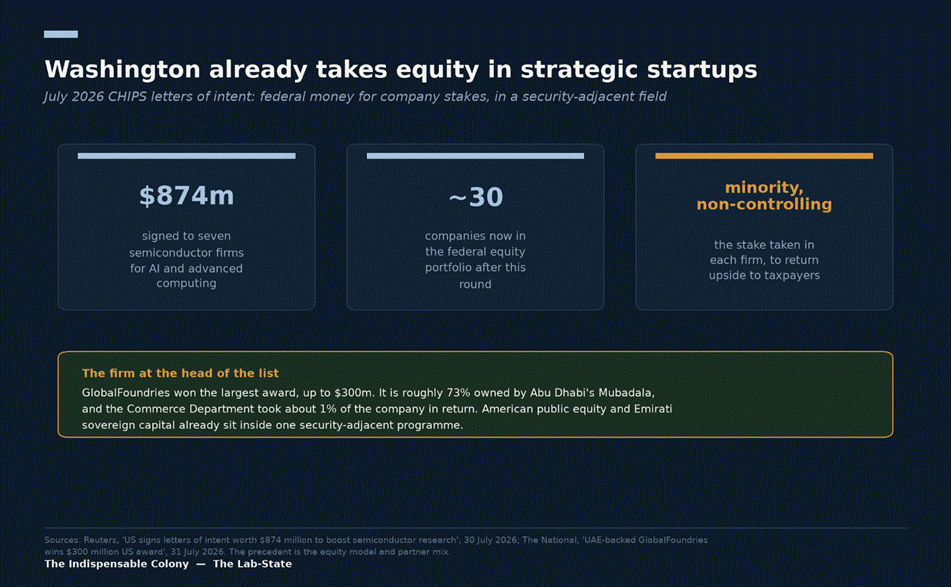
The objection that a public vehicle taking equity in strategic startups is exotic no longer holds, because Washington now does it as a matter of routine. In late July 2026 the Commerce Department signed letters of intent to put roughly 874 million dollars into seven semiconductor companies developing chips for artificial intelligence, taking in each case a minority, non-controlling equity stake meant to return upside to taxpayers if the technology succeeds¹¹. That brought the federal government’s equity portfolio to some thirty companies. What is striking for this proposal is who sat at the head of the list: the largest award, up to 300 million dollars, went to GlobalFoundries, a firm roughly seventy-three per cent owned by Abu Dhabi’s Mubadala, with the Commerce Department taking about one per cent of the company in return¹². The pairing this essay proposes, an American public equity holder and Emirati sovereign capital inside a single security-adjacent semiconductor programme, is therefore not a hypothetical to be litigated but an arrangement that already clears in Washington today. The precedent is the equity model and the partner mix, not the funding line, which is closing as the CHIPS appropriations lapse; the fund’s own capital comes from the mechanism set out in the second essay.
American build, Emirati capital, Israeli model
The division of labour is cleaner than a three-way partnership, and the essay should be exact about it. The United States builds and buys. Puerto Rico owns, through the fund. The startup ecosystem is seeded and matched by the American and Puerto Rican-owned Security Sovereign Defense Fund, which plays Yozma’s role: it de-risks and matches private capital rather than being replaced by it, and its stakes stay under American and Puerto Rican control. The fund funds the startups. Abu Dhabi’s role is the platform beneath them, continuous with the San Juan–Abu Dhabi spine of the previous essay: it finances and anchors the satellite university campus and the physical infrastructure, the layer where sovereign, patient, infrastructure-scale capital has a genuine comparative advantage and where the United States would rather not appropriate and Puerto Rico cannot raise. Emirati money is welcome in the venture layer too, as an ordinary limited partner on commercial terms, but the startups do not depend on it. Israel is the model, credited and studied, and a welcome collaborator, but not a load-bearing supplier of technology or talent. Keeping the Israeli role at model-and-welcome-partner rather than active-partner is not coolness towards Israel. An American security base that depended on foreign transfer would be neither sovereign nor something an ally should be asked to provide. The strength of the design is that it stands on American demand and American-built talent, funded by an American and Puerto Rican-owned vehicle, and improves every alliance it touches by making the United States a more capable partner.
The collaborative plumbing already exists, and Israeli and Emirati investors would be natural participants in the venture layer on ordinary commercial terms. Since the Abraham Accords were signed in Washington in September 2020, Israel and the UAE have stood up a dense layer of joint capital vehicles: a UAE ten-billion-dollar fund to invest in strategic sectors in Israel¹³, the Abraham Fund itself, a US-Israel-UAE vehicle intended to mobilise more than three billion dollars of private-sector investment¹⁴, a joint Israeli-Emirati high-technology research-and-development fund approved by the Israeli cabinet in 2022¹⁵, and cooperation agreements between the Abu Dhabi Investment Office and both Invest in Israel and the Israel Innovation Authority¹⁶. Five years on, Startup Nation Central’s own assessment is that the UAE has become the primary Gulf gateway for Israeli technology, with integration that is measured and durable rather than explosive, and with a fifth of regional investors accounting for more than half of all recorded funding rounds¹⁷. The sectors that draw this capital, cybersecurity, artificial-intelligence infrastructure, mobility and port optimisation, are the same dual-use fields a Puerto Rican security ecosystem would occupy¹⁸. The Accords make Gulf-plus-innovation capital a proven, structurable form. Puerto Rico would channel that proven form towards an American security purpose, with Emirati capital anchoring the platform, the fund as the anchor investor in the startups, and the United States as the anchor buyer.
Declining to make Israel a load-bearing partner carries an honest cost, and the essay should own it. Israel would have supplied the fastest cold-start: ready deal flow, experienced founders, a diaspora of operators. Building the American version instead means igniting the ecosystem from a colder start, with thinner initial deal flow, which is precisely why the two ingredients the United States does control, the anchor buyer and the campus pipeline, have to carry more weight than they would in a straight import. The next two sections are about making each of them real.
Talent without conscription
The hardest thing to reproduce about Israel is not its capital. It is Unit 8200, the conscript signals-intelligence corps that functions, in effect, as the country’s most selective engineering school and its densest founder network. It is a genuine institutional achievement, one that most countries could not build even if they wished to, and it is the engine beneath the ecosystem the rest of this essay admires. It also rests on universal conscription, which the United States does not have and Puerto Rico will not adopt. Reproducing the model therefore means reproducing what 8200 produces, a stream of cleared, elite technical talent bound into a founder network, by other means. The essay is worse for pretending that substitution is easy, and it does not.
The substitute has to be institutional rather than martial, and the institution already exists in the series: the satellite campus of Abu Dhabi’s AI university, proposed in the previous essay to secure the drug supply, watch the sea lanes, and read the ground for minerals. Abu Dhabi finances and anchors the campus; the pipeline it produces is American and Puerto Rican. This is where the Emirati partnership earns its place in the talent story, not as a source of engineers but as the funder of the school that trains them. The campus is the talent factory that stands in for 8200. It gives graduates a reason to stay on an island that has watched two decades of its strongest students leave for the mainland, and a magnet to pull some of the diaspora back. Around it sit the University of Puerto Rico and the Puerto Rico Science, Technology and Research Trust, which can run the scholarship and matching-fund programmes that feed the pipeline. The martial element that cannot be conscripted can be partly recruited: highly selective civilian defence cohorts that combine technical training with rotational placements in federal and defence agencies and a funded pathway into the venture layer. This is a graft, not a transplant, and it is unproven. What makes it credible rather than aspirational is that it is anchored in a real campus with a real mandate and a real owner, not in a policy sketch.
The arrangement also has to make sense from Abu Dhabi’s chair, and the campus is what pays the UAE in the currency it values most. It is an Emirati flagship, a sovereign, named institution educating the talent for an American security ecosystem, which is a prestige project of the kind the UAE has consistently preferred to passive minority stakes. It buys Abu Dhabi the status of co-architect of a United States strategic asset rather than mere investor, integration with the American innovation base on American soil, a US-blessed foothold at the gateway to Latin America where the UAE has been expanding in ports and logistics, and standing goodwill in the relationship that matters most to it. The financial return on the campus is not the point; the strategic position and the standing are, and they are things capital alone cannot buy.
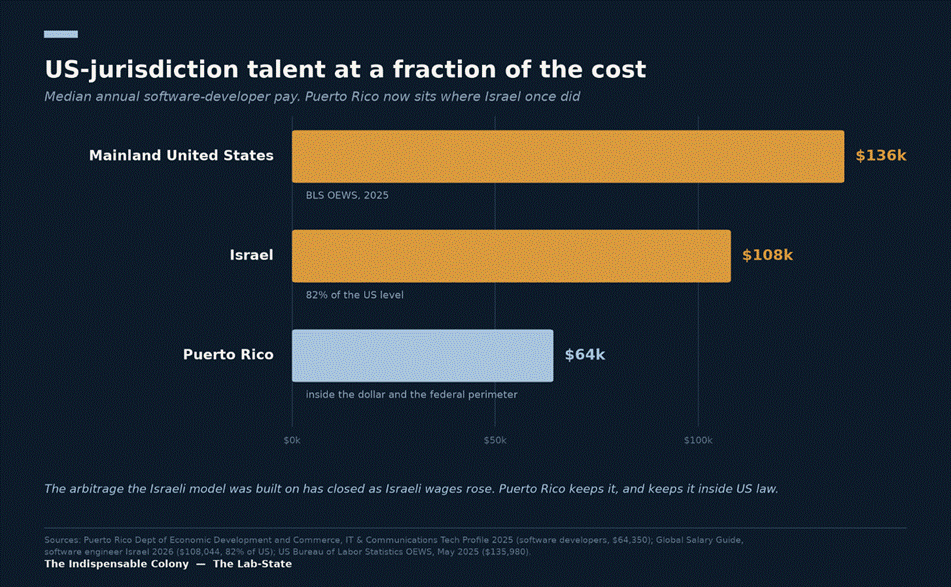
There is a cost argument underneath the talent argument, and recent movement in the labour market has made it stronger. The Israeli model was built on an arbitrage, engineers who were cheaper than Silicon Valley while nearly as good, and that arbitrage has largely closed as Israeli wages climbed towards American ones. Puerto Rico now sits where Israel once did. Software developers on the island earn an average of about 64,000 dollars a year¹⁹, roughly half the mainland median and well below Israeli levels, but inside the dollar, the American legal system and the federal security perimeter, with the Act 60 treatment layered on top. That combination, US-jurisdiction talent at a sub-mainland cost base, is one neither a now-expensive Israel nor any foreign hub can offer, and it is the arbitrage the original model has lost.
The United States as anchor buyer
An ecosystem needs a first customer more than it needs a first investor. Israel’s decisive advantage was never only the talent; it was a permanent, urgent, well-funded defence buyer that de-risked the opening sale for every startup that could clear the bar. A founder in Tel Aviv knew who the customer was before the company existed. That is the ingredient a campus does not supply and capital cannot buy, and it is the ingredient the United States is uniquely able to provide.
The move that dissolves the objection most people raise first, that Puerto Rico is too small a market to support an ecosystem, is to recognise that the market was never meant to be Puerto Rico. The island’s domestic demand is irrelevant. The customer is the federal government, one of the largest and most reliable technology buyers on earth, and it already has installations on the ground. The Pentagon reactivated the former Roosevelt Roads naval station in 2025 and 2026 and Southern Command has begun standing up autonomous-warfare and maritime-intelligence capabilities inside the area of responsibility that contains Puerto Rico. Federal procurement, the small-business research programmes, and that reactivated Caribbean footprint together supply the demand-pull that Israel got from its war economy, and they do so without requiring conscription or a permanent emergency. The United States does not need to be forced to buy. It needs to choose to designate Puerto Rico a preferred source, which is a policy decision rather than a structural impossibility. A policy decision is also a reversible one, and a founder cannot build a company on an executive preference that the next administration retracts by memo. The commitment has to be structural: multi-year procurement authority, or a statutory set-aside for qualifying dual-use firms, that survives an election. Puerto Rico has a century of evidence that federal will towards it is not sustained by good intentions, so the demand-pull has to be written into law rather than left to the disposition of whoever holds the building.
The precise claim is that the United States should be the anchor buyer, not the only buyer. Anchor demand is what removes the small-market ceiling and supplies the pull. Sole dependence on a single customer would simply substitute one fragility for another, and would remove the reason to bring allied capital in at all. Allied market access is the hedge: if federal appropriations soften, the export channels the Abraham Accords opened into Gulf and allied markets keep the ecosystem’s companies selling rather than leaving them stranded on the Pentagon’s annual budget. Anchor buyer plus allied export optionality is the defensible position, and it is the load-bearing mechanism of this entire proposal.
With the pieces now on the table, return to the diagnosis of section three, because the specific ways Puerto Rico’s own past attempts failed each have a named answer here. The prior accelerators had no guaranteed first customer, so their companies stalled or left; the anchor buyer, written into law rather than left to executive whim, is the direct fix. The Act 22 era let value leak off-island to the individuals who imported it; ownership through the fund, which holds the stake for Puerto Ricans, makes the gains accrue to the island instead. Talent kept draining to the mainland; the campus is the institution built to produce and hold it. Companies decamped the moment they scaled, as Red Cat did; the claw-back that anchors headquarters, intellectual property and equity while letting production distribute is designed for exactly that failure. What this cannot claim to have solved is the deepest reason the model resists travel, the culture and scale that grew in Israel from a single small society where the army, the universities and the funds are one social graph. That is not an input a statute can supply, and the honest position is that the campus, the anchor buyer and island ownership give the substitution its best available shot rather than guaranteeing it. The prior attempts failed without a customer and without ownership. This one would be tried with both, and with a clear-eyed view of the one thing it still cannot manufacture.
The objections the structure already answers
If the previous section answered why the island’s past attempts failed, this one turns to the objections a reader would raise against the design itself. A reader who has followed the series will notice that several of the standard ones were pre-empted two essays ago. It is worth naming them, because a first-time reader deserves the honest version and because waving them away would be exactly the move this series has tried not to make.
The colonial critique is the sharpest: that turning a colony into a defence laboratory run with two foreign powers makes the island an experimental zone for other people’s security priorities, tested on Puerto Rico precisely because mainland politics would not permit it at home. The answer is ownership. If Puerto Ricans hold the controlling equity through the Security Sovereign Defense Fund, they own the laboratory, and the charge of experimentation-without-consent loses its object. The related worry, capture by the Oversight Board or by federal and foreign interests, is answered by the same ownership plus the fund’s mixed board and buy-back exit. The talent and brain-drain objection, that an island losing population cannot staff an ecosystem, is answered by the campus, which exists to reverse exactly that flow. These are not dissolved by assertion. Each is answered by a specific mechanism already argued elsewhere in the series, and stated here in one honest sentence rather than re-litigated at length.
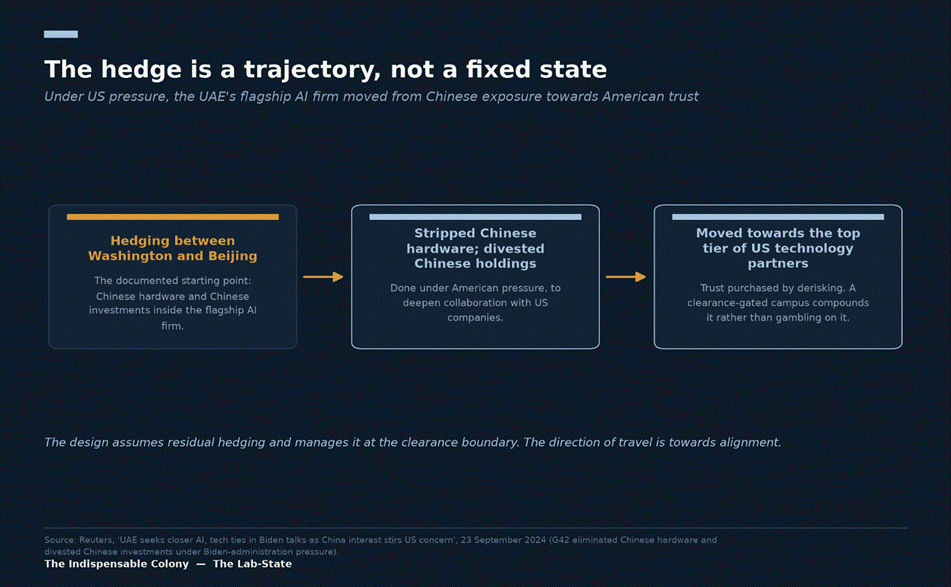
Two objections are not fully dissolved by ownership and the campus, and these deserve the essay’s real attention. The first is that genuine classified defence work requires cleared personnel and secured facilities, and that deep Emirati involvement, given Abu Dhabi’s documented hedging between Washington and Beijing, invites the same tech-transfer scrutiny that the fourth essay confronted over the AI university’s China exposure. The honest way to hold this is as a trajectory rather than a fixed state. The hedging is real, and the design should assume it will persist for a time; but it is also being reduced under exactly the pressure this kind of arrangement applies. Under American pressure the UAE’s flagship AI firm began stripping Chinese hardware from its operations and divested its Chinese holdings to deepen collaboration with US companies²⁰, and Washington has since moved the UAE towards its most trusted tier of technology partners. The direction of travel is towards alignment, purchased by derisking, and a campus that gates its most sensitive work by clearance is a mechanism for compounding that trust rather than gambling on it. The answer is therefore architectural as well as temporal. The fund and campus operate in the dual-use and unclassified-adjacent layer, where allied capital and foreign talent are an asset rather than a liability; genuinely classified programmes stay walled off in US-cleared hands, on the island’s sovereign federal installations. Ownership makes this cleaner because the security-sensitive decisions sit with an American-accountable board, but the clearance boundary is a real constraint that the structure manages rather than erases. The second surviving objection is execution risk on a fragile grid and a thin talent base, which is why the ecosystem must be export-first and globally networked from its first day, and why allied capital and market access are a necessity rather than a flourish.
The political economy of getting it built
The objections above are the ones the design answers. The harder question is who in Washington would fight the design itself, because a proposal that ignores the interest-group map is a policy sketch rather than a plan. Four constituencies matter. The defence primes, Lockheed, RTX, General Dynamics and their congressional delegations, will read any preferred-source designation for Puerto Rico as a diversion of contracts and lobby accordingly; the answer is to design them in as acquirers and downstream customers of the island’s startups rather than as competitors, so that the ecosystem feeds the primes rather than bypassing them. The Jones Act coalition of shipbuilders and maritime unions is the Caribbean’s third rail, which is why this series has consistently proposed to work within the Act rather than against it. Mainland states that host pharmaceutical and defence manufacturing will resist new federal privileges for a rival jurisdiction, an argument best met by framing the island as additive capacity for a supply base the United States is trying to reshore, not as a subsidised competitor. And Puerto Rico’s own factions, the Oversight Board, the utility’s creditors, and parties split by the status question, are not a bloc, so the ownership structure has to be legislated with local consent visible rather than assumed. The China-hawk caucus is the swing vote and cuts both ways: it is the natural champion of an anti-Beijing security build and the natural critic of Gulf capital with residual China exposure, which is the strongest reason the derisking and clearance architecture has to be airtight and told plainly. The optics of foreign capital deserve the same plain treatment, because the objection comes from both flanks, the critique of authoritarian money near American defence work on one side and the discomfort of depending on a Gulf monarchy on the other. The answer is the structure already built: Emirati capital is minority, sits in the platform layer rather than on the cap tables of the startups, and every security-sensitive decision rests with a Puerto Rican and American-controlled board. Two legal points round out the picture. The preferred-source designation has to run through the genuine national-security exemption in procurement law rather than as an open industrial subsidy, and any civilian-export support has to be structured to stay within trade-law limits, which may mean the security and civilian halves of the fund carry different legal wrappers. None of this is fatal. All of it is the difference between an essay and a bill.
Sequence, and the place of this essay in the series
The order of operations matters, because building the fund before the demand, or the campus before the grid, would repeat the island’s history of stranded megaprojects. The sequence is: settle the energy foundation first, because an energy-intensive ecosystem cannot sit on the island’s present grid, which fails roughly twice a year and runs near fifty per cent above the mainland average, so the distributed solar, storage and hydro capacity argued across this series is the precondition for everything that follows; consolidate the existing Act 60, Opportunity Zone and research incentives into a single coherent decree for qualifying security and dual-use firms, so that the fiscal offer is legible to an investor and a founder alike; direct a defined tranche of the already-capitalised fund into the matched, buy-back venture model set out above; stand up the campus and the civilian cohorts as the talent engine; and only then open the venture layer to Emirati co-investment and to Israeli and other allied investors on commercial terms, turning Puerto Rico into a node of the security-technology capital network rather than an isolated experiment. Israel’s part in that final step is the one it has played throughout: the model that proved the thing is possible, and a welcome collaborator, never a crutch the American build leans on.
Two qualifications keep the proposal honest. The first is energy, and it is a scoping decision rather than a hope. The distributed, community-owned solar and hydro that suits ordinary Puerto Ricans is resilient but not the firm, large-scale supply that heavy compute demands, so the island should host the lighter, higher-value layer, the cleared research, the applications, the intellectual property, while the power-hungry compute sits on the mainland twin, which is the same reciprocity logic the fourth essay applied to the AI build-out. An ecosystem scoped to what the grid can actually carry is credible; one that assumes a data-centre base the island cannot yet power is not. The second qualification is distribution. A tax-privileged, dollar-rich security enclave beside an island with deep poverty and high living costs could become a walled garden that lifts a cleared few and bids up rents for everyone else. Two mechanisms already in this design work against that outcome at the structural level rather than by after-the-fact transfer. The first is ownership: because the fund is the anchor investor and Puerto Ricans own the fund, the equity appreciation of the companies it seeds flows back to the island’s population, so the enclave’s success is by construction partly the island’s success rather than a gain captured by founders and outside capital alone. The second is a local-hiring-and-training mandate written into the incentive decree, so that the tax treatment and the fund’s preferential terms are conditioned on bringing Puerto Ricans into the portfolio companies. That turns the enclave’s payroll into a skills escalator for the island’s own workforce and closes the compound the walled-garden image depends on. Together with the campus that supplies the graduates, the citizen dividend, and the local-content and worker-ownership tools set out in the second essay, these convert the enclave from something extractive into something distributive. The residual is real but narrower than the critique implies: it is a transition problem. Until the campus has produced enough graduates, the highest-paid cleared roles will skew towards imported talent, and the rent pressure bites first on renters who feel costs before they feel equity gains. The answer is to phase the build to the pace of the talent pipeline and to keep the distributive tools central rather than treating them as a footnote to the security story. The grid and this transition are the two things the series has most left to prove.
The reason to do this on an island is not, in the end, only about the island. The United States has spent two decades discovering that its advantage in artificial intelligence rests on an industrial base it allowed to hollow out: fabrication concentrated in Taiwan, critical-mineral processing concentrated in China, and a domestic manufacturing capacity for the physical instantiation of AI, the chips, the drones, the sensors, the power, too thin to meet its own strategic demand. That is the dependency layer the third section described, and it is the layer where the country is most exposed and least organised. Rebuilding it at continental scale is the work of a generation and cannot wait for the country to become a place that seeds companies and buys their output, because the mainland is structurally unable to become that place quickly. What a single small jurisdiction can do is prove the machine on a scale where it fits. Puerto Rico is where the United States can run the whole loop, security demand pulling companies into being, a fund owning the upside, a campus supplying the talent, allied capital financing the platform, at a size that is legible, governable, and inside American jurisdiction, and then export the parts that travel.
And most of the parts travel. The manufacturing the island seeds spreads to the mainland by design, so a drone company proven in San Juan builds its airframes in states with no Puerto Rican voters, which is how the island’s success becomes a national jobs story rather than an enclave’s private gain. The equity model the fund runs is the same one Washington now runs through CHIPS, so a template validated on the island is a template the federal government already knows how to operate. The talent the campus produces is United States-jurisdiction talent, cleared and retained, at a cost base below the mainland’s, which is precisely the kind of supply an AI industrial base starved of engineers needs. The lesson is not that America should build fifty Puerto Ricos. It is that the country needs at least one working prototype of the ecosystem it keeps saying it wants, a place where the demand-pull, the ownership, and the talent engine sit close enough together to compound, and this is the one place inside its own borders where that prototype can be built without first rewriting the mainland. Get the loop working on the island, and the mechanisms that rebuild the base, the matched fund, the anchor-buyer procurement, the cleared talent pipeline, the coupling-point equity, are proven, portable, and ready to scale outward into the industrial base they were designed to serve.
This essay has argued the economic half of a proposition whose strategic half occupied the four before it. The strategic case was that the United States needs to own a secure platform astride the sea lanes to the Panama Canal before China buys the alternative. The economic case is that the platform can pay for itself, and pay Puerto Ricans, if it is built as a venture ecosystem on the one model that has ever turned a small jurisdiction with no resources into a technology power. Israel proved the model works. The UAE proved it can be bought into by a Gulf partner Washington can live with. Puerto Rico is the one place inside the United States where the model could be tried without first rewriting the mainland. The fund is how the money would work. The rest is a question of whether Washington decides to be the customer it is uniquely able to be.
Notes
- 1Yozma programme overview. https://en.wikipedia.org/wiki/Yozma
- 2OECD, venture capital policies in Israel. https://www.oecd.org/content/dam/oecd/en/publications/reports/2003/01/venture-capital-policies-in-israel_g17a1564/585780028400.pdf
- 3Neaman Institute, evolutionary venture capital policies. https://neaman.org.il/wp-content/uploads/2024/02/STE20.pdf
- 4Puerto Rico Act 60 and Section 933. https://wiki.private.law/en/puerto-rico-act-60
- 5Hiltzik CPA, Act 60 Chapter 2 guide. https://hiltzikcpa.com/puerto-rico-act-60-individual-investors-chapter-2-guide/
- 6Procopio, Puerto Rico extends resident investor programme. https://www.procopio.com/resource/puerto-rico-extends-act-60-resident-investor-program
- 7World Economic Forum. https://www.weforum.org/stories/2018/07/puerto-rico-startup-entrepreneurship-economic-hope/
- 8Jared J. Jaeger, ‘The IET Analytic Model: A Cross-Layer Framework for Technology Intelligence’ (working paper).
- 9Jared J. Jaeger, ‘The Territorial Cycle of Frontier Technology: A Phase Model of Technological Competition’ (working paper).
- 10Capital Investment Funds Act of 1999, section 3022. https://law.justia.com/codes/puerto-rico/title-seven/part-vii/chapter-142/3022/
- 11Reuters. https://www.reuters.com/technology/us-signs-letters-intent-worth-874-million-boost-semiconductor-research-2026-07-30/
- 12The National. https://www.thenationalnews.com/future/technology/2026/07/31/uae-backed-globalfoundries-wins-300-million-us-award-to-develop-faster-chips/
- 13UAE-Israel strategic fund. https://www.wam.ae/en/details/1395303002502
- 14Jerusalem Post, Abraham Fund. https://www.jpost.com/middle-east/uae-israel-sign-agreements-to-bolster-cooperation-via-3-billion-fund-646384
- 15Xinhua, Israel-UAE R&D fund. https://english.news.cn/20220124/181eb47cb97846b4a420d045c59c2c55/c.html
- 16Times of Israel, ADIO and Israel innovation bodies. https://www.timesofisrael.com/abu-dhabi-investment-office-forms-alliance-with-israel-tech-investment-bodies/
- 17Startup Nation Central, Gulf commercial links. https://israel.com/business/israeli-startups-deepen-commercial-links-with-gulf-states-study-finds/
- 18Startup Nation Central, Abraham Accords tech investment. https://startupnationcentral.org/hub/blog/abraham-accords-tech-investments/
- 19Puerto Rico Department of Economic Development and Commerce. https://docs.pr.gov/files/DDEC/DEDC PUERTO RICO DATA CENTER/Puerto Rico Industry Profiles/Puerto Rico’s IT and Communications Tech Profile 2025.pdf
- 20Reuters. https://www.reuters.com/technology/uae-seeks-closer-ai-tech-ties-biden-talks-china-interest-stirs-us-concern-2024-09-23/