The proposition
The Security Sovereign Defense Fund I was designed to take equity in the industries Puerto Rico hosts: pharmaceuticals, defense manufacturing, critical-mineral processing. This essay extends that vehicle into two domains I left implicit, the sea and the machines that will increasingly govern it. The fund should take a stake in a modernised San Juan port operated with an Emirati port group, and anchor alongside it a satellite campus of Abu Dhabi’s AI university, tasked with securing the drug supply, watching the sea lanes, and reading the ground for minerals the United States can no longer afford to import.
Three facts make the case for doing this now, on this island, with this partner. China has spent a decade buying the physical infrastructure of hemispheric trade. The Gulf states have spent the last three years buying into the same infrastructure, on terms Washington can live with. Additionally, an energy constraint that looks like Puerto Rico’s weakness is, read correctly, the reason a distributed American-Emirati structure makes sense here before anywhere else.
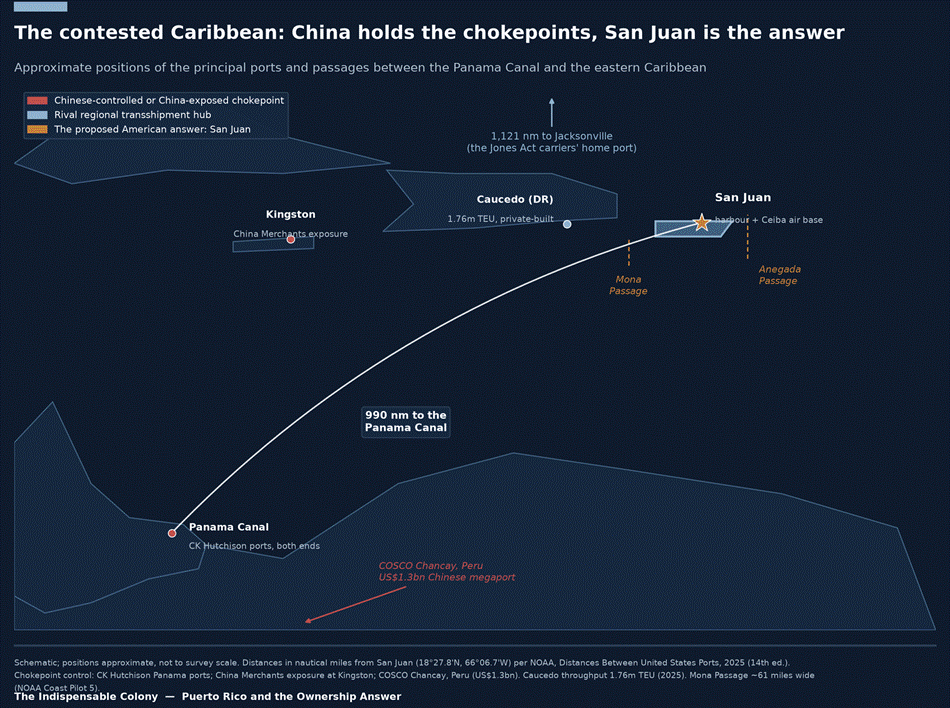
Start with what China has purchased. In November 2024 China’s state shipping giant COSCO inaugurated a deep-water port at Chancay, on the Peruvian coast, owning sixty per cent of the operating company, engineered with a draft deep enough for the largest container vessels afloat, at a projected total cost of 3.6 billion dollars¹,². United States Southern Command, in its 2024 and 2026 posture statements, flagged the “dual-use” potential of precisely this class of Chinese-controlled infrastructure³,⁴. Some eighteen Latin American and Caribbean countries have signed on to China’s Belt and Road Initiative⁵, and even the Caribbean’s largest transshipment hub carries indirect Chinese exposure: Jamaica’s Kingston Freeport Terminal sits inside a joint venture forty-nine per cent held by China Merchants Port⁶. Reversal after the fact is expensive: in late January 2026 Panama’s Supreme Court voided the concessions under which Hong Kong’s CK Hutchison had operated the Balboa and Cristóbal ports flanking the canal⁷, forcing a BlackRock-led consortium to close its twenty-three-billion-dollar purchase of CK Hutchison’s port portfolio around the stranded Panama assets⁸. It is far cheaper to own the alternative in advance. Puerto Rico is that alternative, and the United States already flies its flag over it.
The Gulf states, meanwhile, arrived with a structurally different offer. AD Ports Group, the Abu Dhabi state operator, made its first Latin American acquisition in June 2026, paying 835 million dollars for Brazil’s CLI, an agribusiness-logistics operator handling some seventeen million tonnes a year⁹, a bulk-cargo logic distinct from transshipment. DP World, the Dubai operator, plays the container game that matters more directly here: more than 800 million dollars invested since 2003 in the Caucedo terminal in the Dominican Republic, lifting capacity to 2.25 million containers, plus a completed 400-million-dollar Callao expansion in Peru and terminals at Santos and Posorja¹⁰,¹¹. A comprehensive economic partnership agreement between the UAE and Chile entered into force in November 2025, thickening the wider relationship¹².
A San Juan modernisation is a container-and-energy problem, which points toward DP World’s terminal competence rather than the AD Ports agribusiness template. The cleanest structure marries Abu Dhabi’s sovereign capital and diplomatic standing to DP World’s container competence, with the Security Sovereign Defense Fund holding the controlling American equity that keeps the arrangement politically legible. The partner is Abu Dhabi; the operating discipline is Dubai’s; the owner of record, on the American side, is Puerto Rico itself. Section 4 examines what Abu Dhabi actually wants from this, because “a partner Washington can live with” is doing unexamined work in that phrase.
Before any of that, the proposal has to clear a feasibility test that has nothing to do with geopolitics and everything to do with electricity.
Energy is the foundation, not an afterthought
Treat this as the load-bearing fact of the whole argument. The 2024 dredging of the San Juan harbour entrance was justified in the Army Corps of Engineers’ own economic analysis on energy imports, not container throughput; the Corps’ forecast anticipates no neo-Panamax container calls at San Juan at all¹³, ¹⁴. San Juan is being deepened for liquefied natural gas and fuel tankers that keep the island’s generators running, not for the mega-ships that would make it a transshipment rival. Any account of the port that starts with containers has started in the wrong place.
The reason that matters runs through the grid. Puerto Rico’s electricity system is fragile, and that fragility, not a shortage of talent or ambition, is why the island’s data-centre and advanced-computing plans have repeatedly stalled. An energy-intensive campus cannot simply be dropped onto an unreliable grid and expected to function; the arithmetic does not close.
The way out is not to fix the grid first and build second, but to split the workload. The reciprocity architecture at the centre of the US–UAE technology alliance, described in full in section 4, does not require heavy computing hardware to sit physically in Puerto Rico, only that the matching investment land on American soil. That opens a structural option: Puerto Rico becomes a talent-and-applications site, training the specialists and running the applied research, while the power-hungry compute lives on the mainland grid under the same reciprocity umbrella. The island supplies the people, the problems, and the sovereign platform; the mainland supplies the megawatts. What looks like a disqualifying weakness becomes instead the design rationale for a distributed structure that would probably be sound policy even with a strong grid.
Why San Juan, and why it is harder than it looks
The port numbers sharpen the strategic case for Puerto Rico’s geography even once the energy point is absorbed. San Juan lies 990 nautical miles from the Atlantic entrance of the Panama Canal and 1,121 from Jacksonville, flanking both the Mona Passage and the Anegada Passage, the sixty-one-mile-wide channels through which hemispheric traffic funnels¹⁵. It handled roughly 1.30 million containers in 2024 and processes more than three-quarters of the island’s non-petroleum commerce¹⁶.
Honesty about the obstacles separates a strategic argument from a brochure. San Juan’s container volume fell by more than eleven per cent in the most recent regional accounting, even as Kingston rose by fifty-five per cent and Caucedo handled more containers than all of Puerto Rico combined¹⁶. A legal chain sits around the island’s ankle: the Merchant Marine Act of 1920, the Jones Act, requires goods moving between two American points to travel on American-built, American-crewed, American-flagged ships, defining coastwise trade to include movement “either directly or via a foreign port”¹⁷. A foreign carrier cannot economically drop containers at San Juan for onward Jones Act carriage, so international lines run their transshipment through Kingston and Caucedo instead, where longshore labour costs a fraction of San Juan’s¹⁸. The Government Accountability Office stops short of concluding the Jones Act alone explains San Juan’s disadvantage; that inference belongs to its critics¹⁹.
San Juan’s strategic value is security, not commercial transshipment, and it cannot out-Kingston Kingston so long as the Jones Act stands. A modernised San Juan, complemented by the deep, hurricane-protected harbour at Ceiba, where the old Roosevelt Roads naval station retains a forty-foot harbour and a carrier pier the failed Ponce project never possessed²⁰, gives the United States a sovereign, flag-protected logistics platform no foreign court can void. The Pentagon reactivated Roosevelt Roads in 2025 and 2026, deploying F-35Bs from an eleven-thousand-foot runway, telling you Washington already values the island in exactly these terms²¹.
The cautionary tale sits an hour down the coast. Ponce’s Port of the Americas was to be Puerto Rico’s transshipment saviour. It consumed more than 269 million dollars and remains, as of June 2025, “construction in progress,” its two post-Panamax cranes idle for fifteen years and now contemplated for scrap²²,²³. Ponce chased transshipment volumes on an island the Jones Act had already priced out of that trade. A San Juan–Abu Dhabi partnership that repeated Ponce’s premise would deserve to fail the same way: this is a bet on sovereignty and security, not volume.
The value to Washington
There is a fair objection to everything in this essay: why should a voter in Ohio care whether San Juan gets a modern port and an Emirati-backed AI campus. The answer is that almost every benefit described here for Puerto Rico turns out, on inspection, to be a benefit for the mainland that happens to be sited on the island.
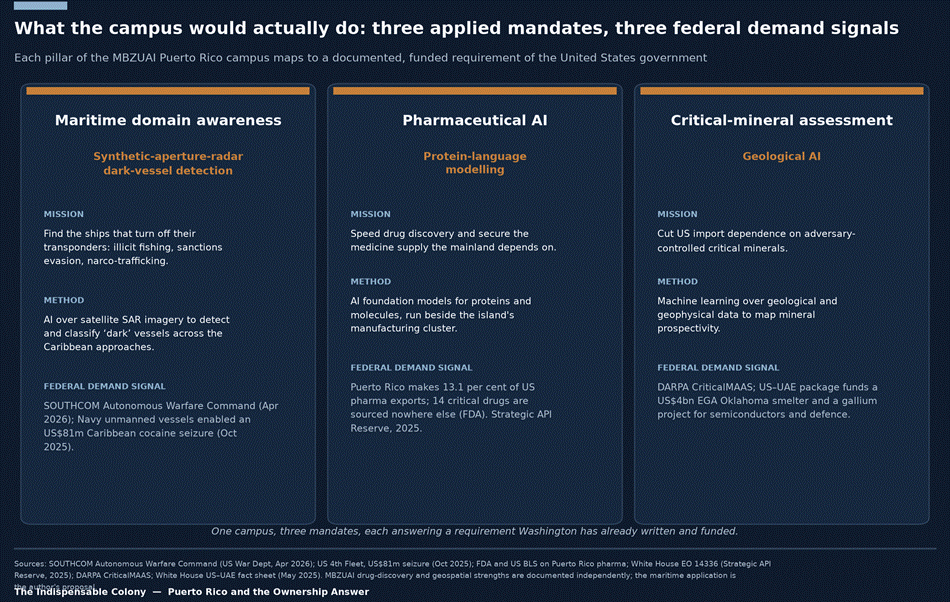
Begin with the thing mainlanders already depend on without knowing it: their medicine cabinet. Puerto Rico manufactures 13.1 per cent of all American pharmaceutical and medical exports by value, second only to Indiana, and the FDA has identified fourteen critical drugs sourced nowhere else in the United States²⁴,²⁵. Only about a tenth of the active pharmaceutical ingredients used in American drugs are made domestically, which is why the federal government has stood up a Strategic Active Pharmaceutical Ingredients Reserve against “the concentration of foreign, sometimes adversary, nations” in that supply chain²⁶. A modernised port that lands pharmaceutical inputs more cheaply, and an AI campus whose strongest applied field is drug discovery, both harden the domestic drug supply every American relies on. When a hurricane knocks out Puerto Rico’s plants, as Maria did, mainland hospitals ration saline.
The reshoring wave shows the benefit is not theoretical. Because Puerto Rico sits inside the US customs zone, its output counts as American-origin and escapes the new pharmaceutical tariffs, drawing fresh mainland investment: Amgen committed 650 million dollars and Eli Lilly more than 1.2 billion to island manufacturing, capital that would otherwise have gone to Ireland, India or China²⁷,²⁸. These are Puerto Rican jobs building drugs for American patients, in a cluster that already supplies sixteen per cent of the entire mainland pharmaceutical manufacturing workforce²⁹.
Security is the second mainland dividend, and it runs through Southern Command. A secure, sovereign, partly island-owned San Juan, feeding a maritime-intelligence campus inside the Southern Command area of responsibility, is a hemispheric defense asset. The stack already exists inside the American government, waiting for talent to operate and extend it. The Defense Innovation Unit’s xView3 challenge produced open-source models that use synthetic-aperture radar to detect “dark” vessels, the ships that switch off their transponders to fish illegally or run contraband³⁰. In April 2026 Southern Command stood up an Autonomous Warfare Command, whose commander stated an intent to “capitalize on next-generation capabilities like unmanned platforms, (artificial intelligence) integration and commercial tools” against cartel networks³¹. In October 2025 an unmanned surface vessel had already enabled an interdiction that seized eighty-one million dollars of cocaine in the Caribbean³². Puerto Rico sits inside this area of responsibility as American territory.
The port itself carries a direct mainland economic tail. San Juan’s cargo is worked almost entirely by carriers based in Jacksonville, Florida: Crowley, TOTE and Trailer Bridge, whose ships, crews and terminals are mainland enterprises employing mainland workers¹⁴. And the Gulf capital under discussion here is capital the mainland is already courting for itself, as section 4 sets out in the context of the UAE’s own reciprocity obligations to build matching capacity on American soil. A Puerto Rico deal extends the same alliance into the one American jurisdiction astride the sea lanes to the Panama Canal, rather than diverting Emirati money away from the mainland.
The deepest mainland dividend is strategic, and it is the throughline of this whole series. China is acquiring the harbours of the Western Hemisphere while the United States debates. A secure, sovereign, partly island-owned San Juan is a defense asset that protects mainland trade, mainland drug supply and mainland security together, and does so because the island’s distance places American territory exactly where the contest is being fought.
The value to Puerto Rico
If Washington’s stake is security and supply-chain resilience, the island’s stake has to be ownership, or the arrangement repeats a history this series has already documented once.
We have built this island once before
The United States has run this experiment already, on this same island, and the result is the reason the pharmaceutical cluster this series keeps invoking exists at all. In May 1947 Puerto Rico’s legislature passed the Industrial Incentives Act, the legal spine of what came to be called Operation Bootstrap, or Manos a la Obra, launched under Governor Jesús Piñero³³. The architecture was simple and, for its moment, radical: exempt manufacturers from local income tax for a decade or more, layer on the federal shelter of Internal Revenue Code Section 931, and use a development agency, Fomento, under Teodoro Moscoso, to court mainland capital into an island that had been an agrarian dependency of sugar³⁴. Luis Muñoz Marín, elected in 1948 as the island’s first chosen governor, carried the programme forward and gave it its political voice.
For two decades it worked, and spectacularly. By 1980 manufacturing had risen from sixteen to roughly forty-eight per cent of output while agriculture collapsed from eighteen to under four per cent; income per head climbed from 342 dollars in 1950 to nearly 3,500 by 1980, and life expectancy from forty-six years to seventy-three³³. This is the industrial base, later thickened by the pharmaceutical incentives of Section 936 in 1976, that the rest of this series treats as a strategic asset³⁵.
The failures matter as much as the successes. Bootstrap drifted, from the mid-1960s, out of the labour-intensive light manufacturing that had put islanders to work and into capital-intensive petrochemicals and pharmaceuticals that generated income without generating employment³⁶. Unemployment stayed near or above the low teens throughout the boom, the value the factories produced flowed heavily off the island, and roughly a million Puerto Ricans left for the mainland between 1945 and 1970, a departure a 1971 federal commission traced directly to Bootstrap’s failure to absorb its own labour force³⁷. Bootstrap made Puerto Rico indispensable to American industry and left Puerto Ricans without a durable stake in the value they hosted, so when Washington withdrew the tax shelter, phasing out Section 936 from 1996 and ending it in 2006, the capital left as easily as it had come³⁸. Indispensability without ownership is the documented history of this island in the twentieth century. The design offered here, sovereign local equity held through a fund, capital invited but unable to simply evaporate, is Bootstrap rewritten so the value stays the second time.
The Jones Act, used rather than fought
This proposal’s appeal is that it operates within the confines of what already exists rather than requiring Congress to invent new authority, and the Jones Act relief below fits that pattern.
The burden is not marginal. The most rigorous recent estimate, by economists at Purdue, puts the annual cost to Puerto Rico at some 1.4 billion dollars, of which about 692 million falls on households, roughly 203 dollars per citizen every year, an average tariff-equivalent of 30.6 per cent on final products arriving from the mainland¹⁷,³⁹. This is, in effect, a permanent internal tariff on the poorest jurisdiction under the American flag, levied hardest on the food and fuel a dependent island cannot produce for itself. The same study finds private capital goods cost about 3 per cent more on the island, and a pharmaceutical and defense-manufacturing cluster runs on exactly such capital goods.
Candour requires the counter-argument. The Act’s defenders argue that a domestic-shipping requirement sustains a US-flag fleet, American shipyards and a pool of trained mariners the country would need in a major war, and the Government Accountability Office concluded that “the independent effect and associated economic costs of the Jones Act cannot be determined” from available data¹⁹,⁴⁰. That caveat is real. But a national-security rationale that produces the collapsed port of Ponce, drives transshipment to Kingston and Caucedo, and taxes the pharmaceutical chokepoint the Pentagon is scrambling to protect is a rationale working against itself.
No new statute is required to fix this. Congress could grant Puerto Rico the same coastwise exemption the US Virgin Islands already enjoys, ninety miles away⁴¹. Failing that, the Secretary of Homeland Security already holds statutory authority to waive the requirement when “necessary in the interest of national defense.” An exemption alone would lower import costs but expose San Juan to competition from Kingston and Caucedo without giving the island a stake in the resulting traffic, the same trap the pharmaceutical cluster fell into. Paired with a modernised, partly island-owned terminal operated to DP World’s standard and held through the Security Sovereign Defense Fund, San Juan could recapture feeder and relay volume it is currently barred from handling, with the margins accruing, in part, to Puerto Ricans. Repeal makes the port viable; the partnership makes the island an owner of the viability.
The employment arithmetic deserves care, because both sides inflate their numbers. A 2019 study by John Dunham and Associates, cited by the Competitive Enterprise Institute, modelled the coastwise regime as costing Puerto Rico roughly 13,250 jobs and about 1.5 billion dollars a year, a model built by the Act’s critics, not a government measurement⁴²,⁴³. On the mainland’s side, defenders claim the Act sustains some 650,000 American jobs, a number the Cato Institute calls lobbyist arithmetic and puts closer to 100,000 in actual shipping and shipbuilding⁴⁴,⁴⁵. A targeted Puerto Rico exemption touches an even smaller slice of that protected employment while delivering the island’s gain in full.
Whose deal is it, and who can say no
Everything so far risks reproducing the very disease this series diagnoses: treating Puerto Rico as an object to be arranged rather than a party that arranges. Beyond the elected Governor and Legislative Assembly, there sits, since 2016, the Financial Oversight and Management Board created by PROMESA, seven presidentially appointed members that certify the island’s fiscal plans and, under Section 204, must approve major contracts⁴⁶,⁴⁷. The Board is not a formality: in December 2023 it ordered termination of a long-term lease the local redevelopment authority had signed to develop the very Roosevelt Roads land this proposal covets, on the ground it came from an unsolicited single-bidder negotiation rather than open competition⁴⁸. The partnership must be procured competitively and transparently from the outset.
Then there is the deeper, political form of consent, where the colonial objection has real force. An Emirati sovereign vehicle taking equity in a Puerto Rican port would be extraordinary. On an island whose status remains unresolved, and which voted in November 2024 for statehood over independence and free association, that arrangement can be read two ways⁴⁹: empowerment, or a fresh indignity, the metropole leasing its colony to a Gulf monarchy without asking. Recent history says the second reading is not paranoid. The privatisation of the island’s grid to LUMA Energy in 2021 was denounced as opaque and imposed, produced chronic outages islanders came to call “Hurricane LUMA,” and by December 2025 the government itself was suing to cancel the contract⁵⁰. A foreign-partnered port imposed on the same terms would earn the same backlash, and deserve it.
The answer is to change the structure so consent is designed in rather than assumed. The controlling American equity must sit with an instrument accountable to Puerto Ricans, the Security Sovereign Defense Fund, with a governance charter giving the island’s elected institutions a real seat. The campus should be built as a partnership with the island’s own university system, and put to the island’s elected legislature on the record, not routed around it. This also answers the investor’s version of the same question: political risk on an island with an oversight board and a demonstrated willingness to litigate its way out of unpopular contracts is managed by making the local stakeholder an owner with something to lose. A deal Puerto Ricans own is a deal Puerto Ricans defend.
The ground is not empty
A satellite campus would not be planting a flag in barren soil. The University of Puerto Rico at Mayagüez runs an Artificial Intelligence Education and Research Institute whose mandate expressly includes supporting “local and foreign industries in understanding and applying artificial intelligence solutions”⁵¹, and in 2026 secured a nine-million-dollar National Science Foundation award for AI-based sustainable-technology infrastructure focused on resilient energy systems, the same grid problem this essay opened with⁵². An MBZUAI campus would arrive to a natural counterpart, a collaboration rather than a colonisation.
The value to the UAE
The case so far has been built almost entirely from Washington’s and San Juan’s side of the table, leaving an obvious question unanswered: what does Abu Dhabi actually want. The convenient answer, a return on port and campus capital, is not wrong, but understates the deal by an order of magnitude. Abu Dhabi is not buying port margins; it is buying strategic position, technology access, and standing as Washington’s most indispensable Gulf partner, and a Puerto Rico anchor would advance all three.
The Blackwell coup and the reciprocity clause
The clearest evidence of what Abu Dhabi is actually purchasing is the chip deal. In May 2025 the United States and the Emirates announced a ten-year, 1.4-trillion-dollar UAE investment framework spanning AI infrastructure, semiconductors, energy and biotechnology, alongside more than 200 billion dollars in fresh commercial deals⁵³. Under it the UAE may import up to 500,000 of Nvidia’s Blackwell-generation AI chips a year through 2027, with an option to 2030⁵⁴: roughly a fifth of the allocation goes to the Emirati champion G42, the remainder to American firms, Microsoft, Oracle, OpenAI, operating data centres inside the UAE. Washington granted the export licence in October 2025⁵⁵, and that November the Commerce Department approved some 35,000 GB300 Blackwell-class chips each to G42 and to Saudi Arabia’s Humain, the only two non-Tier-1 countries so approved⁵⁶. Microsoft alone committed 15.2 billion dollars and more than 60,000 chips to the UAE under the same authority, an arrangement its Washington ambassador, Yousef Al Otaiba, calls a “Gold Standard” for securing AI models, chips, data and access⁵⁷.
The mechanism that makes the chip deal something other than a one-way export licence is the reciprocity clause: for every AI facility G42 builds in the Emirates, a corresponding one must be built in the United States⁵⁴. This twin-build obligation is the template this essay borrows. Puerto Rico is a plausible site for part of the American-side build the UAE is already committed to constructing, and the island’s pharmaceutical strength fits the broader reshoring reciprocity the Emiratis are buying into. That same framework is already delivering a four-billion-dollar Emirates Global Aluminum smelter in Oklahoma, the first new American primary-aluminium plant in almost fifty years, paired with a gallium project feeding the semiconductor and defense supply chain⁵⁸. Puerto Rico is not, at present, a semiconductor fabrication hub; the draw is its place inside a reciprocity architecture the UAE is already committed to building out.
The GlobalFoundries precedent
Return to the objection this series has to answer: how does an American constituency that voted, in 2006, to block a Dubai firm from operating twenty-one American ports come to accept an Emirati stake in San Juan. Part of the answer already exists.
Abu Dhabi’s sovereign wealth fund, Mubadala, is the majority shareholder of GlobalFoundries, one of the handful of companies capable of fabricating advanced semiconductors on American soil, spun out of AMD’s manufacturing arm in 2009 and taken public in October 2021. A March 2026 SEC filing recorded Mubadala’s holding at 77.05 per cent of ordinary shares⁵⁹; a May 2026 sale of 22 million shares, worth roughly 1.91 billion dollars, trimmed the stake to about 73 per cent, described explicitly as “not an exit”⁶⁰,⁶¹. GlobalFoundries is, in short, a strategically sensitive American chipmaker roughly three-quarters owned by an Abu Dhabi sovereign vehicle, and Washington and CFIUS live with it uncontroversially.
That fact resets the terms of the 2006 debate more than anything else here. The objection then was that a foreign state would control American critical infrastructure. Abu Dhabi already controls more of a strategically vital American chipmaker than any plausible port structure would grant it over San Juan, and the arrangement functions. The GlobalFoundries precedent does not make the port case automatically safe, but it removes the claim that Gulf sovereign control of sensitive American assets is categorically unthinkable. It happened already, at a larger scale, in a more sensitive sector than port logistics.
Gulf rivalry: why Abu Dhabi wants to be first
None of this happens in a vacuum against the other Gulf states. Saudi Arabia’s Humain and Qatar are racing for the same class of American chip access and standing; Humain’s own GB300 allocation, approved alongside G42’s in November 2025, shows how close that race is⁵⁶. Abu Dhabi’s advantage over Riyadh and Doha has been earned through infrastructure, capital commitments and the Sheikh Tahnoun relationship with Washington’s security establishment, not a monopoly on any resource. A live, operating stake in an American territory, anchoring a port and a research university on sovereign US soil, is standing none of the other Gulf capitals can easily replicate: a claim to being first and indispensable in the American technology alliance.
Derisking, not decoupling
It is tempting to read the chip licences, the reciprocity clause and the GlobalFoundries stake as evidence that Abu Dhabi has chosen the American side of a binary contest with Beijing. That description is not quite right, and getting it right matters for how safeguards should be designed.
The more accurate frame is derisking. Gulf capital flowing into American infrastructure under audited, twin-build, US-owned-equity conditions reduces the Chinese-access risk attached to that specific investment. It does not require Abu Dhabi to sever its own commercial and technological relationships with China, and no one has asked the Emirates to do so. It walls off the American-side asset, whether GlobalFoundries, a data centre in Oklahoma, or a prospective port and campus in San Juan, from exposure a less structured investment would carry. The alternative framing, that the Emirates is decoupling from China outright, is not fully supportable and invites the kind of overclaim this series has tried to avoid elsewhere.
MBZUAI’s China exposure, addressed directly
The Mohamed bin Zayed University of Artificial Intelligence, founded by government decree in Abu Dhabi’s Masdar City in 2019, is the world’s first graduate research university dedicated wholly to AI⁶². It works closely with G42 on foundation-model research, including the open-source K2 Think reasoning model, and is a partner in the G42-Microsoft Responsible AI Future Foundation launched in 2025⁶³.
The university’s documented ties to China are a legitimate concern. A 2024 Jamestown Foundation report assessed MBZUAI as a high tech-transfer risk, citing Chinese-origin founding leadership connected through the Inception Institute (now folded into G42) and a trustee link to G42’s PRC-facing relationships, Huawei-supported researchers within its orbit, and its access to US export-controlled chips alongside American defense and intelligence-community resources⁶⁴. G42 itself was named by the House Select Committee on the Chinese Communist Party as a company of concern, and Microsoft scaled back a 1.5-billion-dollar investment in G42 in 2024 before re-engaging once the Emirati company had removed Chinese hardware and divested Chinese holdings⁶⁵. None of that disqualifies MBZUAI from this proposal, but pretending it does not exist would be worse than naming it.
The reason it does not disqualify the partnership is structural, and it is the same derisking logic laid out above. A campus with US-side controlling equity through the Security Sovereign Defense Fund, competitive procurement of the kind PROMESA already requires, twin-build reciprocity, and audited access to what it builds and shares, converts a partner with documented China exposure into an acceptable one. The safeguards exist because Abu Dhabi hedges, not despite it. Sheikh Tahnoun bin Zayed, the UAE’s national security adviser and G42’s chairman, signalled to Washington in 2023 that he wanted the United States to be Abu Dhabi’s preferred technology partner, and has pushed the Emirati AI ecosystem to address American security concerns to maintain an edge over China⁶⁶. At the same time, the Emirates runs a dual-track strategy, deepening defense and intelligence cooperation with Washington while expanding economic and technology ties with Beijing⁶⁷. Abu Dhabi is the better-aligned emirate, Washington’s preferred technology partner and a designated major defense partner. It is also still a hedger. The partner is Abu Dhabi; the operating discipline is Dubai’s; the governance realism has to hold both facts at once.
Dubai Ports World, revisited
That governance realism is what lets this series finally close the loop it opened around Dubai Ports World in 2006. That February, after CFIUS cleared the transaction, it emerged that Dubai Ports World, through its purchase of the British firm P&O, would come to manage terminal operations at some twenty-one American ports⁶⁸. A House committee voted sixty-two to two to block the deal, and Dubai Ports World announced it would divest the following day⁶⁹. An Emirati company had been judged, by the elected branch, an unacceptable operator of American ports.
Three things have changed since. The review machinery is stronger: the Foreign Investment Risk Review Modernization Act, signed in August 2018, expanded CFIUS jurisdiction to include real-estate transactions near sensitive facilities, precisely the concern a port raises⁷⁰. The Emirates’ standing in Washington has been transformed: in September 2024 the United States designated the UAE a major defense partner, only the second country after India to hold that status⁷¹. And the GlobalFoundries precedent already shows Washington accepting Abu Dhabi sovereign control of a far more sensitive asset than a port stake would require, given the right structure. The America First Investment Policy, issued in February 2025, eases restrictions on allied capital “in proportion to their verifiable distance and independence from the PRC” and creates an expedited “fast-track” process for trusted allied and partner sources⁷². An Emirati port investment structured through a vehicle Puerto Ricans partly own, screened under FIRRMA, with the derisking conditions above built in, is close to the archetype that policy was written to welcome. The 2006 objection was that a foreign state would control American port operations; the answer here is that the controlling equity sits with the people of an American territory, and the foreign partner’s exposure to Chinese technology is managed, audited and reciprocal rather than pretended away.
Structuring a deal the Senate can live with
The difference between a proposal and a memorandum is structure. The port arrangement would not sell an American harbour to a foreign state, the transaction 2006 taught everyone to reject. It would create a joint operating company for a modernised San Juan in which the Security Sovereign Defense Fund holds the controlling American equity, an Abu Dhabi sovereign vehicle contributes capital and a minority stake, and DP World or an equivalent operator is engaged under a management contract for terminal competence rather than as an owner. Governance would vest security-sensitive decisions, hiring of operating leadership, data-handling protocols, access to the adjacent military facilities at Ceiba, in the American-controlled board, with the Emirati partner walled off from what triggered the 2006 revolt: operational control of American port security.
That structure mirrors the intergovernmental assurance model already built in the AI domain, where Microsoft’s investment in G42 was wrapped in a first-of-its-kind assurance agreement negotiated with both states⁷³. The same instrument, binding the Emirati partner to security conditions, audited technology access, and American oversight, could govern the port and the campus alike. The precedent for trusting Abu Dhabi with sensitive infrastructure exists; it has not yet been applied to a pier, or a classroom.
The economics have to be honest too. San Juan will not become a transshipment hub. Its revenue case rests on three narrower foundations: the island’s own import trade, more than three-quarters of which already moves through the port; energy, the harbour deepened for the liquefied-gas and fuel imports that keep the fragile grid alive; and defense logistics. A sovereign, flag-protected deep-water platform in the contested Caribbean, adjacent to a reactivated air base, is worth more to American power than another marginal transshipment terminal competing with Kingston on price. The commercial case funds the port. The strategic case justifies the partnership. Conflating the two, as Ponce did, is how these projects die.
What the campus would actually do
The bilateral machinery behind this hardened fast. By March 2026 a US-UAE AI Acceleration Partnership interagency working group was meeting in Washington, co-chaired by an Under Secretary of State and the Emirati Minister of Investment, under what participants called the Pax Silica initiative⁷⁴. A Puerto Rico campus is exactly the kind of reciprocal, security-screened, US-sited investment this partnership already demands.
The applied case rests on three problems, unequally mature. The strongest, and the one that should lead, is drug discovery. MBZUAI’s flagship applied achievement is in pharmaceutical AI: in November 2025 the university and its partner GenBio AI won the UAE Artificial Intelligence Award for a unified protein-language modelling framework aimed at collapsing the time and cost of drug development⁷⁵. Puerto Rico is the second-largest pharmaceutical-exporting jurisdiction in the United States, accounting for 13.1 per cent of a 127.6-billion-dollar national export total in 2025, and was designated one of the country’s inaugural biotechnology Tech Hubs in 2023²⁴,⁷⁶. A university whose best applied work is AI-driven biomedicine, planted beside the American pharmaceutical cluster that most needs modernising, is where the campus would earn its keep first.
The second problem is maritime domain awareness, covered in the Washington-value section above: the demand signal from Southern Command is explicit and the tooling already exists inside the American defense establishment. The third is critical minerals, and it should be labelled the most speculative element of the mandate. DARPA’s CriticalMAAS programme built machine-learning tools to automate the United States Geological Survey’s assessment of the more than fifty commodities that exceed criticality thresholds⁷⁷, but MBZUAI has no documented minerals research today. A minerals mandate would be a capability to build from scratch, not one to import. The demand is statutory, but it belongs on the roadmap, not the opening brochure.
There is precedent for MBZUAI’s American reach, though not for the full step proposed here. In May 2025 MBZUAI opened an Institute of Foundation Models with a laboratory in Sunnyvale, California⁷⁸, and that October signed a five-year collaborative research programme with MIT’s Schwarzman College of Computing⁷⁹. The Sunnyvale site is a research lab, not a degree-granting campus, and no foreign AI university currently operates an accredited campus on US soil. A Puerto Rico campus would be precedent-setting, not precedent-following, an argument for ambition made with eyes open about MBZUAI’s own president, Eric Xing, who has described the university’s overseas collaborations as serving “as an important channel for sharing US culture and values”⁸⁰, a framing that sits uneasily beside the China-exposure history above, and should be read as aspiration rather than settled fact.
Puerto Rico is the first case, not the only one
The structure proposed here is not, finally, about Puerto Rico alone. The island is the sharpest instance of a pattern the United States repeats wherever its flag meets contested water: strategic geography that Washington values and local populations that hold no stake in the value. Solve it once, properly, and the same instrument travels.
Consider how the United States already pays for strategic geography when it bothers to pay at all. Under the Compacts of Free Association, the Marshall Islands, the Federated States of Micronesia and Palau grant the American military exclusive access and the right to deny any other power’s forces the run of an expanse of the western Pacific⁸¹. In March 2024 Congress renewed those compacts with roughly seven billion dollars of economic assistance across twenty years, a package the Joint Economic Committee put at 7.1 billion dollars and the Interior Department at 6.5 billion⁸². Washington compensates sovereign partners for strategic denial, and treats the payment as cheap insurance against a rival filling the vacuum.
Set that beside how it treats its own territories. Guam hosts Andersen Air Force Base and a submarine squadron and is called, in the congressional record, “the tip of the spear” of American power in the Pacific⁸³, yet Guam’s own leaders testify the island is “a vital defense point, but lack[s] proper resource allocation”⁸⁴. The Freely Associated States, independent, are compensated for access. Guam, American, supplies the same strategic value and is not. Citizenship, perversely, disqualifies a territory from the bargain a foreign partner would command.
That is the gap the fund closes, and why the design is a template rather than a one-off. It gives an American place an ownership stake in the strategic value it already provides, instead of letting that value accrue entirely to the mainland or leak to a foreign acquirer. Puerto Rico is the natural first case, but the same logic maps onto Guam, the Northern Mariana Islands, and the US Virgin Islands. The precedent is not exotic. Alaska has run it since 1976, dedicating a share of its mineral royalties to a permanent fund now worth more than ninety billion dollars that supplies over half the state’s unrestricted revenue⁸⁵. What Alaska did with oil, a territory could do with the strategic rents of its geography.
The whole machine in one view
Everything in this essay routes back to the vehicle proposed. The Security Sovereign Defense Fund makes the port deal survivable and the campus permanent: the mechanism through which Puerto Ricans hold the American-side equity in a modernised San Juan, converting a foreign port investment from the 2006 nightmare of foreign control into a structure of local ownership with a trusted, audited foreign partner. It can take a stake in the campus, endow chairs, and fund the applied research so the intelligence generated on the island accrues, in part, to the island, binding port, campus, and the pharmaceutical and mineral industries of the earlier essays into a single ecosystem anchored to a sovereign American place.
Stand back and the parts become a single machine. The fund gives Puerto Ricans an ownership stake in their own strategic assets. The San Juan–Abu Dhabi partnership supplies the capital and applied intelligence to make those assets worth owning, on terms that derisk rather than pretend away the exposure Abu Dhabi’s own hedging creates. Around that spine sit the pieces the earlier essays established: the pharmaceutical cluster the mainland depends on, the critical-mineral and defense-manufacturing links the alliance is already funding, the air base at Ceiba, and the harbour that guards the approaches to the Panama Canal. Repeal the Jones Act penalty and the whole structure gets cheaper to run and easier to defend. None of these pieces is decisive alone. Assembled, they interlock into an ecosystem anchored to a place a competitor cannot cheaply move, built on an energy architecture, talent on the island, compute on the mainland grid, that the next essay takes up directly.
The payoff resolves into three outcomes that reinforce one another. A more secure Puerto Rico, because the island holds equity in a modern port, an AI campus, and a fund that captures the returns its own strategic value generates. A more secure United States, because a partly island-owned San Juan feeding a maritime-intelligence and drug-discovery campus hardens the drug supply, the mineral supply, and the sea lanes on which the mainland depends. And a clearer position for Abu Dhabi, because a Puerto Rico anchor advances the standing it is already paying for elsewhere in the alliance, on terms that manage rather than deny its own exposure to Beijing. Indispensability without ownership has been this series’ argument against the old model. The fix is a matter of design: the ships, the harbours, the university, the capital, and the machinery of the alliance all exist. They wait only to be assembled, on the one piece of contested ground that already flies the American flag.
Notes
- 1COSCO SHIPPING Ports, January 2019. https://doc.irasia.com/listco/hk/coscoship/press/p190123.pdf
- 2Institute for China-America Studies. https://chinaus-icas.org/research/map-spotlight-port-of-chancay/
- 3SOUTHCOM 2024 Posture Statement. https://www.southcom.mil/Portals/7/Documents/Posture Statements/2024 SOUTHCOM Posture Statement FINAL.pdf
- 4SOUTHCOM 2026 Posture Statement. https://www.southcom.mil/Portals/7/Documents/Posture Statements/2026_SOUTHCOM_Posture_Statement_FINAL.pdf
- 5Green Belt and Road Initiative Centre. https://green-bri.org/countries-of-the-belt-and-road-initiative-bri
- 6CMA CGM, December 2019. https://www.cmacgm-group.com/en/news-media/cma-cgm-signs-binding-agreement-china-merchants-port-sell-portfolio-ten-port-terminals
- 7Reuters, January 2026. https://www.reuters.com/world/asia-pacific/panama-court-voids-ck-hutchison-port-contracts-2026-01-30/
- 8Reuters, March 2026. https://www.reuters.com/world/americas/blackrock-backed-group-seeks-close-ck-hutchison-ports-deal-without-panama-assets-2026-03-03/
- 9AD Ports Group, June 2026. https://www.adportsgroup.com/en/news-and-media/2026/06/02/ad-ports-group-acquires-cli
- 10DP World, December 2025. https://www.dpworld.com/en/news/dominican-republic/dpw-expands-caucedo-port-operations-after-22-years-in-dr
- 11DP World. https://www.dpworld.com/en/news/peruvian-trade-set-for-boost-as-dp-world-completes-400m-callao-port-expansion
- 12UAE Ministry of Economy. https://www.moet.gov.ae/en/uae-chile-cepa
- 13USACE, economic appendix. https://jp.pr.gov/wp-content/uploads/2022/03/Appendix-C_Economics.pdf
- 14RAND Corporation. https://www.rand.org/content/dam/rand/pubs/research_reports/RR3000/RR3040/RAND_RR3040.pdf
- 15NOAA, distances between ports. https://nauticalcharts.noaa.gov/publications/docs/distances.pdf
- 16World Bank via ECLAC. https://repositorio.cepal.org/server/api/core/bitstreams/78bf876d-9187-403a-a3d6-58adaba60f15/content
- 1746 U.S.C. §55102. https://www.cato.org/research-briefs-economic-policy/effect-jones-act-puerto-rico
- 18Hernández Colón. https://rafaelhernandezcolon.org/CB/CB_NOV_24_11.pdf
- 19GAO-13-260. https://www.gao.gov/assets/gao-13-260.pdf
- 20NOAA Coast Pilot 5. https://www.nauticalcharts.noaa.gov/publications/coast-pilot/files/cp5/CPB5_C13_WEB.pdf
- 21Military.com. https://www.military.com/daily-news/investigations-and-features/2025/11/03/us-deploys-f-35-fighters-cold-war-era-puerto-rico-base-venezuela-tensions-escalate.html
- 22Autoridad de Ponce. https://hacienda.pr.gov/sites/default/files/autoridad_de_ponce.pdf
- 23Periódico La Perla. https://www.periodicolaperla.com/actualidad/puerto-o-mausoleo-cumplen-15-anos-de-inaccion-las-gruas-post-panamax/
- 24U.S. Bureau of Labor Statistics. https://www.bls.gov/mxp/publications/regional-publications/puerto-rico-exports.htm
- 25FDA, Securing the Future. https://www.fda.gov/media/108975/download
- 26The White House. https://www.whitehouse.gov/presidential-actions/2025/08/ensuring-american-pharmaceutical-supply-chain-resilience-by-filling-the-strategic-active-pharmaceutical-ingredients-reserve/
- 27Amgen. https://www.amgen.com/newsroom/press-releases/2025/09/amgen-announces-650m-expansion-of-us-manufacturing-creating-hundreds-of-new-jobs
- 28Reuters. https://www.reuters.com/sustainability/boards-policy-regulation/eli-lilly-invest-12-billion-puerto-rico-part-us-manufacturing-push-2025-10-29/
- 29Departamento de Desarrollo Económico y Comercio de Puerto Rico. https://docs.pr.gov/files/DDEC/DEDC PUERTO RICO DATA CENTER/Puerto Rico Industry Profiles/Puerto Rico’s Pharmaceutical Profile 2025.pdf
- 30Defense Innovation Unit. https://www.diu.mil/latest/a-collaboration-between-the-defense-innovation-unit-global-fishing-watch-and
- 31U.S. Department of War, April 2026. https://www.war.gov/News/News-Stories/Article/Article/4467892/southcom-establishes-autonomous-warfare-command/
- 32U.S. 4th Fleet, June 2026. https://www.fourthfleet.navy.mil/Press-Room/News/Article/4507691/navys-unmanned-vessels-key-to-81-million-cocaine-seizure-in-caribbean/
- 33Enciclopedia de Puerto Rico. https://enciclopediapr.org/content/operacion-manos-a-la-obra-1947/
- 34Bard College. https://digitalcommons.bard.edu/cgi/viewcontent.cgi?article=1037&context=senproj_s2023
- 35U.S. Government Accountability Office. https://www.gao.gov/assets/ggd-97-101.pdf
- 36Cabán. https://www.uvm.edu/~jwaldron/articles/Cabanoperationbootstrap.pdf
- 37Puerto Rico Report. https://puertoricoreport.com/a-page-from-history-operation-bootstrap/
- 38congress.gov. https://www.congress.gov/bill/104th-congress/house-bill/3448
- 39Cato blog. https://www.cato.org/blog/new-paper-examines-jones-acts-cost-puerto-rico
- 40American Maritime Partnership. https://www.americanmaritimepartnership.com/puerto-rico-service/
- 41U.S. Customs and Border Protection. https://www.cbp.gov/sites/default/files/2024-12/Jones Act ICP_Complete_04DEC24.pdf
- 42Competitive Enterprise Institute. https://cei.org/studies/america-last/
- 43John Dunham and Associates. https://docs.wixstatic.com/ugd/5b4228_4e79040fd1b043a59df921358825334a.pdf
- 44Cato Institute. https://www.cato.org/blog/wicker-jones-act-reality
- 45Grassroot Institute. https://www.grassrootinstitute.org/2022/02/jones-act-jobs-claims-err-wildly-on-the-high-side/
- 46congress.gov. https://www.congress.gov/bill/114th-congress/senate-bill/2328
- 47Financial Oversight and Management Board. https://oversightboard.pr.gov/about-us/
- 48Financial Oversight and Management Board. https://docs.oversightboard.pr.gov/n/id6ek3qs8yrm/b/CR_PUBLIC/o/4401_CRLetter-LRALooplandDec132023.pdf
- 49Puerto Rico Report. https://puertoricoreport.com/certified-results-of-puerto-ricos-2024-plebiscite/
- 50El Nuevo Día. https://www.elnuevodia.com/english/news/story/government-of-puerto-rico-files-lawsuit-seeking-to-cancel-contract-with-luma-energy/
- 51UPRM AIEaRI. https://www.uprm.edu/cse/artificial-intelligence-education-and-research-institute-aieari-2/
- 52San Juan Daily Star. https://www.sanjuandailystar.com/post/upr-secures-9-million-to-advance-ai-research
- 53The White House, May 2025. https://www.whitehouse.gov/fact-sheets/2025/05/fact-sheet-president-donald-j-trump-secures-200-billion-in-new-u-s-uae-deals-and-accelerates-previously-committed-1-4-trillion-uae-investment/
- 54Reuters, May 2025. https://www.reuters.com/business/finance/us-close-letting-uae-import-millions-nvidias-ai-chips-sources-say-2025-05-14/
- 55Yahoo/Bloomberg. https://finance.yahoo.com/news/u-finally-grants-nvidia-license-113748038.html
- 56Reuters, November 2025. https://www.reuters.com/business/us-authorizes-export-advanced-american-semiconductors-companies-saudi-uae-2025-11-19/
- 57Fortune, November 2025. https://fortune.com/2025/11/03/microsoft-nvidia-ai-chips-gb300-grace-blackwell-uae-trump/
- 58Emirates Global Aluminium. https://media.ega.ae/ega-progresses-plans-to-build-first-new-primary-aluminium-production-plant-in-the-us-since-1980-in-oklahoma/
- 59StockTitan, SEC 13G/A. https://www.stocktitan.net/sec-filings/GFS/schedule-13g-a-globalfoundries-inc-amended-passive-investment-disclos-85edfe3598e4.html
- 60National Law Review. https://natlawreview.com/press-releases/mubadala-announces-sale-22-million-shares-globalfoundries
- 61Investing.com. https://www.investing.com/news/stock-market-news/mubadala-sells-globalfoundries-stake-for-191-billion-93CH-4711931
- 62IBM Newsroom, May 2022. https://newsroom.ibm.com/2022-05-25-IBM-and-MBZUAI-join-forces-to-advance-AI-research-with-new-center-of-excellence
- 63G42. https://www.g42.ai/resources/news/g42-and-microsoft-launch-responsible-ai-foundation
- 64Jamestown Foundation. https://jamestown.org/prc-uae-collaboration-and-us-technology-transfer-concerns-in-abu-dhabi/
- 65CSIS. https://www.csis.org/analysis/united-arab-emirates-ai-ambitions
- 66Al-Monitor. https://www.al-monitor.com/originals/2024/06/china-rivalry-mind-uaes-sheikh-tahnoon-hits-tech-reset-us-visit
- 67Tactical Report. https://www.tacticalreport.com/daily/63928-uae-sheikh-tahnoons-strategy-to-balance-relations-with-the-us-and-china
- 68U.S. Department of State fact sheet. https://2001-2009.state.gov/e/eeb/rls/fs/2006/61915.htm
- 69Nuclear Threat Initiative. https://www.nti.org/analysis/articles/dp-world-and-us-port-security/
- 70U.S. Department of the Treasury. https://home.treasury.gov/policy-issues/international/the-committee-on-foreign-investment-in-the-united-states-cfius
- 71Congressional Research Service, RS21852. https://www.congress.gov/crs_external_products/RS/PDF/RS21852/RS21852.155.pdf
- 72The White House. https://www.whitehouse.gov/presidential-actions/2025/02/america-first-investment-policy/
- 73Microsoft, April 2024. https://news.microsoft.com/source/2024/04/16/microsoft-invests-1-5-billion-in-abu-dhabis-g42-to-accelerate-ai-development-and-global-expansion/
- 74U.S. Department of State, April 2026. https://www.state.gov/releases/office-of-the-spokesperson/2026/04/the-first-u-s-uae-ai-acceleration-partnership-interagency-working-group-meeting
- 75MBZUAI, November 2025. https://mbzuai.ac.ae/news/mbzuai-and-genbio-ai-win-uae-ai-award-2025-for-their-work-to-revolutionize-drug-discovery-and-biomedicine/
- 76U.S. Economic Development Administration. https://www.eda.gov/news/press-release/2023/10/23/PRBio-Tech-Hub
- 77DARPA. https://www.darpa.mil/research/programs/critical-mineral-assessments-with-ai-support
- 78MBZUAI, May 2025. https://mbzuai.ac.ae/news/mbzuai-launches-institute-of-foundation-models-and-establishes-silicon-valley-ai-lab/
- 79MIT News, October 2025. https://news.mit.edu/2025/mit-schwarzman-college-computing-mbzuai-launch-collaboration-shape-future-ai-1008
- 80MBZUAI, Q&A with Eric Xing. https://mbzuai.ac.ae/news/qa-with-eric-xing-global-collaborations-ethical-ai/
- 81U.S. Department of the Interior. https://www.doi.gov/ocl/cofa-amendments-act
- 82U.S. Joint Economic Committee. https://www.jec.senate.gov/public/_cache/files/f9bd0318-7057-4b31-83a8-fef3c71d3299/jec-fact-sheet-on-cofa.pdf
- 83Congressional Research Service. https://www.congress.gov/crs_external_products/R/PDF/R47643/R47643.2.pdf
- 84congress.gov. https://www.congress.gov/event/118th-congress/house-event/116304/text
- 85Alaska Permanent Fund Corporation. https://apfc.org/about/history/